Immigrants Celebrate Their First July 4th As U.S. Citizens: ‘I Feel Like I Have Waited All My Life For This Day’
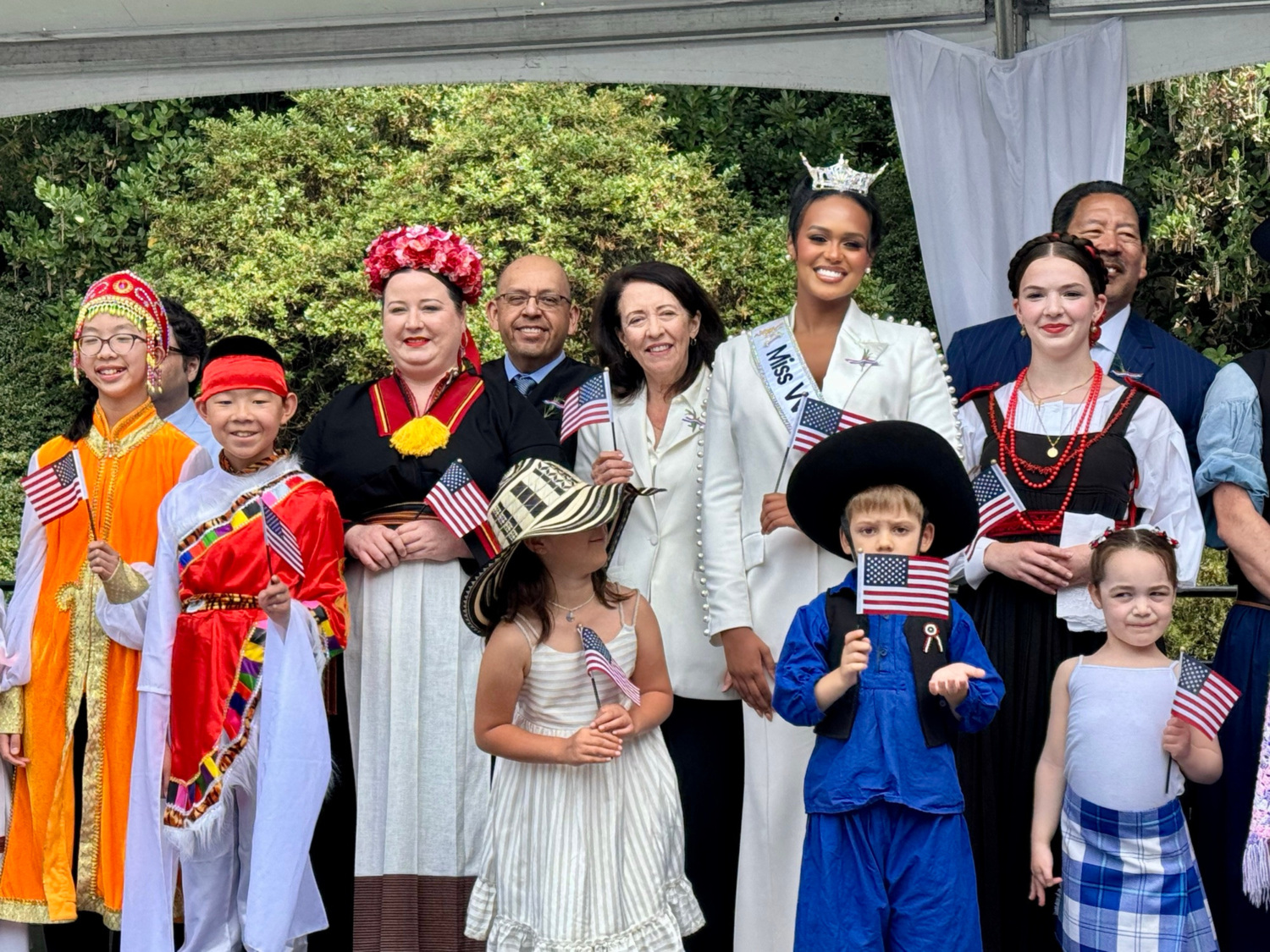
For many immigrants across the nation, this past July 4th holiday was one that they’ll never forget. From George Washington’s historic estate in Virginia to Arizona’s majestic national parks to California’s Travis Air Force Base, hundreds of immigrants raised their right hands and were sworn in as brand-new citizens of the United States.
Washington saw one of the largest naturalization ceremonies of the holiday weekend, when more than 500 immigrants from nearly 80 nations were welcomed as American citizens at the Seattle Center, KING5 reports.
“Among them was Gareth Lim, originally from Malaysia, who said the moment brought ‘excitement and joy and honestly a lot of relief.’ His path to citizenship took nearly 20 years and included earning a degree from Seattle University, building a career, and starting a family. ‘To me that’s the American ideal,’ Lim said. ‘I found the life that I want and I got it.’”
It was also a special day for Alma Franulović Plancich, who has coordinated naturalization ceremonies at the Seattle Center for years. She was presented with an award commemorating her 40th ceremony at the center.
In Arizona, immigrants were naturalized in ceremonies at a local community college in Phoenix and the historic Saguaro National Park. At South Mountain Community College, Angelica Ortiz told the Arizona Republic that her citizenship was more than 30 years in the making.
“Ortiz worked for years as a shampoo assistant at a hair salon in Surprise while raising her daughters, learning English and paying her way through beauty school. ‘I feel like I have waited all my life for this day,’ she said.”
At Saguaro National Park, Chiui Lin noted that she’d already been a contributor for many years before becoming a U.S. citizen. The difference is that she can now exercise the full civic responsibilities of being an American, such as making her voice heard through her vote.
“You have to pay the same taxes and you have to obey the laws all the same,” she told the Tucson Sentinel. Immigrants regardless of legal immigration status pay hundreds of billions of dollars in total taxes every single year. “Before, I had all the responsibilities of being here, but now I have the full rights.”
KENTUCKY:
MASSACHUSETTS:
NEW HAMPSHIRE:
In North Carolina, Kritza Contreras has been “serving to protect a country she wasn’t a citizen of until this Independence Day,” WTVD reports. She’s a first-year North Carolina National Guard troop. “I am very proud of it,” she said. “I have learned a lot of discipline. I have to show up and be on time. I was here like two hours early.”
“My motivation was mainly my parents, so I could provide for them and help them,” she continued. “I wanted to pursue and further my education, you know, the American dream. I was very decisive on it. It was no take-backs, no second thoughts.” Just ahead of the July 4 holiday, 14 immigrants, including active-duty service members and civilians, became U.S. citizens during a naturalization ceremony at Travis Air Force Base. Immigrants have a long tradition of serving in the U.S. military, fighting in major conflicts since our country’s founding.
In Virginia, more than 100 immigrants from nearly 100 nations became U.S. citizens at the historic Mount Vernon estate of the nation’s first president. Randa Alakkad told The Washington Post that “when she came to study in the United States from Syria 12 years ago, she never expected she would take her oath of allegiance on the country’s 249th birthday, at the home of George Washington.”
New Americans also got the thrill of hearing remarks from former California governor and actor Arnold Schwarzenegger, who is himself an immigrant and naturalized American. He told new Americans to treasure what they bring to their adoptive country.
“America needs you with your accent, with your memories of your homeland, the hopes and dreams that you have, and your love for freedom and for family,” he said. “You do not just deserve to be in America. You are needed here.”
“The day I raised my right hand and became an American citizen was, without a doubt, one of the greatest days of my life,” Schwarzenegger continued. “If you told me on that day that 43 years later I would be standing at Mount Vernon, the home of one of my heroes and a historic symbol of freedom and democracy, to welcome more new citizens, I would have been shocked. But that’s the beauty of the United States of America: nothing is impossible.”
The ceremonies followed a number of naturalization events heading into the July 4 holiday. In Illinois, more than 700 immigrants from more than 90 countries were sworn in as U.S. citizens in a Chicago ceremony presided over by Chief Judge Virginia M. Kendall of U.S. District Court for the Northern District of Illinois, “whose great-grandparents emigrated from Ireland in the 1880s,” WGN reported. Judge Kendall said her story is an example of the promise of America. “Did my ancestors live the American dream? Yes they did.”
“Freedom took on a whole new meaning this year for William Nigira,” who became a U.S. citizen at the Saguaro National Park ceremony, as 13 News reported. “It feels like a home,” he said. And, that’s how it should feel, for him and others welcomed as new Americans. Our country will only be stronger and more hopeful thanks to their skills, contributions, and dreams.
July 4: Celebrating the Contributions of Immigrants in the U.S. Military
Serving, Defending, Dying to Protect America
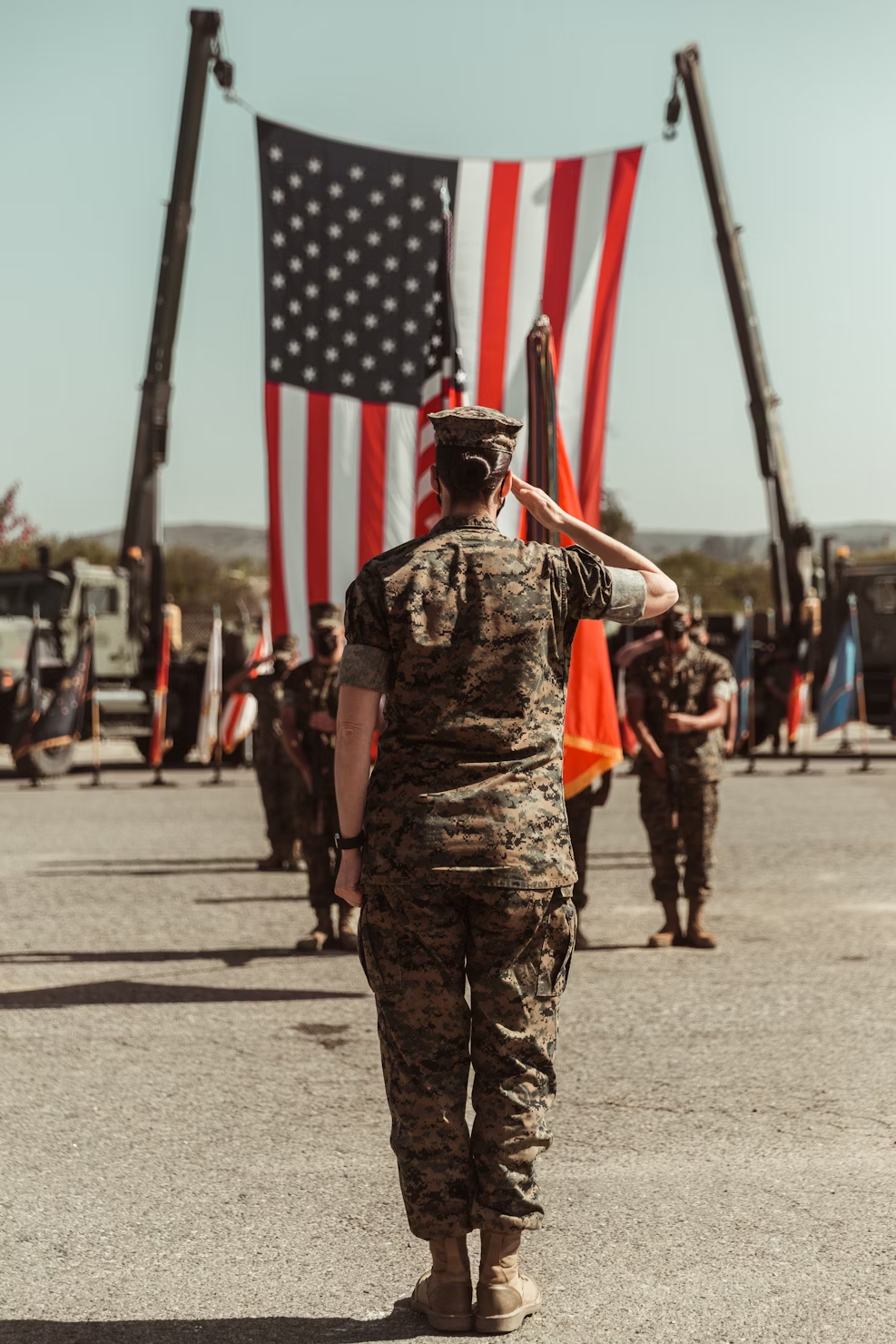
As Americans all over the country prepare to celebrate July 4 festivities with picnics, fireworks, and parades, it’s also a time to celebrate our nation’s enduring history as a beacon of hope for millions of immigrants who have arrived here in search of better lives. Many have served with honor in the U.S. military. In fact, immigrants have a long tradition of serving in the military, fighting in major conflicts since our country’s founding.
“Hundreds of thousands of immigrants pledged to defend the United States with their lives in the Civil War, both World Wars, and conflicts like those in Vietnam, Afghanistan and Iraq,” FWD.us said in a 2022 report, estimating that roughly 45,000 immigrants were actively serving at that time. “The most recent government estimates report that about 5,000 legal permanent residents enlist each year.”
Not only does the U.S. military depend on foreign-born recruits to build and strengthen its numbers, skills and power, military service has been a valuable mechanism for immigrants to gain U.S. citizenship. More than 187,000 immigrants have naturalized through military service since 2002, U.S. Citizenship and Immigration Services (USCIS) said last year. “In FY 2024, we naturalized more than 16,290 service members, a 34% increase from the previous year.”
“Service members born in the Philippines, Jamaica, Mexico, Nigeria, and Ghana — the top five countries of birth among those naturalized — comprised over 38% of the naturalizations since FY 2020,” USCIS continued. “The next five countries of birth — Haiti, China, Cameroon, Vietnam, and South Korea — comprised an additional 16% of military naturalizations from FY 2020 to FY 2024.” According to FWD.us, “approximately 700,000 foreign-born veterans, many of whom are now U.S. citizens, live in the U.S. today.”
And without their critical skills – including in translation, interpreting, specialized knowledge of regions around the world, and pure grit – our military would be at a significant disadvantage. Foreign-born enrollees are also critical to military strength when U.S. recruiting goals have fallen short in recent years.
Their service and dedication have not gone unnoticed. “Of the more than 3,400 Medals of Honor awarded since the Civil War, 22% have gone to immigrants, according to the nonprofit National Foundation for American Policy (NFAP),” Military.com reported in 2020. The report highlights retired Army Lieutenant Colonel Alfred V. Rascon, a Mexican immigrant and naturalized American who was honored with the Silver Star and Medal of Honor for his courage in Vietnam:
“Disregarding his own life and his numerous wounds, Specialist Rascon reached and covered him with his body, absorbing the blast from the exploding grenades and saving the soldier’s life, but sustaining additional wounds to his body,” the citation states. “While making his way to the wounded point squad leader, grenades were hurled at the sergeant. Again, in complete disregard for his own life, he reached and covered the sergeant with his body, absorbing the full force of the grenade explosions.
“Once more, Specialist Rascon was critically wounded by shrapnel, but disregarded his own wounds to continue to search and aid the wounded,” it adds. “Severely wounded, he remained on the battlefield, inspiring his fellow soldiers to continue the battle.
“After the enemy broke contact, he disregarded aid for himself, instead treating the wounded and directing their evacuation,” according to the citation.
Some have made the ultimate sacrifice in honor of their adoptive nation. According to one figure, 300 foreign-born soldiers died in combat between 2001 and 2013. One of these immigrant patriots, Marine Lance Corporal Jose Gutierrez, 22, was one of the first U.S. service members to be killed in action during Operation Iraqi Freedom. He was once undocumented, arriving in the U.S. alone when he was just 14.
“The last time he wrote to his foster mother he complained he couldn’t keep the sand out of his tent or food,” TIME reported. “Less than a month later he was dead,” becoming the second U.S. service member to be killed in action in the conflict. He was posthumously awarded U.S. citizenship by the federal government.
Specialist Francis Obaji, originally from Nigeria, enlisted in the U.S. military following September 11, New American Economy said in 2015. “Throughout his training and deployment in Iraq, Francis never lost his optimism, and he was unstoppable in his determination to defend his adopted country. Sadly, on January 16, 2005, Francis died in a vehicle accident in Iraq.” Sergeant Catalin Dima, originally from Romania, also enlisted in the U.S. military following the 2001 terror attack. He was killed in Iraq on the same day he was promoted to sergeant, New American Economy said.
We should also remember that many immigrants, such as Military Dreamers, wish to serve their country but are hindered by their lack of legal immigration status, while other recruits have seen the expedited path to citizenship promised to them by Congress blocked by anti-immigrant policy. “This commitment represents extraordinary patriotism and honorable service to others, and our country should meet this commitment in good faith by offering a clear, expedited pathway to citizenship for immigrant service members,” FWD.us added.
Ahead of Independence Day 2025, we recognize immigrant military members, and all military members, for their service to our nation. That includes ensuring they have the benefits and citizenship they’ve deservedly earned, and are able to live in the country they’ve fought for.
‘I Do Belong’: Hundreds Of Immigrants Sworn In As New Americans Ahead of July 4 Holiday
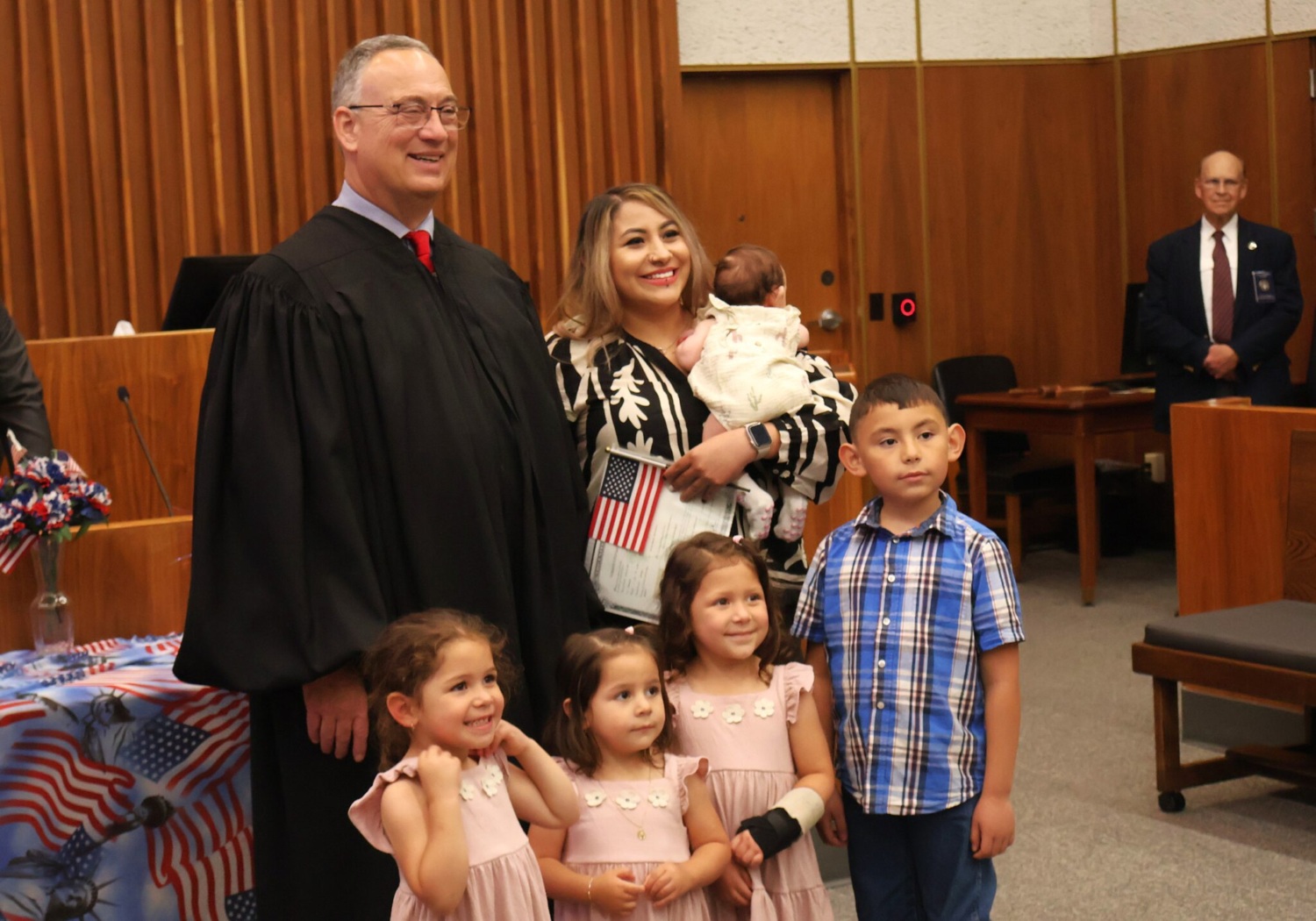
Immigrants continue to believe in America, as a number of naturalization ceremonies ahead of the Independence Day holiday make clear.
At Chicago’s Wintrust Arena, more than 700 immigrants from more than 90 countries were sworn in as U.S. citizens in a ceremony presided over by Chief Judge Virginia M. Kendall of U.S. District Court for the Northern District of Illinois, “whose great-grandparents emigrated from Ireland in the 1880s,” WGN reported. Judge Kendall said her story is an example of the promise of America. “Did my ancestors live the American dream? Yes they did.”
New Americans told NBC Chicago they were eager to reunite with close family members still in their home countries, participate in civic engagement, and fully live out their lives in the adoptive nation they call home.
Sherzad Yafret, originally from Kazakhstan, said he hoped to one day be able to bring his parents so that he can show them the “beauty” of America. Richard Crawford, originally from the U.K., said he’s been here for more than 30 years and was eager to participate in jury duty. Estefania Toledo, originally from Ecuador, said America offers “many opportunities … to succeed.” Watch a short clip below:
Chicago also made history last month (which also marked Immigrant Heritage Month), after Midway International Airport hosted its first-ever naturalization ceremony, ABC7 Chicago reported. That ceremony saw more than two dozen immigrants from half a dozen countries become Americans on paper. “Some said they’ve waited a long time for this special moment.”
Daria Rum, originally from Russia, said she’s been in the U.S. since she was 19 and feels like she “basically grew up in this country.” To now be a U.S. citizen “means everything,” she said. “It means like I do belong from here, truly, fully.” Silvia Garcia, originally from Mexico, said she wants the stories of these new Americans “to be examples for immigrant families to never give up on their American dreams,” ABC7 Chicago continued.
“Just encourage them to stay stronger, they can do it,” Garcia said. “They can do it.” Click below to watch a portion of the event:

In North Dakota, North Dakota Monitor reports that “Sheyla Muñoz Garcia came to the United States from Mexico 15 years ago. All five of her children are U.S. citizens. On Friday, she became a citizen, too.” Her youngest is just 10 weeks old, and wanted to become a U.S. citizen to bring her children the stability they deserve.
“I had my green card and I was just trying to make sure my status is here, you know, because all my kids are Americans,” she said.
Jayla Crouse, from the Philippines, has become a U.S. citizen after seven years here and is studying to become a surgical technician. “The United States gave me a lot of opportunities here,” she said. When the American Hospital Association is projecting a shortage of about 100,000 critical health care workers by 2028, Crouse’s skills will be much-needed.
And in Louisiana, 50 immigrants from nearly two dozen nations became new Americans in a ceremony at The Strand Theatre in Shreveport. For one Cameroonian immigrant, it was a bittersweet moment, The Shreveport-Bossier City Advocate reports.
“Corine Phillips from Cameroon moved in 2018 and wanted to gain citizenship because her husband and children were American. She said she is happy to be a citizen, but it was also emotional for her because her son died and she said she missed his presence during the ceremony.”
“For one new citizen, Que Shqair from Jordan, his American born son was almost as excited as he was, calling out for his dad during the ceremony,” The Shreveport-Bossier City Advocate continued. Click below to watch the ceremony in full:

Naturalization ceremonies are set to continue throughout the July 4 holiday weekend, including at George Washington’s Mount Vernon. That ceremony will be hosted by former California governor and actor Arnold Schwarzenegger, who is himself a naturalized American. “If you told me on that day that 43 years later I would be standing at Mount Vernon, the home of one of my heroes and a historic symbol of freedom and democracy, to welcome more new citizens, I would have been shocked,” he said. “But that’s the beauty of the United States of America: nothing is impossible.”
We’ll be lifting up further naturalization ceremonies taking place over the next few days. Until then, a happy and safe July 4 to all – and congratulations to our newest Americans.
Every Month Is Immigrant Heritage Month In America
Celebrating Our Shared Immigrant Heritage
As Immigrant Heritage Month 2025 comes to a close, we wanted to make sure you didn’t miss out on any of the content from the America’s Voice team lifting up the immigrants who call this country their home.
We kicked off the month with a celebratory graphic and blog lifting up “You Belong,” the multilingual campaign from 30 cities and counties affirming that immigrants have always belonged in America. “Chicago is a proud, welcoming, and global city shaped by the many cultures and communities that call it home,” said Mayor Brandon Johnson. “From every corner of the world, people have come here seeking refuge and opportunity, and together, we’ve built a city of hope, resilience, and innovation.”
“This National Immigrant Heritage Month, we want to say clearly and firmly: Chicago will always be a welcoming city. You belong here,” he continued.
No Immigrant Heritage Month is complete without celebrating the cultural contributions of immigrants, including to music, literature, and film:
This month we also celebrated the 13th anniversary of the DACA program. These bright young people who are American in every way except full legal status have transitioned from students and job seekers to professionals and heads of households to become leaders, breadwinners and major contributors.
“For years, elected officials and media outlets highlighted DACA recipients’ youth and the fact that they’d been educated alongside their U.S. citizen peers,” FWD.us said. “Today, DACA recipients are no longer children; the protections afforded by the policy have helped them to build their lives in the U.S., graduate from school, grow their careers, and establish their own families.”
Many of these Dreamers are now dads and are in limbo due to continued attacks on the program. This Father’s Day, we wanted to lift up the loving immigrant dads who currently are separated from their families due to our nation’s outdated – and increasingly cruel – immigration policies.
We also marked the immense, vibrant contributions of millions of Black immigrants as part of Juneteenth celebrations this month. More than four million Black immigrants call the U.S. their home, with most hailing from the Caribbean, Sub-Saharan Africa, and Latin America. These immigrants contribute billions in taxes annually, and many play essential roles in industries critical to millions of Americans, including healthcare.
It was also important to call out the ongoing inequities that Black immigrants face under our outdated and oftentimes discriminatory immigration system – and use this occasion to demand better.
June 20 also marked World Refugee Day, a time to remember that solidarity with displaced people must go beyond words and translate into action. “Solidarity must mean boosting humanitarian and development support; expanding protection and durable solutions, such as resettlement; and upholding the right to seek asylum — a pillar of international law,” said UN Secretary-General António Guterres. “Becoming a refugee is never a choice — but how we respond is. So let us choose solidarity. Let us choose courage. Let us choose humanity.”
In addition to being Immigrant Heritage Month, June also marked Pride Month, a time to celebrate the many LGBTQ immigrants who enrich and better our nation through their hopes, skills, and dreams. It’s also been a time to stand with our LGBTQ immigrant neighbors, like asylum-seeker Andry Hernández Romero, who has been unjustly persecuted by the administration. Several Pride events across the nation made him an honorary grand marshal in solidarity with him and immigrant communities.
“Andry’s story is one of unimaginable resilience,” said North County LGBTQ Resource Center Executive Director Max Disposti, “and his lived experience serves as a powerful reminder of why we continue to fight for liberation, dignity, and human rights for all.”
And let’s also have this month serve as a reminder that shining a light on the accomplishments and contributions of immigrants – as well as the injustices they face – should be a year-round endeavor. You can do your part by sharing our “Reclaiming Our Story” campaign with your family, friends, and neighbors, as well as aiding grassroots organizations that are helping immigrants thrive.
Faith Leaders Bring Moral Clarity As They Stand In Solidarity With Immigrants
San Diego Bishop-elect Michael Pham, a former refugee who recently became Pope Leo XIV’s first bishop appointment, was among faith leaders to bear witness and support immigrants at their immigration court hearings on World Refugee Day last Friday, compelled by their values and the unprecedented surge in arrests of individuals just trying to follow the rules by attending their court dates. Masked mass deportation agents “have apprehended so many people showing up for routine appointments this month that the facilities appear to be overcrowded,” The New York Times reports.
But emerging from the Edward J. Schwartz Federal Building in downtown San Diego later that Friday, faith leaders told reporters that deportation agents actually fled after spotting them in the hallways. As a result, no one was abducted.
Initially, deportation agents were “standing there covered with masks as we walked toward the courtroom,” Bishop-elect Pham said. “Eventually the … agents kind of scattered and went away. No wonder people come in fear.” It’s hugely significant when past abductions literally stain the federal building. Journalist Ken Stone reported that boot markings were streaked on the hallway walls from deportation agents “who rested their feet during earlier assignments.”
But on this day, individuals following the rules by going to their court dates walked back out and returned home to their families after their appointments concluded. There’s no disputing that the moral courage of faith leaders and advocates had everything to do with it.
“‘Like the story of Moses and Exodus, the Red Sea parted,’ said observer Scott Reid of the immigrant-aiding San Diego Organizing Project,” Stone reported at Times of San Diego. “Said another: ‘We’ve never seen the hallways cleared out so quickly.’” Faith leaders standing in solidarity with immigrants at the federal building also included Imam Taha Hassane of the Islamic Center of San Diego, Bishop Susan Brown Snook of the Episcopal Diocese of San Diego, San Diego Auxiliary Bishops Ramón Bejarano and Felipe Pulido, and Jesuit Father Scott Santarosa, who coordinated the visit with San Diego Organizing Project Executive Director Dinora Reyna-Gutierrez.
During a homily delivered at St. Joseph Cathedral ahead of the courthouse visit, Bishop-elect Pham “denounced the policy and tactics being employed” by the federal government “and shared his own story,” Jesuit magazine America reported.
“Today, I stand as a leader of the Catholic Church thanks to these opportunities that allowed me to contribute to society,” Bishop-elect Pham said. “I believe most refugees, immigrants, and migrants over the years, whether documented or undocumented, come to the United States seeking opportunities for a better life and success …I believe most people like me strive to be good.” Bishop-elect Pham said it was “concerning” to see the brutal tactics of the federal government, which has been abducting Dreamers, loved ones of U.S. military service members, and other long-settled immigrants. “When I was 10 years old, living in Vietnam, I witnessed this situation,” he continued. “It involved seeing people being taken away without an obvious reason.”
All across the nation, leaders from many faiths have mobilized interfaith actions to protect their congregations and communities, in particular in L.A., where the federal government has used peaceful public pushback to the abduction of neighbors and community members as an excuse to illegally deploy California National Guard against Americans.
“Since federal immigration officers descended on Los Angeles on 6 June, dozens of faith leaders from across southern California – clergy in their long robes, Quakers in black felt hats, laymen and rabbis – have marched in demonstrations against workplace raids and mobilized to provide services to undocumented immigrants,” The Guardian reports. “Many spoke of their faith as a guiding force in their activism and devotion to help the most vulnerable.” Eddie Anderson, Senior Pastor at McCarty Memorial Christian Church, told the outlet that “to not speak out is to be complicit in saying that some of us are disposable.”
“Rabbi Susan Goldberg said she was defending ‘the deepest values of the Jewish community,’ including ‘compassion,’ ‘love’ and ‘care and support for the most vulnerable,’” KTLA reports. “It’s the most-repeated command inside our Torah to take care of the widow, the orphan and the stranger, and to treat them as family and to take care of them,” Rabbi Goldberg continued.
In the Washington, D.C. area, Village Church pastor and Washington Interfaith Network member James Tait said that faith leaders were lifting up their voices in “holy protest.”
“We say unequivocally that no child should be snatched from their mothers arms in the name of national security,” Reverend Tait told AFRO. “The Washington Interfaith Network stands in solidarity with immigrant communities across the country, from east of the river in D.C. to Central California’s migrant camps.” Reverend Tait told AFRO that as a Black clergyman, it’s impossible for him to not see the similarities between the mistreatment of Black communities and undocumented communities.
“We see ICE for what it is: a tool of state violence,” Reverend Tait continued. “We see Trump and hear his rhetoric for what it is … the same hate that once haunted our ancestors.”
In Texas, “Amreena Hussain, vice president of the Dallas chapter of the Indian American Muslim Council, said her beliefs compelled her to speak out against the treatment of immigrants,” Baptist News Global reported.
“Our faith does not permit neutrality in the face of injustice, and it certainly does not permit the stripping away of basic due processes, fairness and the dignity of every human being,” Hussain said. “When people are denied the chance to defend themselves and to stay with their families and to live with dignity, it is not just a legal failure, it is a moral and religious failure.”
“Hussain referenced the Islamic principle of Ummah, which refers to unity among Muslims and with humanity,” Baptist News Global continued. “In this case, it means when one part of the community suffers, all parts suffer.
“When families in our cities and neighborhoods are torn apart, we are obligated to feel their pain, and we are obligated to defend their dignity and to stand alongside them,” Hussain told the outlet. “Justice in Islam is a divine obligation.”
Back in L.A., Reverend Stephen “Cue” Jn-Marie called the protesting of inhumane immigration policies a moral obligation.
“In Scripture and in my faith tradition, it says the two greatest commandments are to love the Lord your God with all your heart and to love your neighbor as yourself,” the reverend said. “They can’t be separated; you have to do them together … In order to love God, I have to love you first, because you’re created in the image of God in my faith tradition.”
World Refugee Day 2025: ‘Let Us Choose Solidarity. Let Us Choose Courage. Let Us Choose Humanity’
On World Refugee Day 2025, solidarity with displaced people must go beyond words and translate into actions, say directly impacted individuals, their advocates, faith voices, and international leaders.
“Solidarity must mean boosting humanitarian and development support; expanding protection and durable solutions, such as resettlement; and upholding the right to seek asylum — a pillar of international law,” said UN Secretary-General António Guterres. “Becoming a refugee is never a choice — but how we respond is. So let us choose solidarity. Let us choose courage. Let us choose humanity.”
“As our Holy Father, Pope Leo XIV, has affirmed, the temptation to turn inward, to isolate ourselves from the needs of our brothers and sisters around the world, is incompatible with a Christian vision for the common good,” said Bishop Mark J. Seitz, chairman of the U.S. Conference of Catholic Bishops’ Committee on Migration. Pope Leo XIV’s first US bishop appointment, Bishop Michael Pham, is himself a former refugee.
“We must remember Christ’s exhortation in Luke’s Gospel: to whom much is given, much is required,” Bishop Seitz continued.
“On World Refugee Day, we remember that displacement is not a choice – it’s the result of conflict, violence, and failed policies,” said S.D., a New Mexico delegate of the Refugee Congress. “Many of us know this firsthand. We carry the memory of leaving everything behind, not for want—but for survival. We urge global leaders and communities to address the causes of displacement and welcome those seeking safety – not as a favor, but as a shared responsibility.”
As record numbers of refugees have been forced to leave their homes, communities, and loved ones in recent years due to armed conflicts, environmental disasters, climate change, and persecution, displaced people from around the globe need our support now more than ever.
“The UN Refugee Agency reports that over 122 million people are now displaced around the world,” with children making up 40% of this number, the International Rescue Committee (IRC) said. “This number has doubled in the past decade, highlighting a bleak global reality, especially as aid funding is being cut.” A humanitarian catastrophe has been unfolding as thousands of foreign aid contracts have been canceled and an indefinite refugee ban remains in place, with thousands of vetted individuals left stranded.
“But, even as the world falls short, refugees continue to show extraordinary courage, resilience and determination,” Secretary-General Guterres continued. “And when given the chance, they contribute meaningfully — strengthening economies, enriching cultures and deepening social bonds.”
UNHCR lifts up some of these stories of strength and courage. Jean Pierre Gatera, a refugee from Burundi, is now a faith leader in Minneapolis and “serves as a source of strength and inspiration for the church’s congregation and local community.” In Utah, Aline and Christine are among Congolese refugees helping to heal and empower each other through a knitting group. And back in Minneapolis, Vietnamese refugee Bao Phi is now a renowned author and two-time Minnesota Grand Slam champion.
“Everyone needs protection, everyone needs a community, everyone needs opportunities,” Pastor Gatera said.
Not only is embracing displaced people the right thing to do, it benefits our nation as well. A U.S. Department of Health and Human Services (HHS) study from last year found that refugees and asylees are net contributors to our economy, paying an estimated $581 billion in revenue to federal, state and local economies. “They contributed an estimated $363 billion to the federal government through payroll, income, and excise taxes, and $218 billion to state and local governments, through income, sales, and property taxes,” the study said.
Refugees also “enter the workforce at high rates, often filling labor shortages in critical industries,” IRC said, and are natural-born entrepreneurs who strengthen communities through their resilience and skills.
“Entrepreneurship is a key driver of economic growth, and refugees excel in this area. In 2019, 13% of refugees in the U.S. were entrepreneurs, surpassing the 11.7% rate among non-refugee immigrants and the 9% rate among U.S.-born citizens. This amounted to nearly 188,000 refugee-owned businesses across the country.”
“Their businesses range from restaurants and retail shops to technology firms and transportation services,” IRC continued. “In cities like Buffalo, NY, and Fargo, ND, refugee entrepreneurs have revitalized entire neighborhoods, turning abandoned storefronts into thriving small businesses that create jobs and boost local economies.”
You too can play an important part in affirming the dignity and rights of refugees. The Refugee Advocacy Lab, the International Refugee Assistance Project (IRAP), Refugee Congress, Refugee Council USA (RCUSA), Refugees International, Save Resettlement, and Welcoming America have launched the #WeWillWelcome pledge affirming that communities in the U.S. are welcoming communities.
Gestures like talking to your neighbor, volunteering at a local resettlement agency, or simply sharing your own family’s immigration story can go a long way in saying that everyone belongs:
Refugees “are not a burden—they are a benefit to this country,” says Mandela Gapala, who writes that a “spirit of resilience” helped his family survive a decade in a refugee camp after fleeing the Democratic Republic of Congo. He now calls Kentucky his home, and works to help other refugees rebuild their lives, continue contributing, and reach their full potential.
Refugees “pack our food, build our homes, and take care of our loved ones even though many have credentials to do more,” Gapala said. “Refugees stay in jobs longer than native-born, raise families, pay taxes, and help local businesses grow. But beyond all they contribute, even though it mostly goes unnoticed, refugees deserve protection because they are human beings with dignity, dreams, and the right to live in safety.”
Juneteenth: Celebrating the Contributions of Black Immigrants
Juneteenth, celebrated on June 19, commemorates when news of freedom finally reached enslaved Black Americans in the former Confederate state of Texas following the end of the Civil War.
“Even though the Emancipation Proclamation was made effective in 1863, it could not be implemented in places still under Confederate control,” said the National Museum of African American History and Culture. “As a result, in the westernmost Confederate state of Texas, enslaved people would not be free until much later. Freedom finally came on June 19, 1865, when some 2,000 Union troops arrived in Galveston Bay, Texas. The army announced that the more than 250,000 enslaved black people in the state were free by executive decree. This day came to be known as ‘Juneteenth,’ by the newly freed people in Texas.”
“Juneteenth marks our country’s second independence day,” the museum continued. “The historical legacy of Juneteenth shows the value of never giving up hope in uncertain times.” And, it’s a national holiday that can’t be fully observed without also celebrating the contributions of millions of Black immigrants.
“Think of authors Chinua Achebe and Chimamanda Ngozi Adichie; musicians Miriam Makeba and Wyclef Jean; comedian Trevor Noah; activist Marcus Garvey; NBA hall of famer and philanthropist Dikembe Mutombo—to name but a very few,” Immigration Impact said in 2023. “For generations across the United States, Black immigrants have enriched our academics, music, cuisine, fashion, dance, and more.”
More than four million Black immigrants call the U.S. their home, with most hailing from the Caribbean, Sub-Saharan Africa, and Latin America. “Black immigrants have higher than average rates of naturalization and English language proficiency among immigrants,” and “actually have much higher levels of educational attainment than the overall U.S. average,” the New American Economy Research Fund said in 2020.
These immigrants contribute billions in taxes annually, and many play essential roles in industries critical to millions of Americans, including healthcare.
“For example, Black immigrants are more likely to work in healthcare than are other immigrant groups,” Immigration Impact said. “In 2021, a total of 719,000 Black immigrants worked in the healthcare and social assistance industry, representing 3.3% of the industry’s total workforce. Within healthcare occupations, 152,000 Black immigrants worked as home health and personal care aides, 130,000 as registered nurses, and 16,000 as physicians.” Among Haitian immigrants alone, more than 100,000 work as healthcare workers.
In Virginia, more than one in five Black immigrants works in the commonwealth’s healthcare and social services sector, “compared to about one in nine U.S.-born Virginians,” said The Commonwealth Institute. “Ghanaian- and other west African-born Black Virginians are particularly likely to work in the health care and social services sectors.”
And as the U.S. continues to face a shortage in healthcare and other essential industries – the American Hospital Association projects a shortage of about 100,000 critical health care workers by 2028 – Black immigrants can be essential in bolstering this vital labor force. Black immigrants are also vital to domestic work, often said to be the work that makes all other work possible.
And, of course, there are the significant fiscal contributions that Black immigrants make to help sustain critical federal programs like Social Security and Medicare, and to our economy overall.
“In 2021, Black immigrant households generated a total income of $153 billion,” Immigration Impact said. “They paid $39 billion in taxes: $24 billion in federal income taxes and $15 billion in state and local taxes. This left Black immigrant households with $114 billion in spending power—money households used to support American businesses, invest in housing, and more. As the Black immigrant population grows, so does their spending power—it increased by 7.1% from 2018 to 2021.”
It is also important to call out the ongoing inequities that Black immigrants face under our outdated and oftentimes discriminatory immigration system.
“Black migrants are subject to abuse and a disturbing pattern of racism, violence, and harm at disproportionately higher incidence than non-Black migrants while in the custody of Immigration and Customs Enforcement (ICE),” Freedom for Immigrants, Black LGBTQIA+ Migrant Project, Black Alliance for Just Immigration, and UndocuBlack Network said in a 2022 report. Findings revealed that nearly 30% of calls to an abuse hotline came from Black immigrants despite this group making up six percent of the ICE population.
As The Immigrant Magazine said last year, Juneteenth isn’t just a celebration, it’s a call to action to demand better for our nation’s immigrants. Not only is it the right thing to do, a more just country benefits everyone.
“It reminds us of the work that still needs to be done and inspires us to build a world where all people, regardless of race or background, can live free from prejudice and discrimination,” The Immigrant Magazine said. “Together, as a unified people, we can grow both economically and socially, ensuring our survival and prosperity not only in America but wherever we find ourselves. The strength in our unity can drive significant progress, turning the lessons of the past into the foundations of a brighter future.”
One of The Biggest Protests in America’s History
Last weekend was historic. Millions of Americans across the country joined ”No Kings Day” rallies to defend our democracy, to speak out against the unfettered power grab by Donald Trump, and to oppose Stephen Miller’s mass deportation machine. The rallies drew more than 5 million people, making it one of the largest protests in American history. With Trump’s illegal use of the National Guard to the crackdown on peaceful protests against U.S. Immigration and Customs Enforcement (ICE) mass deportation raids across Los Angeles on full display, Americans were even more galvanized to fight against the authoritarian powers seeping into our American democracy and threatening our personal freedoms.
There were over 2,000 peaceful protests in different cities and towns. The protests weren’t just in blue cities and towns, but in all 50 states, including red states. It was a sharp contrast to Trump’s $45 million birthday parade, which reportedly did not meet his expectations.
The massive turnout at the protests means around 1.2-1.8% of the U.S. population attended a No Kings Day” protest – a staggering number of people. G. Elliott Morris noted that scholars find that “mobilizations of 1-1.5% of the population still have a 40-60% chance of accomplishing their goals”. According to the Crowd Counting Consortium, a joint project of Harvard Kennedy School and the University of Connecticut, there are far more protests happening in Trump’s second term compared to this first term over the same time period.
In Minnesota, where political violence early Saturday morning resulted in the horrific murder of state Rep. Melissa Hortman and her husband and serious injuries to State Senator John Hoffman and his wife, tens of thousands of Minnesotans came out to remember the victims and to stand together on No Kings Day.
Across the country, rally attendees shared messages defending democracy and the rights of all of us. But, one consistent theme was the fierce opposition to the Trump/Miller mass deportation crusade.
One of the protesters, Angeleno Maria Rodriguez, explained how important it was as a Dreamer and “as an American” to “fight for what’s right, to stand up for our rights,” particularly after seeing the arrest of the California union leader David Huerta at a protest against immigration raids in Los Angeles.
Angeline Garza, an elementary school teacher from Texas, said that “Now more than ever, [deportations] are affecting a lot of people and they are seeing what the Trump administration wanted to do from the beginning, that it was not just about deporting criminals.”
And Janey Christoffersen, a first-time protester from Wisconsin, said that she was angered over mass deportation raids and wanted tto affirm that immigrants belong here. “I want to get out of my comfort zone to show people that we love and care about them, that the whole country is not angry.”
America isn’t about separating families or giving up on our freedoms and our right to due process. It’s about coming together as “We the People” to protect each other and stand up for what is right. While this won’t be the last time there will be protests out on the streets to speak out against Trump and Miller, and this single day won’t stop the inhumane mass deportation of our families, coworkers, and friends, it shows that Americans are not just going to idly standby and watch authoritarian powers hide behind false xenophobic characterization of g immigrants in this country. These protests, especially when compared to Trump’s birthday parade, show that support for Trump and Miller’s mass deportation obsession is weak, despite their recent show of state force.
The “No Kings Day” protests were one step towards the bigger resistance and a litmus test for how much America values democracy and freedom and will not stay ignorant nor silent. Some examples from across the country:
IDAHO:
WISCONSIN:
TENNESSEE:
ALASKA:
ALABAMA:
ILLINOIS:
MISSISSIPPI:
FLORIDA:
NORTH CAROLINA:
TEXAS:
Happy Father’s Day to All The Immigrant Dads
This Father’s Day, we honor and celebrate the resilient stories of immigrant dads like Hoang Pham, who nearly five decades later still vividly remembers the day he waved goodbye to his family in Vietnam – and left behind the only life he’d ever known. He was just 18.
“He carried nothing but his parents’ hopes for him and his dream of becoming a university professor,” Rutgers Today reports. And, he accomplished just that, joining Rutgers University in 1993 as a Distinguished Professor. He’s also a beloved husband and father. He’s the epitome of the American Dream.
“But he has never forgotten his identity as one of Vietnam’s ‘boat people,’ the term used to describe the hundreds of thousands who escaped their country by sea after the fall of Saigon in 1975 to Communist forces,” Rutgers Today continues. Many did not survive. Professor Pham himself fell seriously ill with malaria after his boat arrived in Malaysia. “Eventually, the Royal Malaysian Navy placed the survivors in boats, hauled them back out to sea and left them there alone in international waters.” He ultimately found safety in the U.S., where he was sponsored by a missionary and began to excel in his studies.
Other Vietnamese refugees who fled to America also included a young Michael Phạm, who was recently named bishop of San Diego by Pope Leo XIV. “He is the first Vietnamese American bishop to lead a U.S. diocese,” Religion News Service said.
This immigration history, sparked in tragedy but one that blossomed into a new beginning, is what Professor Pham, along with his son, Hoang Pham Jr., hope to pass along to new generations in their new documentary. “Unstoppable Hope,” which will premiere on YouTube this Father’s Day weekend, “marks the 50th anniversary of the Vietnamese refugee exodus and shares the stories of 12 refugees along with several guests,” Rutgers Today said.
“It’s important for young Vietnamese people to know their history,” Professor Pham said. “Our story is one of resilience and determination.”
This Father’s Day, we also think of the loving immigrant fathers who are separated from their families due to our nation’s outdated – and increasingly cruel – immigration policies.
We think about Kilmar Abrego García, a sheet metal worker, husband, and dad from Maryland. He arrived in the U.S. in 2011, and five years later married his U.S. citizen wife, Jennifer. “Together, they have built a strong, supportive family with bright hopes for the future,” CASA said “At the time he disappeared, Kilmar was a unionized sheet metal worker actively pursuing career advancement by enrolling in a college course to obtain a professional license.”
We know that immigrant dads like Kilmar aren’t just critical to their family’s prosperity, they’re critical to our nation’s as well. In Maryland and across the nation, essential immigrant workers form the backbone of the construction industry, for example.
But this Father’s Day, when Kilmar should be sitting at a dinner table with his family in the home he’s helped build, he’ll instead be sitting in a detention center due to his unjust targeting by the federal government. “Kilmar’s children need their father home,” CASA continued. “His wife needs her partner. This Father’s Day, we honor all families separated by injustice – and we fight to reunite them.”

This Father’s Day, we also think about Don Miguel, who is also in detention after being swept up during the chaotic raids targeting Southern California, The San Fernando Valley Sun reports. He was at work supporting his family when he was arrested. He’s their sole breadwinner, his daughter says. “At home, the arrest and separation are causing a lot of pain, according to Maria.” The San Fernando Valley Sun:
“We are a tight-knit family,” she said with pride.
“But for the first time in years, our dad was absent from our weekly Sunday dinner,” she added with a breaking voice.
Her younger sister, 22, is graduating from the University of California this week, and their dad won’t be there to celebrate.
“He was supposed to walk with her, go up on the stage to pick up her diploma,” Maria explained.
The youngest sibling, a 10-year-old boy, is also struggling to cope with his dad’s sudden and prolonged absence. He is finding it difficult to process what happened so quickly and unexpectedly, and he is afraid of a future without Don Miguel.
We think about Miguel Angel Lopez, a father, grandfather, and winery worker who was swept up by immigration officials after just trying to follow the rules and attend his immigration court date. We think about Nelson Gonzalez, a dad who was deported in March after nearly four decades in the U.S. Gonzalez and his wife, Gladys, were also detained at a check-in. We think about Joel Gutierrez, who was detained while he was out working in order to provide for his family. “My dad is honestly the best person there is,” his daughter, Denise, told supporters. “He is the sweetest, most understanding person, and he truly does not deserve to be where he is right now.”
When more than five million U.S. citizen children live with at least one undocumented family member, humane and common-sense immigration policies are an American issue. Not only do these dads deserve the chance to see their dreams fully realized, they deserve to see the manifestation of those dreams – their children – grow up and succeed. As Professor Pham said, his children “are my greatest achievement.” This Father’s Day, we honor and lift up immigrant dads and continue to call for a more just immigration system that allows these families to be able to thrive in peace and stability.
New From Vanessa Cárdenas: “Two Visions of Immigration and America”
The following is a reflection from Vanessa Cárdenas, Executive Director of America’s Voice, on the current moment.
Read “Two Visions of Immigration and America” on AV’s Substack HERE and find the full essay below:
“President Trump and Stephen Miller seem hell-bent to erase America’s history as a nation of immigrants and have deliberately inflamed and provoked a confrontation in Los Angeles as a pretext for their larger, anti-democratic agenda. When the going gets tough, Trump and Miller always, always return to the topic and find new ways to target and scapegoat immigrants. And once again, they’re using the issue as the ‘tip of the spear’ for a broader assault on American democratic pillars, such as deploying the military in American communities, seizing unchecked executive powers and handcuffing and tackling a U.S. Senator for simply having the audacity to ask a question at a public press conference.
Armed ICE agents in masks, handcuffing political opponents and federalizing the National Guard and deploying Marines to L.A. are all the warm up acts to this weekend’s military parade in the streets of Washington, DC. Troops and tanks will parade in lockstep in front of President Trump on his birthday. What we’re witnessing is an approach perfected by desperate tinpot authoritarian dictators – not American presidents in a flourishing democracy. This flexing of military might is not a sign of strength, but rather their weakness and insecurity.
But since Trump and Miller are so eager to refocus attention on immigration, let’s do exactly that. And since they care so much about imagery and made-for-TV versions of politics, let’s take a wider lens than simply looking at a few square miles of Los Angeles. Let’s zoom out across America.
We see swarms of militarized ICE agents and law enforcement in militarized tactical gear, weapons brandished and masks on, targeting immigrant parents, trusted workers and even kids to try and meet new deportation quotas (see here for visual examples). We see federal agents chasing and tackling farmworkers in the fields of Central Valley; detaining American women who are about to give birth; targeting high school soccer players in Ohio and other Dreamers like Ximena, Marcelo and Dylan. As Philip Bump of the Washington Post notes, ‘ICE detentions of people with no criminal records are up nearly 900 percent over the same period last year.’
Why? As Greg Sargent wrote: ‘Miller and Trump spent the 2024 campaign depicting all migrants as dangerous criminals in order to sell mass deportations to the voters. Now, however, because there aren’t enough dangerous criminal migrants around, two-bit fascist Miller is frantically urging ICE officials to head to the nearest Home Depot and scoop up as many migrants as possible.’
Keep in mind that Miller is now using the response to the raids in L.A. that he helped spark as a pretext to turbocharge even more deportations, including through the $151.3 billion in new immigration funding contained in the big ugly bill pending in Congress. All this despite the harms and costs to American values, communities or our economy.
All of this goes beyond L.A. and beyond the military parade in DC and straight to sharply contrasting visions of our nation and what country we want to be; to two visions of immigration and America that encapsulate two visions about America itself.
As I recently wrote, ‘Is it better for our nation to follow the Trump vision that seeks to seal our borders, criminalize immigrants, slash legal immigration, and seek to deport as many immigrants as possible, including deeply rooted immigrants?’ I’d now add to that formulation an additional point: do we support the Trump vision of deploying America’s military against American communities and weaponizing immigration fears to seize new executive powers and crack down on political opposition and dissent? Forcibly removing, tackling and detaining a U.S. Senator for trying to ask questions of DHS Secretary Noem at a public press event?
I think there’s a better vision that’s aligned with our values and our interests and speaks to the American majority. As a policy direction, it involves a secure and orderly border; a resourced, fair and efficient asylum system; legal immigration channels to sustain our economy; and targeted enforcement against public safety threats paired with a path to legal status, instead of deportation for Dreamers and long-residing undocumented immigrants.
And this vision goes well beyond the contours of a policy debate – it also seeks to unite the nation around common sense solutions, not deliberate chaos and cruelty, birthday parades and military deployments to American communities. It recognizes that political dissent and the separation of powers, due process and habeas corpus, aren’t abstract concepts or archaic notions but instead the lifeblood of a democratic system.
Crucially, these two visions of America shouldn’t be viewed as simply cleaving along partisan lines. There is a strong American majority, including a sizable group of Republican voters, who support citizenship instead of deportation for Dreamers and long-settled immigrants. Who oppose Trump and Miller’s indiscriminate mass deportation agenda. And who believe that state/local authorities should take the lead in responding to protests on the ground, while disapproving of Trump’s decision to deploy National Guard soldiers and Marines to Los Angeles.
Note that even some Republican Members of Congress are joining business owners and community leaders to express qualms over the indiscriminate deportations and the targeting of long-settled workers and family members (see Axios article). And Americans of all party affiliations are wondering why we’re deploying the military to our own communities. They’re asking why we’re tackling U.S. Senators for their speech. And they’re wondering if shifting federal law enforcement money and manpower away from active investigations and toward low-level immigration enforcement is smart and sensible.
What President Trump and Stephen Miller are unleashing on American communities is unpopular, undemocratic and, yes, un-American. It’s incumbent on all of us – no matter our party – to speak out and stand up for a different vision of America.”
This Pride Month, Stand With Andry
“I think Pride Month is an opportunity to highlight his story even more,” said Rep. Robert Garcia. “The more folks learn about it, the more they’ll put pressure on the administration and Homeland Security to do the right thing.”
Pride Month is a time to celebrate the many LGBTQ immigrants who enrich and better our nation through their hopes, skills, and dreams. It’s also a time to stand with our LGBTQ immigrant neighbors, like Andry Hernández Romero, the gay asylum-seeker who was unjustly purged to El Salvador’s notorious CECOT prison by the Trump administration. It’s now been weeks since his advocates and loved ones have heard from him, or even know if he’s still alive.

In a June 9 letter to the State Department, more than 50 House members are expressing deep worry for his well-being and are calling on the administration to conduct a wellness check, give him access to attorneys, and immediately facilitate his release. After all, if the administration returned Maryland dad Kilmar Abrego García to the U.S. because it finally agreed the Supreme Court was right and he deserved due process, why hasn’t that been applied to Andry and other unjustly deported men?
“Mr. Hernández Romero’s family and lawyers have had no contact with him in more than a month,” lawmakers write. “His mother does not even know whether he is alive. Given both the well-documented concerns about conditions at CECOT and the history of anti-LGBTQI+ persecution in El Salvador, there is serious cause for concern about Mr. Hernández Romero’s well-being.”
Hernández Romero, a makeup artist, thought he’d found safety in America after being harassed by armed vigilantes aligned with the Venezuelan government. U.S. immigration officials agreed that he faced legitimate danger, determining “that his threats against him were credible, and that he had a real probability of winning an asylum claim,” his attorney, Lindsay Toczylowski, told 60 Minutes in April.
Despite his legitimate asylum claims, Hernández Romero’s innocuous tattoos – crowns on each wrist, with the names of his parents underneath – were used to falsely portray him as a public safety threat, and he was disappeared to CECOT along with many other innocent men. The makeup artist was also purged to this foreign mega-prison with zero warning to his attorney or loved ones.
“But Andry did appear in photos taken by Time magazine photographer Philip Holsinger, who was there when the Venezuelans arrived at CECOT,” 60 Minutes continued. “Holsinger told us he heard a young man say: ‘I’m not a gang member. I’m gay. I’m a stylist.’ And that he cried for his mother as he was slapped and had his head shaved.”
The letter from lawmakers notes that despite public pleas, the administration refuses to update attorneys, family members, and the public on Hernández Romero’s well-being.
During a House hearing last month, the Department of Homeland Security “refused to commit to letting Mr. Hernández Romero’s mother know that he is alive,” the letter said. “No mother should have to worry that their child will be forcibly disappeared from the United States without due process or whether their son is even alive and healthy because of the actions of the United States government.”
But communities – and in particular the LGBTQ community – are making it clear they will not relent in the fight to bring Hernández Romero back home. Numerous Pride events have continued to shine a light on his case by naming him an honorary grand marshal, including the Pride by the Beach festival in Southern California and Queens Pride in New York City.
“Andry’s story is one of unimaginable resilience, and his lived experience serves as a powerful reminder of why we continue to fight for liberation, dignity, and human rights for all,” said North County LGBTQ Resource Center Executive Director Max Disposti. “In appointing Andry as our grand marshal, we uplift his voice and the countless unheard voices of LGBTQ+ immigrants who are criminalized for simply existing. His story represents the intersection of queer liberation and immigrant justice, both of which are at the heart of our mission.”
“We honor Andry. We demand his release. We demand that Trump intercede and get Andry out of CECOT immediately,” said Queens Pride co-founder Daniel Dromm. “We will not give up until Andry is freed from that prison. This is an immigrant community — we stand up for our immigrants, we stand up for our LGBTQ people.”
And Cleve Jones, a legendary AIDS and gay rights activist who was close to late San Francisco Supervisor Harvey Milk, has also spoken out in Andry’s defense, saying his “situation brings home to me something about the brutality and horror of what we are facing.”
Rep. Garcia, an openly gay member of Congress and himself an immigrant from Peru, told LGBTQ news outlet The Advocate “that the story remains underreported, particularly during Pride Month.”
“This is a story that I think has captured the attention of a lot of folks across the country. Our community, others, and members of Congress are outraged, rightly so,” he told the outlet. “I think Pride Month is an opportunity to highlight his story even more. The more folks learn about it, the more they’ll put pressure on the administration and Homeland Security to do the right thing.”
Immigrants Have Always Belonged In America
Immigrant Heritage Month, first established in June 2014 and observed every year since, is a time for our nation to honor, celebrate, and uplift the stories of immigrants and their communities. In honor of the month-long celebration, 30 cities and counties have launched a multilingual campaign affirming that immigrants have always belonged in America.
“You Belong,” a campaign co-led by Cities for Action (C4A) and Cities & Counties for Citizenship (CC4C) national networks, will be available in nearly 30 languages and “is intended to inspire, uplift, and support immigrant communities in our cities and the nation” during the month of June. “Chicago is a proud, welcoming, and global city shaped by the many cultures and communities that call it home,” said Mayor Brandon Johnson. “From every corner of the world, people have come here seeking refuge and opportunity, and together, we’ve built a city of hope, resilience, and innovation.”
“This National Immigrant Heritage Month, we want to say clearly and firmly: Chicago will always be a welcoming city. You belong here,’” he continued.
Others cities and counties participating in the “You Belong” initiative include Long Beach, San Francisco, San Jose, San Mateo County, CA; Aurora, Boulder, Denver, CO; North Miami, FL; Atlanta, GA; Champaign, Chicago, Evanston, IL; Louisville; KY; New Orleans, LA; Boston, Somerville, MA; Baltimore, Montgomery County, MD; Minneapolis, Saint Paul, MN; Roselle, NJ; Albuquerque, NM; New York, NY; Erie, Montgomery County, PA; Dallas, El Paso County, TX; Salt Lake City, UT; and Seattle, Shoreline, WA.
Ahead of the “You Belong” campaign launch, the Boston City Council issued a proclamation recognizing Immigrant Heritage Month and “the countless ways immigration enriches Boston’s neighborhoods, economy, and culture.”
“Immigrants make up over 28% of Boston’s population, with nearly 189,500 foreign-born residents calling the city home,” the proclamation said. “One in ten Bostonians is a naturalized citizen, and nearly 30,000 more are eligible for citizenship. Immigrants play essential roles in every sector of Boston’s workforce – from healthcare and construction to education and entrepreneurship. In fact, immigrants own 28% of Boston’s businesses and contribute billions to the city’s economy and tax base.”
“Beyond economic impact, immigration fuels Boston’s diversity and creativity,” the proclamation continued. “From cuisine and music to language and literature, immigrants bring rich cultural traditions that strengthen community ties and broaden our collective identity.”
Boston’s City of Belonging Festival plans events all month long, including a community concert and panel lifting up LGBTQ immigrants, The Bay State Banner reported. June also marks Pride Month, and is an important reminder that many of our fellow neighbors enriching and bettering our nation with their hopes, skills, and dreams are LGBTQ immigrants who are also deserving of dignity and respect.
Boston’s Office of Immigrant Advancement is also publishing a “Stories of Belonging” comic series to help illustrate the immigrant experience in Boston. One post lifts up a beloved Polish market in town:

“Boston’s immigrant communities help make Boston culturally vibrant, prosperous, and connected,” said Mayor Michelle Wu. “We lift up our community members by standing in solidarity with the ‘You Belong’ campaign, continuing all efforts to ensure that Boston is a safe and welcoming home for everyone.”
No matter what opponents might claim, the fact is that immigration is good for all of America. In city after city and state after state, immigrants regardless of legal immigration status make robust contributions that help sustain federal programs like Medicare and Social Security, fund schools and libraries, and boost local and national economies. This lifts up everyone, strengthens our communities, and makes for a more hopeful future for all.
In Dallas, Texas, immigrant households contributed nearly one billion in state and local taxes in 2022, the American Immigration Council said last year. Mexican immigrant Ricardo Martínez told The Dallas Morning News that he got his start “picking up trash at construction sites” before being promoted in the industry. “He eventually was one of thousands of workers who helped build Globe Life Field, the Texas Rangers’ home.” In New York state, immigrant-led households contribute more than $27 billion in local and state taxes annually.
“I think it was really important for people to know that immigrants are a big part of New York, and we play a big role in society,” Guadalupe Ramírez, a Mexican immigrant who co-owns a Brooklyn tattoo salon with her dad, told Documented NY last year. “It’s not just the stuff in the news — we also contribute to the community.”
Immigrant-led households overall “paid $524.7 billion in total taxes in 2021, a slight increase since 2019,” Immigration Impact said in 2023. “This includes $346.3 billion in federal income taxes, and $178.4 billion in state and local taxes. These tax contributions made up 15.9% of total tax revenues governments received from U.S. residents in 2021, yet immigrants make up just 13.6% of U.S. households.”
Undocumented workers also contribute, paying an astounding $96.7 billion in federal, state, and local taxes in 2022 alone. That includes paying billions to help sustain Social Security – a literal lifeline for elderly Americans, disabled Americans, and American children who have lost one or both parents – and Medicare despite being ineligible for these programs themselves. Common sense action legalizing these essential workers would be the right thing to do for them – and our country.
Since our nation’s founding, untold numbers of immigrants have thrived after arriving here in hopes of new lives for themselves and their loved ones. But another unwavering truth has been that our nation has also thrived because of them. We’ll continue lifting up their stories through the next several weeks – and we hope you’ll join us in celebrating Immigrant Heritage Month.