‘The Face of America Is All Of Us’: Celebrating New Americans On Constitution Day and Citizenship Day 2025
This week’s Constitution Day and Citizenship Day observance, which was held nationwide on September 17, celebrated immigrants who have had the opportunity to raise their right hand and take the Oath of Allegiance to their adoptive home country.
In Arizona, 29 new Americans hailing from more than a dozen nations were naturalized at a ceremony overlooking the majestic Grand Canyon National Park. Park Superintendent Ed Keable “opened the ceremony with heartfelt remarks, drawing parallels between the resilience of the landscape and the perseverance of those on the path to citizenship,” the National Park Service said.
“‘The Grand Canyon endures. Life will return, forests will regrow, and the canyon will remain a symbol of strength and renewal,’ Keable said, noting ongoing fire management efforts on the North Rim. ‘In many ways, this mirrors the journey you have taken to become U.S. citizens. The path to citizenship is not always easy. It requires perseverance, courage, and a steadfast belief in building a better future.’”
In Utah, the nearly 90 immigrants who were sworn in as U.S. citizens were reminded that they each form a unique thread in the fabric that is America.
“This is our country’s motto: E Pluribus Unum — out of many, one,” a speaker told attendees, who hailed from three dozen nations. Among the new Americans was Ciria Almanza, a small business owner who said her naturalization process was “long, but worth it,” Fox 13 reported. Almanza was accompanied by her family, including a son who is enrolled in the U.S. military. “It’s fantastic,” Luis Almanza told Fox 13. “We’re so happy for her.”
“I think it’s a really big thing for us, and I’ve been wanting this for so long,” daughter Emma Almanza added. “I don’t think a lot of people understand how hard it can be for so many people. I think it’s just really good that she has her citizenship now.” Ciria said her children are a big reason why she took this final step in her naturalization process. “We are all here for the same reason: looking for a better life, for our kids, for ourselves,” she said.
In Massachusetts, 51 immigrants from 31 nations swore the Oath of Allegiance during a ceremony held at Western New England University School of Law, Western Mass News reported. Following the event, new Americans celebrated with cake, photos, and civic engagement information, such as voter information. “There’s no one face of our country,” U.S. District Court Judge Mark Mastroianni told the audience. “The face of America is all of us. America is every country you’re from every place you have been from, mixing and coming here, and it’s such a happy day.”
In North Carolina, Charlotte kicked off its “Week of Welcoming” with a naturalization ceremony that saw more than two dozen immigrants become U.S. citizens. It was also a very special day for Saira Estrada, who helped organize the event and is Charlotte’s Language Access and Immigrant Integration Coordinator. “Naturalization ceremonies take me back to when I became a naturalized citizen,” she told WFAE. “So it’s excitement, it’s the nerves, it’s remembering how I felt. So it’s very personal.”
And in Florida, our immigrant neighbors got the unique experience of being sworn in as U.S. citizens before a Jumbo Shrimp baseball game at Jacksonville’s VyStar Ballpark, News4JAX reported. Kevin Mierez-Galo, among the 20 new citizens, arrived in America as a refugee and was accompanied to the ceremony by all his loved ones. “Its just like a big open hug from the community,” Mierez-Galo told News4JAX. “I’m going to cry no questions.”
“Last year approximately 818,500 people in the United States were granted U.S. citizenship, according to U.S. Citizenship and Immigration Services,” CBS News reported. “Every year, thousands of Coloradans prepare for the citizenship exam.” Among new and prospective Americans are Luz Ocampo and her daughter Itzel, who have been studying together. Itzel is a brand-new U.S. citizen; mom Luz is currently working at it.
“’How many amendments does the constitution have?’ asks Luz, and Itzel responds, ‘27.’ Itzel didn’t want her mother to get tripped up during the interview because of her limited English,” the report said. “‘I want my family proud for me,’ said Luz. Itzel urged Luz to make sure she took time to absorb and understand what was being asked.”
Itzel noted that one thing that surprised her during her studying was finding out that some U.S.-born neighbors aren’t as knowledgeable about the history and facts that prospective citizens must study and know as part of their naturalization process. “I was like ‘What you mean you don’t know if you’re from here? You’re supposed to know more about your government.’ But they don’t,” Itzel said.
This year’s Constitution Day and Citizenship Day marks 20 years since the first federal recognition of the observance. While the federal law officially designating the observation was passed in 2004, what we know today as Constitution Day and Citizenship Day was first commemorated in various forms as far back as the 1930s and 1940s, when President Franklin D. Roosevelt signed a resolution recognizing the third Sunday in May as “I Am An American Citizenship Day,” said the Congressional Research Service.
“In 1952, I Am An American Citizenship Day was renamed to Citizenship Day and the observance date was moved from May 3 to September 17 to coincide with the anniversary of the Constitution’s signing,” the Congressional Research Service continued. “In 1956, September 17-25 was designated as Constitution Week. In November 2004, Congress renamed the September 17 observance to ‘Constitution Day and Citizenship Day’ and directed educational institutions that receive federal funding to hold related educational programs.”
Zuhail Corro-Vazquez, Welcoming Network Project Manager at the Philadelphia Office of Immigrant Affairs, said that as a recent American, she knows how important it is that eligible immigrants have the support and knowledge they need when embarking on the naturalization process.
“Many immigrants arriving to the U.S. are faced with the challenges of navigating a new culture, learning a foreign system, and figuring out what steps they should take to fully begin to belong here,” she wrote in a blog published at Phily.gov. “I am familiar with these challenges because I experienced them myself. When I first arrived in the United States, becoming a U.S. citizen felt like a distant dream.”
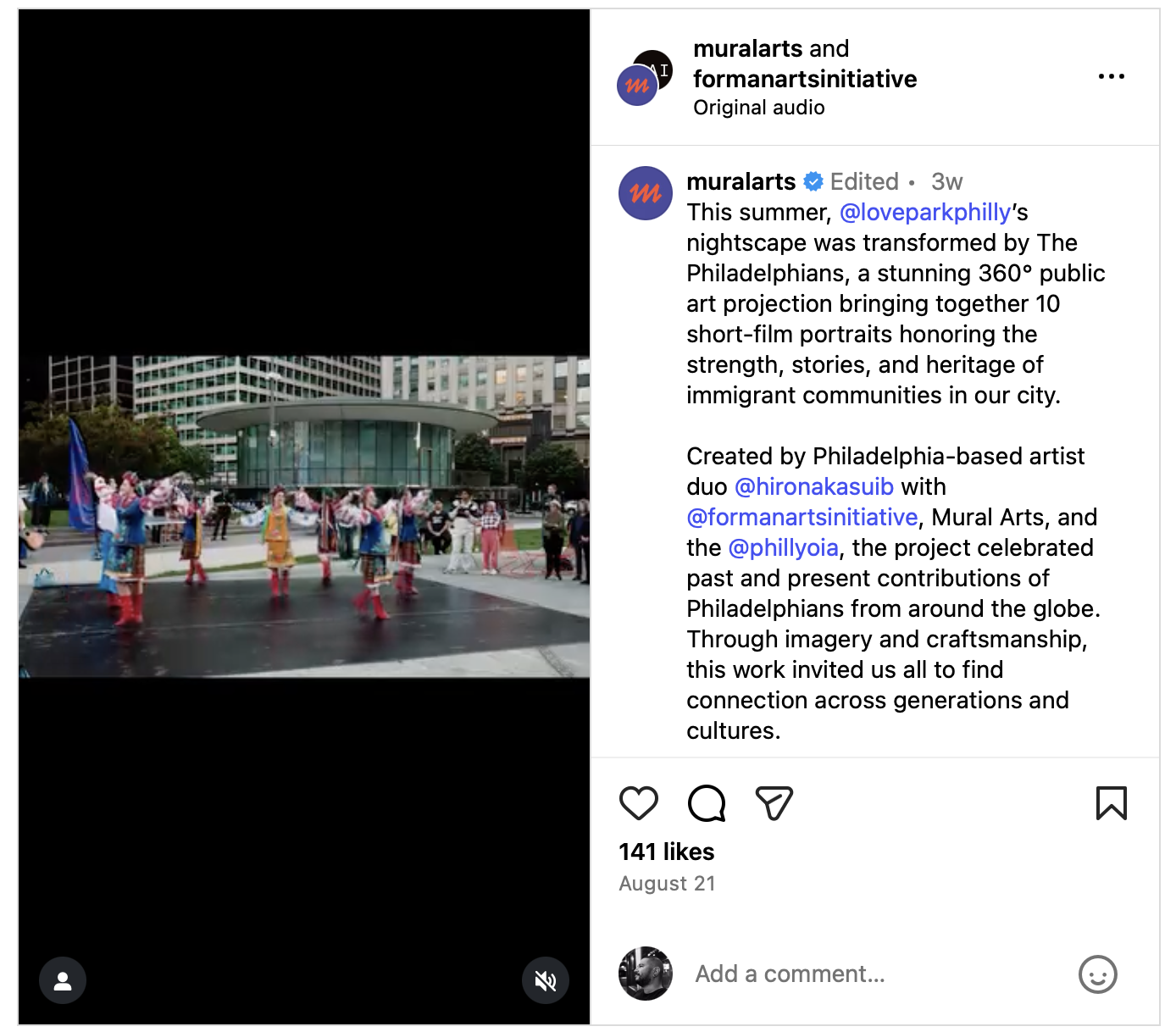
The fact is that the dreams of immigrants help sustain the American Dream for us all. In Philadelphia alone, data has shown that immigrants have boosted the city’s population growth over the past three decades, contributing to the city’s economic sustainability and benefitting everyone. Their tax dollars go back into the community, helping keep streets clean and local libraries and fire departments running. Last month, a recent art project led in part by the city of Philadelphia honored the stories of some of these immigrant Philadelphians:
“The naturalization process is a long journey, one that requires patience, determination, and a deep commitment to understanding not only the laws but also the responsibilities that come with being a citizen,” Corro-Vazquez continued in her blog post. “When I finally took the oath of allegiance, it was more than a formality. It was a moment of pride, accomplishment, and gratitude. I was no longer just living in the United States; I became part of it as a citizen.”
Constitution Day and Citizenship Day: A Powerful Recognition That America Is Stronger And More Vibrant Because Of Immigrants
This month marks 20 years since the first federal recognition of Constitution Day and Citizenship Day, which is observed on September 17 and encourages U.S. citizens to learn about their civic responsibilities. It’s also historically been a day for prospective U.S. citizens to complete the naturalization process, whether it’s submitting their application forms or raising their right hands to take the Oath of Allegiance.
While the federal law officially designating the observation was passed in 2004, what we know today as Constitution Day and Citizenship Day was first commemorated in various forms as far back as the 1930s and 1940s, when President Franklin D. Roosevelt signed a resolution recognizing the third Sunday in May as “I Am An American Citizenship Day,” said the Congressional Research Service.
“In 1952, I Am An American Citizenship Day was renamed to Citizenship Day and the observance date was moved from May 3 to September 17 to coincide with the anniversary of the Constitution’s signing,” the Congressional Research Service continued. “In 1956, September 17-25 was designated as Constitution Week. In November 2004, Congress renamed the September 17 observance to ‘Constitution Day and Citizenship Day’ and directed educational institutions that receive federal funding to hold related educational programs.”
For many naturalized U.S. citizens over the years, Constitution Day and Citizenship Day has been engrained in their memories and hearts as their first official day as an American on paper. Last year, more than 17,000 immigrants were welcomed as part of observances. First-time naturalization events that year included a historic ceremony at New York’s Fire Island National Seashore. It was fitting in a region built by immigrants who, much like them, were seeking new lives in this country.
A number of naturalization ceremonies welcoming our newest citizens have already been underway in a number of states ahead of this year’s Constitution Day and Citizenship Day. It’s a day we should be proud of. No other nation has the distinction of being known as “a nation of immigrants.” And, we’re stronger for it. These are our neighbors, and many of them are essential workers who feed us, make our roads safer, teach our children, care for our loved ones, help power our economy, and make our country more vibrant.
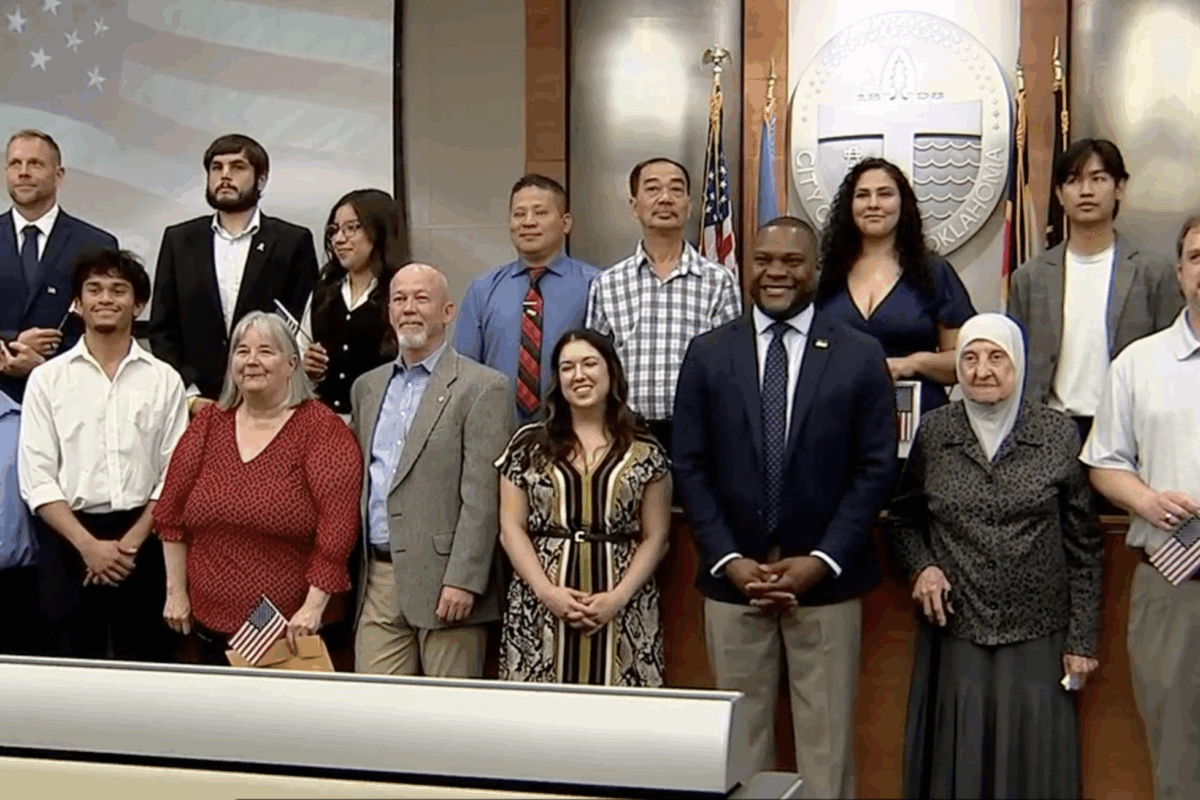
In Tulsa, Oklahoma, officials held the city’s 50th naturalization ceremony this past Thursday, which welcomed 20 new Americans hailing from more than a dozen nations, including Brazil, Burma, Canada, Colombia, Germany, Israel, Jordan, Laos, Mexico, the Philippines, Sri Lanka, the United Kingdom, Venezuela, and Vietnam.
Among them was Matthias Boehme, formerly from Germany. He called the day “a great milestone” for him and said he looked forward to being able to vote for the first time, Fox23 News reported. The University of Toledo College of Law is also set to welcome another 40 people as new Americans on Friday. Eugenio Mollo Jr., a clinical associate professor of law and director of the College of Law’s Immigrant Justice Clinic, will be a guest speaker and is himself from an immigrant family.
“My dad cherished his citizenship, and I’m excited for these soon-to-be citizens to share in the same benefits and opportunities that he and our family have enjoyed,” Professor Mollo said. “We’re enriched by the history, culture and traditions that each of them brings to the United States.”
In New York, 30 immigrants from 17 different countries also became American on paper this week, The Buffalo News reported. For Jamaican immigrant and entrepreneur Bryan Salmon, the day was two decades in the making. There were times when he felt discouraged due to complicated paperwork issues and the daily stresses of life, he said. But he never gave up.
“The pressure that was on me before, it’s like all of it just got lifted,” Salmon told The Buffalo News. “I’m feeling happy. I’m feeling real happy. It’s been a hard, rough road, and now that I’ve crossed the bridge, I can build my own bridge to move forward.”
“This is like your second birthday,” a U.S. Citizenship and Naturalization Services official told new Americans. “You get to celebrate your birthday, but now you become a naturalized U.S. citizen. That’s a special day. So make sure you commemorate this day, so that every year you celebrate yourself for the hard work and the dedication that you put forward to become a United States citizen.”
In Florida, Miami University’s Citizenship and Democracy Week next week will see nearly 100 immigrants sworn in as U.S. citizens. The week will also feature a blood drive as part of its civic-minded activities. In North Carolina, Charlotte is kicking off its “Week of Welcoming” with a Friday naturalization ceremony, WSOC-TV reported. “Charlotte was the first city in the Southeast to earn the Welcoming America Certified Welcoming designation, highlighting its ongoing commitment to strengthening connections and community,” the outlet reported.
The American Immigration Lawyers Association said it’s also been working to welcome new Americans, including holding sessions on organizing local Citizenship Day events.
“This year, on and around September 20, 2025, AILA members and community partners will come together again to light the path and provide guidance and support to eligible lawful permanent residents as they move one step closer to becoming U.S. citizens,” writes AILA’s Paul Rampersaud. “AILA’s 27 participating chapters will do more than just offer a time and a place to get help preparing a naturalization application. They will build trust, strengthen partnerships, and foster community.”
New Jersey Faith Leaders and Volunteers Pray With And Support Families Waiting To Visit Detained Loved One
At a privately-operated immigration detention facility in New Jersey, some family members have to travel for hours just to get a 15-minute visit with their jailed loved ones. But at times, officials at GEO Group’s Delaney Hall have cruelly turned them away and told them to try again tomorrow, adding further stress onto the burdens facing families when breadwinners and other loved ones are kidnapped by masked federal agents and detained.
Many others are forced to wait for hours after arriving, often in the hot sun. But they don’t have to wait alone.
Religion News Service reports that following Delaney Hall’s contentious reopening in May, local volunteers and faith members from the community have begun to camp out in the facility’s parking lots every week in order to support visiting families, including distributing coffee, water, and coloring books, as well as holding a “Let Us Pray” service seeking the protection of immigrant families.
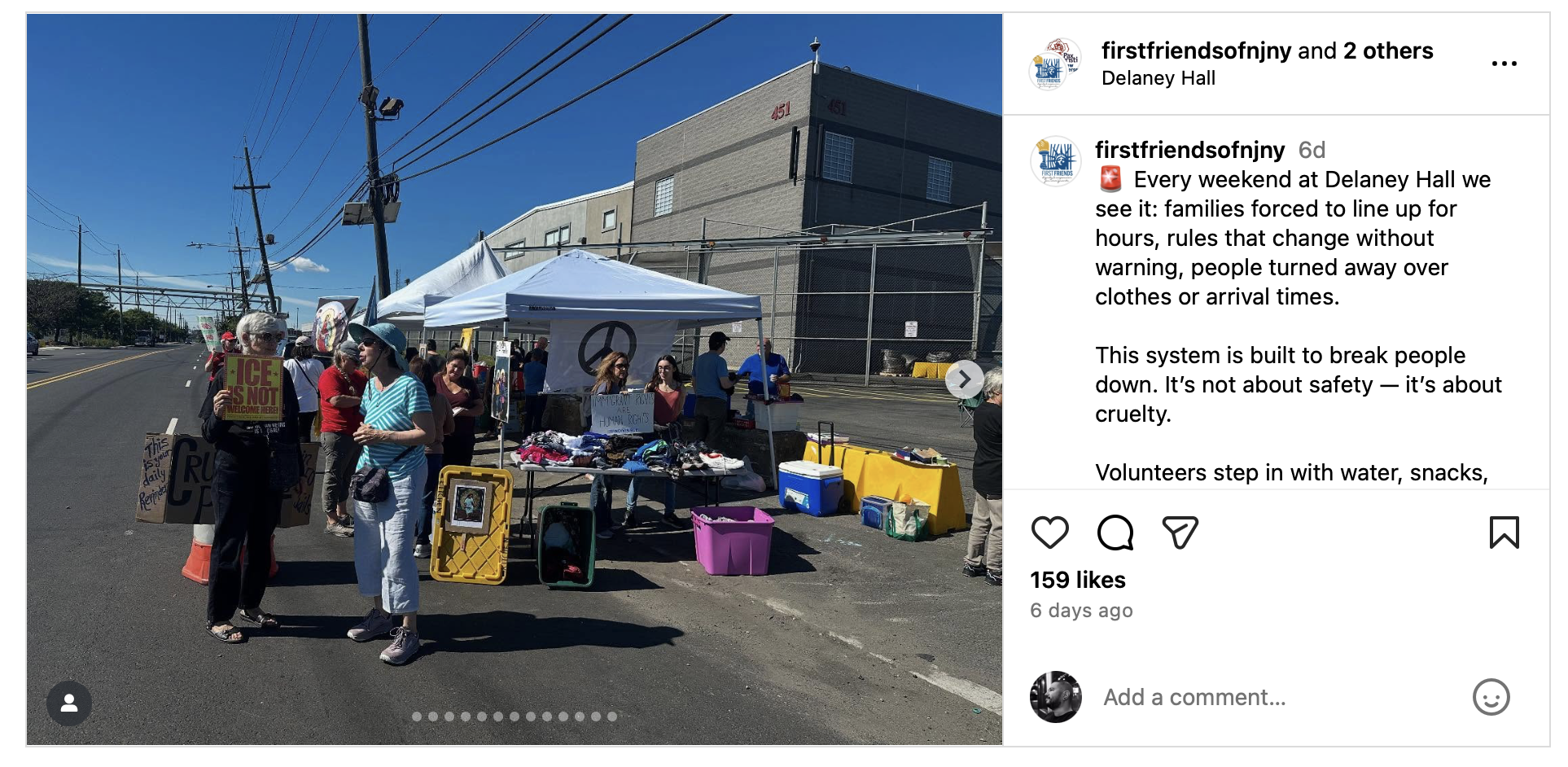
“A small altar sat in the middle of the circle holding sanctus bells, prayer cards and a photo of St. Frances Xavier Cabrini, the Catholic patroness of immigrants the leaders called on for intercession,” the report said. “Two people joined the group from the visitor’s line. Clutching the paper, both said they wished to remain anonymous and kept their eyes fixed on the sidewalk below.”
During the short service, Fr. Eugene Squeo, a retired diocesan priest, affirmed the humanity of immigrants in his English and Spanish remarks. “We are here because we recognize the dignity of each and every human person,” Fr. Squeo said. “And no one should be treated cruelly or inhumanely.”
Monica Aguilar of community-based organization Action 21 told Religion News Service that as an immigrant herself, her faith has been central to her experiences and hopes prayers “reach inside those walls to people who are looking at us. Hopefully, they can see us through the windows. Sometimes at night, we can see the shadows. I don’t know if they can see us, but it will reach their spirit.”
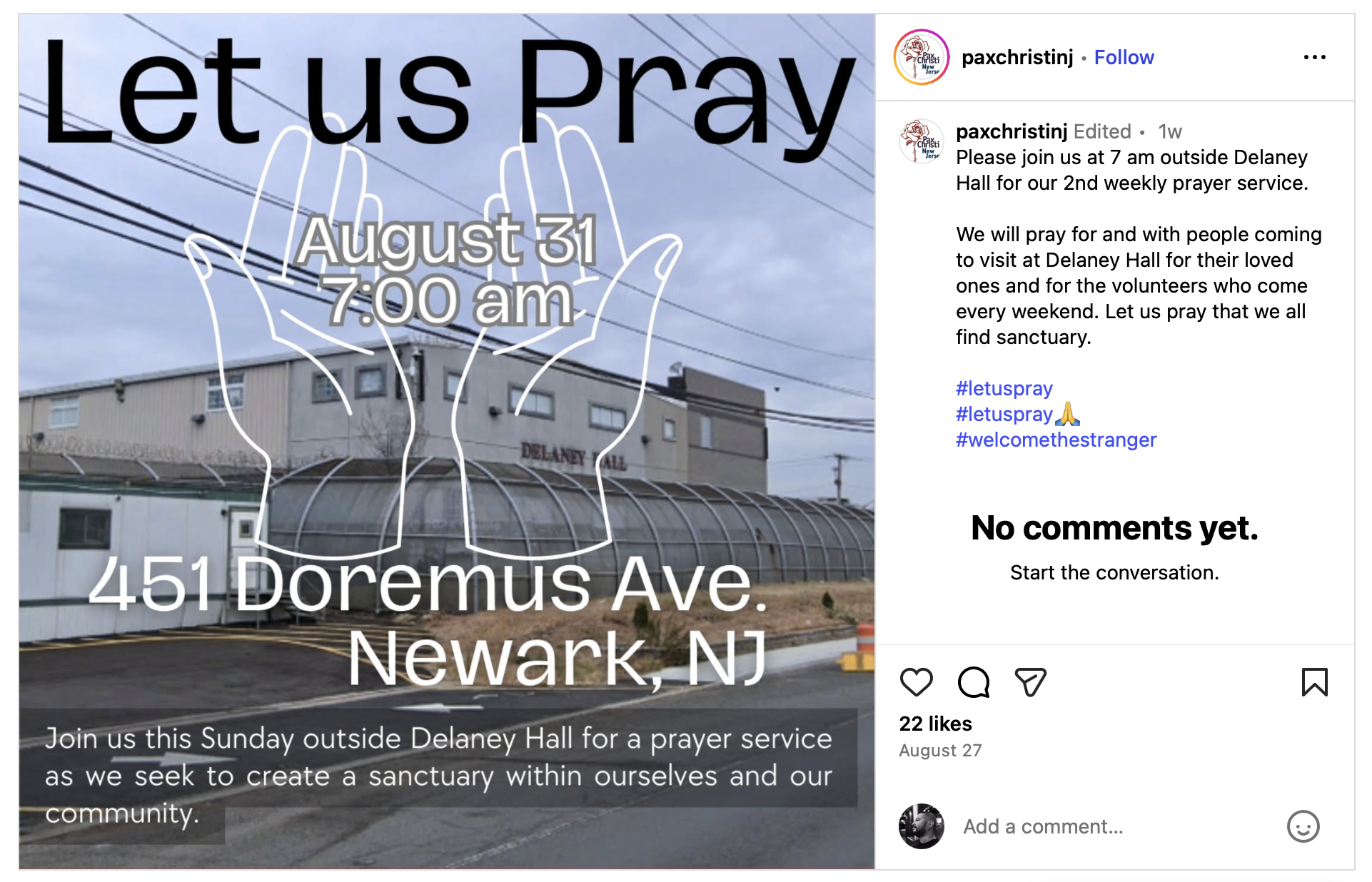
Volunteers and supporters hope their prayers can reach many others too. Pax Christi New Jersey‘s Kathy O’Leary, who helped organize the weekly event, said she’s “working with the Archdiocese of Newark to hold a Catholic Mass in the coming weeks and with the Episcopal Diocese of Newark to arrange a prayer service,” the report said. “The plan, she said, is to invite different denominations and faith traditions to lead services in the space beside Delaney Hall for the foreseeable future.”
And, volunteers and supporters plan to be at the GEO Group-operated site for as long as they can. Many other local voices, such as First Friends of NJ/NY, Cosecha NJ, Radio Jornalera NJ, NJ Alliance for Immigrant Justice, Faith in New Jersey, SOMA Action, Newark Solidarity Coalition, and Resistencia en Acción NJ have also been leading actions around Delaney Hall. GEO Group’s federal contract is valued at $1 billion and multiplies detention capacity in the state four times over, the ACLU said.
“We’re going to come out here, as long as we need to be out here, as long as we can be out here,” O’Leary told Religion News Service. “We kind of expect that eventually we’re going to irritate people, someone in power too much, and get shut down, but we’ll figure out another way then to support our neighbors. We hope that this is the beginning.”
Faith leaders and volunteers have been standing with immigrant families in increasing ways during the past several months, as we noted in August.
During the summer, San Diego Bishop Michael Pham, an appointee of Pope Leo XIV, was among faith leaders to support immigrants at their immigration court hearings on World Refugee Day, compelled by their values and the unprecedented surge in arrests of individuals just trying to follow the rules by attending their court dates. Since then, dozens of volunteers have joined the San Diego diocese’s court accompaniment program.
Similar court accompaniment efforts have been ongoing in Texas, where Scalabrinian Sister Leticia Gutiérrez told Religion News Service that El Paso Bishop Mark Seitz was also recently in immigration court to bear witness to proceedings. “Seitz witnessed the detention of three people — ‘the sobbing, the anguish of the wife of one of them,’ said Gutiérrez in Spanish. Seitz told her, ‘I saw Jesus walking through the hallway, sister, defenseless.’”
And, in his most extensive remarks on migration since his election to the papacy in May, Pope Leo called migrants and refugees “messengers of hope” and a “true divine blessing” in a world often “darkened by war and injustice.”
The remarks, released ahead of next month’s 111th World Day of Migrants and Refugees, recognized the global circumstances that force individuals to migrate, including “wars, violence, injustice and extreme weather events.” But as Pope Leo noted, nations that receive migrants and refugees who have had the “courage” and “tenacity” to leave everything behind and begin their lives anew also have much to gain from their presence.
“With their spiritual enthusiasm and vitality, they can help revitalize ecclesial communities that have become rigid and weighed down, where spiritual desertification is advancing at an alarming rate,” Pope Leo wrote. “Their presence, then, should be recognized and appreciated as a true divine blessing, an opportunity to open oneself to the grace of God, who gives new energy and hope to his Church: ‘Do not neglect to show hospitality to strangers, for by doing that some have entertained angels without knowing it’ (Heb 13:2).”
This Labor Day, A Reminder That Immigrants Are Essential To Our Communities And Key Industries
During a summer when Superman is back in theaters to save the day, we should also remember that there are real-life heroes all around us. They’re the workers who feed us, make our roads safer, teach our children, care for our loved ones, and help sustain our economy. Millions of these essential workers are immigrants, and what better day to recognize their work, contributions, and sacrifices than on Labor Day.
Immigrant workers feed us, build our homes and repair our roads, teach our kids, and are caregivers for our loved ones. Immigrants nourish our country and quite literally keep the entire agricultural industry alive. Nearly three-quarters of U.S. farmworkers are foreign-born, meaning that if we were to eliminate the skilled labor of immigrants, grocery prices would go up and our food supply would face collapse. They carry out this essential labor in rain or shine, cold or extreme heat:
Immigrants are the backbone of construction, making up more than 2 million workers in the industry. This trend isn’t new. “Construction work has been a historical launching pad for immigrant communities going back to the 19th century and the formation of the German-Speaking Framers’ Union in New York and subsequent Irish and Italian labor rolls in the 20th century,” one housing expert has said. Chinese immigrants built the western section of the transcontinental railroad during the second half of the 19th century, called “one of the greatest engineering feats in American history” by the Department of Labor in 2014. “Many of these workers risked their lives and perished during the harsh winters and dangerous working conditions.”
DACA recipients also teach our kids while more than 800,000 immigrants work as direct care workers providing long-term care and unique skills sets. “In particular, some older adults may feel more comfortable with direct care workers who share or understand their language, race, ethnicity, or other cultural characteristics,” KFF said in April.
Immigrant workers are an integral part of our workforce, help drive economic growth, and contribute billions in taxes that help sustain federal programs essential to our lives. Immigrants represent one in six U.S. workers and have been described as “natural entrepreneurs,” with one study finding that they’re as much as 80% more likely to start a company. DACA recipients also outpace the general population in terms of business creation, another study found. Immigrant households are major participants in our economy, holding “$1.3 trillion in collective spending power (after-tax income) in 2019,” the American Immigration Council said in 2021.
Immigrants also help sustain vital federal programs like Social Security and Medicare, paying $524.7 billion in total taxes in 2021, “a slight increase since 2019,” Immigration Impact said in 2023.
@americasvoice Immigrants make robust contributions to our economy. #immigrants #economy #taxes ♬ original sound – AmericasVoice
And contrary to the years of tired myths, undocumented households do pay taxes, to the tune of nearly $100 billion in taxes annually, according to the Institute on Taxation and Economic Policy. In 2022, undocumented workers paid $25.7 billion into Social Security, $6.4 billion into Medicare, and nearly $2 billion into unemployment – all programs that they’re barred from accessing unless they can adjust their legal status. In other words, undocumented workers have been helping subsidize critical federal programs for Americans, and getting nothing in return.
Immigrant workers are our friends, neighbors, and loved ones – and they deserve to be here. Immigrants are not just key to our nation’s continued success, allowing families to continue building their lives here is simply the right thing to do. Roughly half of the nation’s undocumented population, 6.7 million, has lived here for a decade or more, while nearly two million undocumented immigrants have lived here for an astounding 25 years or more, FWD.us said. Many of these individuals have families here, including millions of U.S. citizen children. “In total, it is estimated that more than 4.9 million U.S. citizen children have at least one undocumented parent,” FWD.us said. “At the same time, more than a million undocumented immigrants are married to a U.S. citizen spouse.”
Creating a pathway to citizenship for these families is an overwhelmingly popular position. One Gallup poll from July found that 78% of Americans support citizenship for undocumented immigrants. An even greater share of Americans, 85%, support a pathway to citizenship for young immigrants who have only ever known the U.S. as home. Gallup also found that by a record high 79-17% margin, Americans think immigration is a “good thing” rather than a “bad thing” for the country.
@americasvoice🚨Este el aniversario de DACA, recordemos una verdad incómoda: incluso los Dreamers — quienes trabajan, estudian y aportan millones a este país — siguen siendo blanco de arrestos y deportaciones.♬ original sound – AmericasVoice
On Labor Day, we honor and recognize the skills and contributions of U.S. workers while also making clear that immigration is good for families, it’s good for our economy and businesses, and it’s key to our success.
‘I Cannot Sleep Or Anything’: Immigration Fears Are Hurting Schoolkids
It’s back to school season, which means that millions of students all across the country will be returning to classrooms beginning this week. But when many of these kids should be excited about new clothes, school supplies, and getting to see their friends again, there will be empty desks as others are left to worry that going to school will also result in separation from their families and community.
These fears are particularly pronounced in regions of the country that have been occupied by federal agents. In the Washington, D.C. area, some 100,000 students are going back to school amid the unjustified deployment of National Guard troops and federal agents to the district.
“The crackdown has especially been affecting parents and caregivers as the new school year begins,” The Guardian reports, with parents saying “they were scared to send their children to school. Nannies are calling out or asking to be escorted to and from work. Daycares are having to implement new safety precautions.” In L.A., some parents have reportedly missed drop-off amid ongoing raids that have been targeting community members. “Parents like Anna Bermudez and her husband arrived at Brooklyn Avenue School with their children and noticed many parents were absent compared to previous years,” CNN reported.
“‘It sucks, and it’s horrible and heartbreaking,’ said Anna Bermudez, whose son attends eighth grade at the school,” the report said. “‘It should be a happy day, and bringing our kids to school feeling safe. But the fact that you don’t feel safe, even dropping them off, you know? It’s very emotional.’” And despite a claim from a top federal immigration official that students will not be stalked on the first day of school, there will already be empty desks in many classrooms across the country.
In L.A., Miguel Contreras Center educator Karina Pérez told El País that her “students will miss their 17-year-old Guatemalan classmate, who was deported this summer along with her mother.” The girl was taken into custody after trying to just follow the rules and attend her immigration court date.
“Her classmates are very sad, especially those who ran track with her. They’re outraged that she can’t be in her senior year of high school,” Pérez said. “The kids no longer have the security they used to have, when schools were considered sanctuaries.” This senseless detention and deportation of a student simply exercising their constitutional guarantee to a public school education is not an aberration.
In New York, federal immigration agents snatched 15-year-old high school student Roger Iza after he went to his check-in with his dad. Both father and son had their phones confiscated and were quickly moved out of state to Louisiana to be detained in a Sheraton hotel, The Intercept reported. “As the immigration detention system is becoming more overcrowded, authorities are turning to hotels to house detainees.” From Louisiana, they were then moved to another private hotel in Texas, where Roger said that agents monitored their every move, including what they could say to loved ones during the brief calls they were allowed. Roger said agents even monitored them when they went to the bathroom and barred them from just looking out the window.
“We couldn’t call or go on the web to ask for help,” Roger said. “Without our phones, we didn’t know any names or phone numbers.” That same month, a six-year-old elementary school student was also deported with her mother, again in New York, THE CITY reported.
“The child had attended P.S. 89 in Queens,” the report said. “Its principal had pleaded with ICE agents to release her in a letter reported on by THE CITY. The student, the principal wrote, is ‘a kind, respectful, and dedicated young lady’ whose ‘unexpected removal will cause significant disruption to her learning and will likely have a deep emotional impact on her classmates and our entire school community.’” The plea was ignored and both mother and child were deported, drawing widespread condemnation. And then there are the students who have been able to avoid deportation – for now.
Georgia college student Ximena Arias-Cristobal was pulled over for what local police initially claimed was a traffic violation. “I have not been able to enjoy life since I’ve gotten back because I do live in fear now and so does my family,” she said following her release from immigration detention. “My life is completely different, my life was turned upside down.”
In Massachusetts, immigration officials detained honors student Marcelo Gomes da Silva while he was on his way to volleyball practice. “He said he served as a translator for the other men in the room and cried when he informed them that their paperwork said they were being deported,” CBS News reported. And in Utah, college student Caroline Dias Goncalves was also detained after a traffic stop. “I was scared and felt alone,” she said. “I was placed in a system that treated me like I didn’t matter.”
We should all care because this militarization of our communities hurts kids and represents an immediate threat to the freedoms of all Americans. “Marta Urquilla, a D.C. resident and mother of two teenagers, says she will not let her kids ride public buses to school” out fear they could be racially profiled, TIME reports.
“‘At this point, that’s off the table,’ she says. ‘My kids present as Black, and that’s just not something I am inclined to expose them to.’ She says families in her neighborhood near Howard University have organized walking groups to the grocery store and that similar plans would be in place for school commutes.” TIME continues: “The federal occupation, Urquilla adds, has not been evenly felt across the city. ‘The closer you get to where immigrants live, to where Black folks live and work, the more you see it,’ she says.”
And in L.A., Nathan Mejia, a 15-year-old American citizen teen with special needs, “was pulled from the passenger seat of his mother’s car and handcuffed by federal immigration agents outside Arleta High School in northern Los Angeles on Monday,” CNN reported. Los Angeles Unified School District Superintendent Alberto Carvalho “confirmed the boy was detained and noted he was released after a bystander intervened in the case of ‘mistaken identity.’”
“Mistaken identity” is of no comfort to Nathan, who said he no longer wants to live in the area. “I cannot sleep or anything,” he said.
These policies are damaging an entire generation of American children, just as the family separation policy did to thousands of children at the southern border.. Mass deportation will inflict similar harms, with a recent study from mental health experts at the University of California Riverside School of Medicine finding that heightened immigration fears on children “have been shown to lead to school absenteeism, academic disengagement, and heightened emotional distress.”
“This back-to-school season, children in Washington D.C. and communities nationwide are facing something no child should ever experience: the terror of wondering if their parents will be there when they come home,” responded America’s Voice Executive Director Vanessa Cárdenas. ”The usual first-day jitters have been replaced by paralyzing fear. Kids are missing school, afraid to leave their homes. Parents are having to make plans in case they are disappeared. And teachers are having to be trained in safety protocols should they encounter ICE.”
Working Families Will Feel The Costs of Anti-Immigrant Policies
New data reveals that the agriculture, construction, and hospitality industries are already being harmed by mass deportations
The predictable economic harms that stem from the targeting of essential immigrant workers are under way, according to a new analysis from leading economic experts. Michael Ettlinger, Robert Lynch and Emma Sifre of Economic Insights and Research Consulting write that as deportations ramp up, “we have started to see both widespread anecdotal reports and verifiable warning signs in the data that the economic harms predicted are being realized.”
That includes notable shifts in key industries that depend heavily on the skills and labor of immigrant workers and are critical to the nation’s economy, such as agriculture, which has seen employment plummet from March to July 2025. This reverses two years of growth seen toward the second half of the previous administration. “In addition, there are early signs that the labor shortages are starting to reduce production and boost food prices,” the report said.
“From March to July 2023, agricultural and related industries employment increased by 15,000, or 0.7%. From March to July 2024, agricultural and related industries employment increased by 49,000 or 2.2%.” But as the current administration has begun implementing its promised anti-immigrant agenda, employment numbers in these industries have remarkably shifted for the worse. “By contrast, from March to July 2025, agricultural and related industries employment decreased by 155,000 or -6.5%.”
While labor fluctuations can often be the result of weather patterns that affect the agricultural industry, there have been “many reports from the agricultural industry of substantial labor shortages because of the new immigration restrictions and deportations begun earlier this year,” the report noted.
Tony DiMare, a tomato grower in Florida, told Bloomberg this past January that “there’s no doubt” that the targeting of essential workers is “going to restrict and put pressure on farming and many other industries that rely on this workforce.” He said workers were already fleeing worksites. “A lot of people left Florida for Georgia, north, scared,” he noted. “Farmers had to let their crops rot.”
Meanwhile, employment in construction – another industry that relies so heavily on immigrant workers that in some parts of the U.S. entire work crews are all foreign-born – has dropped in the ten states with the highest reliance on undocumented workers. So have building permits, “a possible indication of investor and builder confidence that workers will be available to build buildings,” the report said. “The northeast, south, and west regions, all with at least 4.9% of their workforce comprised of unauthorized workers, have seen declines of 17%, 3% and 4% respectively, in permits through June 2025 relative to the same point in 2024.”
Robby Robertson, a construction site superintendent in Alabama, said he’s losing money after raids in nearby Florida scared off his own workers. “Even though nearly two months have passed since then, he said a little more than half of his workforce has come back,” Common Dreams reported. He added that he doesn’t think “raids are the answer.”
Construction work has long been a fundamental employer and a source of job creation for immigrant communities, housing expert Dr. Carlos Martín said in a 2016 report for the Urban Institute. Indeed, roughly 2.2 million construction workers are immigrants, representing a historic high according to Census figures. In the Baltimore and Washington region, immigrants make up nearly 40% of the construction workforce, specializing in carpentry, drywall, roofing, brick masonry, and painting.
“In some areas of the country, such as the Southwest, all work crews are immigrants,” Dr. Martín noted. “This trend is even more pronounced in some hazardous occupations, like construction laborers, roofers, and drywallers.”
When it comes to leisure and hospitality, employment growth fell to just 0.2% in high-immigrant states compared to 1.5% in other states, forcing neighborhood restaurants and local businesses to limit hours or close their doors, the economists said.
“Loss of a significant portion of this workforce would be particularly damaging as there is already a longstanding shortfall of workers in the industry,” the report said. “As of April 2025, there were nearly 1 million unfilled jobs in leisure and hospitality. There is both frequent anecdotal reporting of the industry being hurt by deportations and emerging evidence in the data.” In Nebraska, numerous restaurants in the state’s biggest cities said they’ve had to temporarily shut down due to the targeting of their workers.
“Every restauranteur is probably concerned about this whole immigration debacle we’re in at this time,” Omaha Fernando’s Café and Cantina owner Mitch Tempus tells Nebraska Public Radio. “We’re all trying to run our business and take care of our families and our employees.”
“If deportation numbers continue to stay at high levels or further accelerate, we also expect that national data will increasingly reflect economic injury from the policy, such as slowdowns in economic growth, higher unemployment rates, declines in business formation and broadly rising prices,” the economists concluded. “As has been seen in past mass deportations, these trends will damage the wellbeing of all Americans as well as non-citizen residents.”
Working families are already struggling with housing costs, grocery prices, and childcare, among other daily costs. Under mass deportation, it’ll only get worse.
Dreamers Deserve To Stay In The Only Country They Know As Home
More and more Dreamers are getting swept up in the federal government’s anti-immigrant agenda despite holding work permits and protection from deportation under the popular and successful DACA program.
In southern California, a DACA recipient and rideshare driver who has called the U.S. his home for two decades, faces deportation after simply taking a wrong turn while driving a customer.
NBC News reported late last month that 34-year-old Erick Hernandez was driving passengers to San Ysidro – “known as the ‘most southern community in California’ because it is so close to the Mexican border,” the report said – when he missed his exit and ended up in Tijuana. “Because DACA recipients are not allowed to leave the country without prior approval, federal immigration authorities took Hernandez into custody when he tried to return to the U.S.” He’s called the U.S. his home for two decades.
“It seems like at this moment, there isn’t that much mercy towards people who make mistakes,” his attorney told the Los Angeles Times. “I would hope that [Customs and Border Protection] agents would still understand and know that this is an accident, that this person didn’t intend to abandon their claims, but they are a good person, and they accidentally exited the U.S.”
Sadly, the arrest and detention of this Dreamer isn’t an outlier, but rather a “growing pattern,” as United We Dream’s Anabel Mendoza told NBC News.
Javier Diaz Santana, a 32-year-old DACA recipient who is deaf and mute, was detained for nearly a month following a chaotic raid that targeted his worksite. Diaz was arriving at his car wash job when he saw masked immigration agents descending on the location and “shouting commands that he could not hear or understand,” NBC Los Angeles reported. But when he tried to use his phone in order to communicate with them, they snatched it away. And when he asked to be uncuffed so he could use his hands to try to communicate with them, they refused.
“An officer showed Diaz his phone, where he had typed a question: What country are you from? Diaz couldn’t answer,” the LA Times reported. “I can’t sign with my hands cuffed,” Diaz later recalled. “They took my power.”
Diaz was then transferred to a detention facility in Texas as immigration officials sought to deport him to a country he hadn’t called home since he was just five. Diaz spent nearly a month there before an immigration judge granted him release on bond. He would later share that the court interpreter who was explaining the hearing to him “was the first time in weeks someone communicated with him using sign language,” the LA Times reported.
Meanwhile, to others afraid of also being ensnared by an anti-immigrant agenda that’s also targeted day laborers, ice cream vendors, landscapers, and many others simply trying to support themselves and their families, the federal government offered this “advice”: get out.
“Illegal aliens can take control of their departure with the CBP Home App,” Department of Homeland Security Assistant Secretary Tricia McLaughlin told Truthout when questioned on the slew of arrests targeting Dreamers. “The United States is offering illegal aliens $1,000 and a free flight to self-deport now. We encourage every person here illegally to take advantage of this offer and reserve the chance to come back to the U.S. the right legal way to live [the] American dream.”
These unjust words and actions come as polling consistently shows that an overwhelming majority of the American people want permanent relief – not detention and deportation – for Dreamers.
And, it’s simply the right thing to do. DACA recipients live in every single state in the nation. They’re teachers, first responders, and business owners, caregivers and parents of American citizens. They boost the economy and help sustain critical programs essential to the everyday lives of millions of Americans, such as Social Security and Medicare.
FWD.us further revealed that as DACA recipients have increased their median income from $4,000 in 2012 to nearly $45,000 in 2025, beneficiaries have paid “well more than a hundred billion dollars to the economy as well as tens of billions in combined taxes.” DACA recipients have also outpaced U.S.-born Americans when it comes to opening a business.
Earlier this year, CAP highlighted the story of Texas DACA recipient Christian Serrano, who started a home design and construction business as a way to support his family. “Serrano’s contributions to the local economy have not gone unnoticed: He was recently honored with Dallas Business Journal’s 2023 ‘40 Under 40’ award,” the Center for American Progress said last year.
And for all the talk about “following the rules,” that’s exactly what DACA recipients have been doing for years now. They’re staying out of trouble and passing their background checks. They’re paying their fees and submitting their biometrics. They’ve been keeping their end of the bargain, and they deserve to stay in the country they call home. Our nation needs to do its part.
“I have DACA. I’ve already applied. I went through the steps. I thought everything was fine,” Diaz continued to NBC Los Angeles. “I was doing everything, following everything.” Attacking Dreamers isn’t just wrong, it’s self-defeating, because when the federal government punishes DACA recipients, it’s really punishing American communities.
Pope Leo Calls Migrants And Refugees ‘Messengers Of Hope’ In A World ‘Darkened By War And Injustice’
Migrants and refugees are “messengers of hope” and a “true divine blessing” in a world often “darkened by war and injustice,” Pope Leo XIV said in his most extensive remarks on migration since his election to the papacy in May. “Indeed, they demonstrate this daily through their resilience and trust in God, as they face adversity while seeking a future in which they glimpse that integral human development and happiness are possible.”
The remarks, released ahead of this October’s 111th World Day of Migrants and Refugees, recognize the global circumstances that force individuals to migrate, including “wars, violence, injustice and extreme weather events.” But as Pope Leo noted, nations that receive migrants and refugees who have had the “courage” and “tenacity” to leave everything behind and begin their lives anew also have much to gain from their presence.
“With their spiritual enthusiasm and vitality, they can help revitalize ecclesial communities that have become rigid and weighed down, where spiritual desertification is advancing at an alarming rate,” Pope Leo wrote. “Their presence, then, should be recognized and appreciated as a true divine blessing, an opportunity to open oneself to the grace of God, who gives new energy and hope to his Church: ‘Do not neglect to show hospitality to strangers, for by doing that some have entertained angels without knowing it’ (Heb 13:2).”
“At the same time, the communities that welcome them can also be a living witness to hope, one that is understood as the promise of a present and a future where the dignity of all as children of God is recognized,” he continued. “In this way, migrants and refugees are recognized as brothers and sisters, part of a family in which they can express their talents and participate fully in community life.”
Following in the bold tradition of Pope Francis, who died this past April at the age of 88, Pope Leo has shown “a special interest in the well-being of immigrants that precedes his papacy, as The Washington Post noted. “Before his papacy, Leo served the poor in Peru for decades and was especially concerned about Venezuelan migrants who fled there, opening churches as soup kitchens and asking priests to convert free spaces into makeshift refuges while bishop of Chiclayo.”
Pope Leo’s first U.S. bishop appointment since his election is himself a former refugee. San Diego Bishop Michael Pham, who is also the first Vietnamese American bishop to lead a U.S. diocese, fled his home country in 1980 and was eventually sponsored by an American family in Minnesota.
In June, Bishop Pham was among faith leaders to bear witness and support immigrants at their immigration court hearings on World Refugee Day, compelled by their values and the unprecedented surge in arrests of individuals just trying to follow the rules by attending their court dates. And, their advocacy made a real difference. Bishop Pham said that when masked agents saw the faith leaders, they “kind of scattered” and went away.
“‘Like the story of Moses and Exodus, the Red Sea parted,’ said observer Scott Reid of the immigrant-aiding San Diego Organizing Project,” Times of San Diego reported. “Said another: ‘We’ve never seen the hallways cleared out so quickly.’” Those at the courthouse that day also included Imam Taha Hassane of the Islamic Center of San Diego, Bishop Susan Brown Snook of the Episcopal Diocese of San Diego, San Diego Auxiliary Bishops Ramón Bejarano and Felipe Pulido, and Jesuit Father Scott Santarosa, who coordinated the visit with San Diego Organizing Project Executive Director Dinora Reyna-Gutierrez.
Since then, dozens of volunteers wearing “FAITH” — “Faithful Accompaniment In Trust & Hope” buttons have joined the San Diego diocese’s program to continue accompanying immigrants to their court dates. “Among the mostly older volunteers for San Diego’s new ministry were Bonnie and David Freeman of San Diego, both retired professors who worked with teachers of English as a second language at schools in Texas and Central California,” National Catholic Reporter said. “Both 81, the Freemans called the new ministry ‘extremely important.’”
“’All our lives,’ Bonnie said, ‘we’ve been working with immigrants and we know them as people and we care about them and we know they care about this country and they care about the work they do and they’re proud, wonderful people.’ David added: ‘Once you get to know these folks, you hate to see the way they’re now being treated — it’s just criminal to us.’”
New York City Non-Profit Delivers Food – And Lots of Love – To Immigrant Asian Elders
What began as a dinner for a group of friends is now a volunteer-led non-profit that tackles food insecurity by helping feed hundreds of Asian elders, many of them immigrants, across New York City. In the process, Heart of Dinner also boosts the local economy by partnering with local businesses, including grocers and farms, in the area.
Civil Eats reports that Heart of Dinner’s roots stretch back a decade and across the country to L.A., where Yin Chang and Moonlynn Tsai hosted group dinners at their home. “Admission to these dinners was free, but guests were invited to leave donations in a large urn on the table, with proceeds going to No Kid Hungry, a child hunger campaign that supports school and community meal programs.”
In 2018, the couple moved to New York City, and when the COVID-19 pandemic hit two years later, they were distraught at the wave of hate crimes targeting AAPI community members. “According to the Stop AAPI Hate Center, nearly 1900 hate crimes against Asian Americans were reported by victims, and around 69% of cases were related to verbal harassment, including being called the ‘Chinese Coronavirus,’” Sage Journals said in 2022.
“After a period of feeling helpless, they sprang into action to mobilize support for the elderly Asian community,” Civil Eats continued. That planted the seed for Heart of Dinner, which became an official non-profit in late 2020.
As the Heart of Dinner website notes, the effort also seeks to tackle loneliness and isolation felt by many seniors. Volunteers carry that in their hearts as they meet weekly to help pack gift bags loaded with fresh produce, healthy meals, and notes personalized with a lot of love. Civil Eats continues:
The notes included simple wishes for health and prosperity written in each recipient’s native language—in many cases, messages one would expect a grandparent to give, not receive: “Make sure you drink water” or “Please eat well today.” Two of the bags had notes written in Thai; other Heart of Dinner sites also prepare notes in Cantonese, Japanese, Korean, Vietnamese, and Tagalog.
The volunteers at the East Harlem site came from all walks of life: college students, bartenders, musicians, physician assistants, and retirees. After loading the care packages into large stroller wagons, the team divided into small groups, traversing the neighborhood’s intricate web of public housing developments by foot.
The volunteers warmly greeted each elder at the door, wearing masks as a precautionary measure, and presented the bags respectfully with two hands. They inquired with genuine concern about each person’s health, as a grandchild would. Most conversations were brief but cordial and ended with gentle bows and exchanges of “xiè xie” (“thank you” in Mandarin) with the many Chinese recipients who live in the area.
In addition to providing nourishment to community members and letting them know that someone cares, Heart of Dinner is also good for the local economy, Civil Eats continued. “Pei Wei, the co-owner of Zaab Zaab, a Thai restaurant in Williamsburg, has supported Heart of Dinner since the pandemic, and her kitchen staff continues to supply over 100 hot meals every week for the Brooklyn delivery site.” Just as in the preparation of gift bags and subsequent delivery, a lot of care goes into the food preparation as well.
Wei told Civil Eats that she instructs her kitchen “to cook the vegetables a little longer so it’s softer for people who have sensitive teeth,” she said, “or to chop the meat into smaller pieces so it’s easier to digest.” Heart of Dinner also partners with local farmers like Choy Commons to supply healthy veggies for their clients. It’s also yet another reminder that from an organic collective in the Catskills to Florida’s famed citrus orchards to California’s dairy farms, farmworkers are the heroes who feed us all.
And, these farmworkers are part of the fabric of our nation. Roughly 2.4 million farmworkers across the country feed us, keep food shelves stocked, and keep the agricultural industry running. At least half are undocumented, meaning that immigration policy is an issue that affects everyone. In agriculture-rich states like California, as many as 75% of farmworkers may lack legal immigration status. Many are contributors, have U.S. citizen children, and have called this country their home for a decade or more.
In dairy states like California, Idaho, Utah, Vermont, South Dakota and Wisconsin, immigrant workers are largely responsible for producing the fresh milk, delicious cheeses, and other dairy products that are enjoyed by Americans all over the country. And before Florida’s citrus industry was affected by hurricanes and other environmental factors, no matter where in the U.S. you were eating an orange, the overwhelming likelihood was harvested by a farmworker in the state. And, for some seniors in New York City, their baby Shanghai bok choy and hakurei turnips are lovingly harvested by hands who know that this produce is doing so much more than just feeding them.
Heart of Dinner’s story has been highlighted in prominent outlets like Fortune, Vice, and Glamour, according to the organization’s website. Read more about this great project here.
Catholic Moms Launch Letter-Writing Campaign Urging U.S. Bishops to Advocate For Immigrant Neighbors
Florida mom Heidy Sanchez Tejeda was simply following the rules by going to what she thought was a routine immigration check-in back in April when she was suddenly taken into custody and told that she would be deported back to Cuba within hours. Making the matter even more excruciating was that Sanchez Tejeda had her two-year-old child with her at the time.
“But Sanchez Tejeda says ICE did not give her any choice in what would happen to her baby and instead, ordered the girl to stay behind in Florida with her father,” Scripps News reported the following month. “Two days later, Sanchez Tejeda was flown in handcuffs to Cuba.” The case shook Ohioan Katie Holler, who is the mother of two, including an infant.
“I have a 6-month-old baby. How distressing that would be to me as a mother to be separated from a baby I’m breastfeeding,” she told Jesuit magazine America. “These are vulnerable people, people we as Catholics say we love and want to support, and yet this administration is doing the exact opposite of what our faith demands us to do.”
Angered by the government’s actions and looking for any way she could help make a difference for other immigrant mothers who may be facing separation from their children, Holler recruited other Catholic moms to take part in a letter-writing campaign calling on U.S. bishops to advocate for immigrants who call this country home.
“The group named itself the Dorothea Project, in homage to two Catholic women known for being outspoken for justice: Catholic Worker founder Dorothy Day and Sister Thea Bowman, a Franciscan Sister of Perpetual Adoration who famously called out the U.S. bishops on racism in 1989,” America reported. “Both are on the path to sainthood in the Catholic Church.”
Already the Dorothea Project has written more than 150 letters to nearly 80 bishops as of July 22. One sample letter shared by America asked U.S. bishops to “help lead our local Church in defending the vulnerable and promoting policies that reflect the Gospel as well as Catholic Social Teaching,” noting that Jesus was also a refugee. In his letter to U.S. bishops last February, the late Pope Francis called the Holy Family “emigrants in Egypt and refugees.”
“As a shepherd of the Church, your voice carries moral authority and hope,” continues the sample letter from Dorothea Project. “In light of the Church’s teachings on human dignity, the preferential option for the poor, and the call to welcome the stranger, I believe now is the time for bold and courageous leadership in defense of the marginalized.”
Last month, San Diego Bishop-elect Michael Pham, a former refugee who recently became Pope Leo XIV’s first bishop appointment, was among faith leaders to bear witness and support immigrants at their immigration court hearings on World Refugee Day. While the masked abductions of immigrants trying to follow the rules have been rampant, on this particular day, not one person was detained. Initially, deportation agents were “standing there covered with masks as we walked toward the courtroom,” Bishop-elect Pham said. “Eventually the … agents kind of scattered and went away. No wonder people come in fear.”
And in what have been described as “extraordinary decrees,” several bishops have excused their congregations from the obligation to attend Mass due to immigration raids, including in California, which has been an epicenter of the federal government’s chaotic and unsparing sweeps.
In a July 8 letter, San Bernardino Bishop Alberto Rojas excused parishioners who are afraid to attend mass “due to genuine fear of immigration enforcement actions,” writing that he is “guided by the Church’s mission to care for the spiritual welfare of all entrusted to my care, particularly those who face fear or hardship.” The decision was backed by Sacramento Bishop Jamie Soto, who said that his community stood “with our brothers and sisters in Southern California who are being unfairly harassed by the intimidating, disruptive raids employed by federal agents.”
In May, the Diocese of Nashville appears to be the first to have excused congregants from their obligations, saying that while churches remained open, “no Catholic is obligated to attend Mass on Sunday if doing so puts their safety at risk.” More recently, Archbishop Thomas G. Wenski of Miami has prayed outside the Everglades detention camp in Florida and sought to hold Mass for detained individuals there.
“The Dorothea Project will focus next on parish pastors, encouraging them to take actions of solidarity with immigrants and refugees, Holler said,” America continued. Already, Dorothea Project now boasts nearly 200 members and has potential to continue growing. Porsia Tunzi, professor of theology and religious studies at Saint Mary’s College in California, told America that online spaces have been “especially significant among women who felt ostracized, unsafe and/or not accepted in an in-person church community.”
Like in Holler’s case, advocating for immigrant families is an issue that hits close to home for Mercedes Fratamico. The mom, who is Mexican American, “said the issue of immigration is personal,’” the report continued. “‘I could have been born on the other side of the border. It’s just a matter of luck and circumstances,’ she said. ‘My parents are citizens, but I still have a lot of solidarity with the migrant community.’”
John Lewis and ‘Good Trouble’: Stand Up for Justice, Stand Up For Our Immigrant Neighbors
The late civil rights icon was arrested in defense of immigrant rights in 2013: “We cannot rest, we cannot be satisfied until we have comprehensive immigration reform,” he said at the time
The late John Lewis, congressman from Georgia and civil right icon, was no stranger to what he coined as good trouble. Throughout his life, he was arrested at least 45 times in his fight for a more just nation for all, including on behalf of a pathway to citizenship for undocumented immigrants in 2013. Lewis, along with seven other members of Congress, was detained after staging a sit-in outside the U.S. Capitol. “We cannot rest, we cannot be satisfied until we have comprehensive immigration reform,” he said at the time.

So it’s no surprise that immigrant justice was one of the top concerns at many of the more than 1,600 Good Trouble rallies last week (as well as subsequent demonstrations from throughout the weekend), which brought Americans together in communities both large and small. “Progress may be slow,” wrote Rural Organizing’s Matt Hildreth, who attended one rally in his South Dakota hometown. “But after seeing hundreds of Good Trouble rallies across the country—including in places like Brookings, South Dakota—we can confidently say that in Rural America, the good trouble lives on.”
In California, Melanie Gonzalez Aguilar was one of hundreds of demonstrators outside the state Capitol building in Sacramento. It was personal, after “ICE agents appeared at her father’s workplace, where he is employed in home utilities,” The Sacramento Bee reported. That same day, she protested shocking arrests carried out by Border Patrol at a local Home Depot. “It was a very small protest,” she said, “but it still fills my heart to see our community in south Sacramento speaking up because we don’t usually see that.”
In Michigan, community members in Detroit honored Lewis’ legacy by organizing a mutual aid effort and collecting food for immigrant families in the area. “He talked about good trouble — the food drive is making good trouble because we’re trying to disrupt the attack on immigrants by feeding families,” Debbie Rosenman, co-chair of Indivisible Fighting 9, told the Detroit Free Press. “People are coming out of the woodwork to try to do things to help their community, to make an impact and to speak out.”
In Arizona, most demonstrators outside the state’s Capitol in Phoenix “carried signs protesting the administration’s immigration policies, in particular the expansion of Immigration and Customs Enforcement and the continued immigration crackdowns,” the AZ Mirror reported. 80-year-old Elissa Hugens, “who said she’s been protesting since the 1960s,” referenced cruel ICE quotas that are harming, not helping, our communities.
“‘He’s taking away people that we really care about just to count bodies,’ Hugens said, adding that the issue of immigration, ‘hurts her’ the most,” the AZ Mirror continued.
In Florida, site of the cruel and inhumane Everglades detention camp, immigrant neighbors were on the minds of many Melbourne demonstrators. “We definitely have a lot of bad trouble going on,” Anna Dahl told Florida Today. “People that I work with in the community are experiencing discrimination. We had a mom with six children who was recently snatched up by ICE and put in a detention center for three weeks and nobody knew where she was.”
“I’m out here for people like her,” Dahl continued. “This is our country and there are a lot of people in our own community who don’t feel safe.”
Pro-immigrant actions continued into the weekend. Back in California, Japanese American-led Tsuru for Solidarity was among local groups to help organize a protest condemning possible immigration detention in their communities, the San Francisco Chronicle reported. Among those raising alarms are Japanese American residents, who have been issuing urgent reminders that what’s past is prologue and that the administration’s current actions represent a threat to the freedoms of all Americans.
“I’m here because the Japanese were interned, my father was interned, and it can’t happen again, but it is happening, it’s shameful,” Lynn Yamashita told ABC 7 News.
The “Good Trouble” protests follow June’s record-setting “No King” protests, which drew more than 5 million people all across the country, making it one of the largest protests in American history. The rousing discontent from Americans continues to show that the more they witness the overreach, costs and chaos of mass deportation, the more they reject it and want dignity and relief for their immigrant neighbors. So keep speaking out, because good trouble depends on you and me.
“Continue to build union between movements stretching across the globe because we must put away our willingness to profit from the exploitation of others,” as Lewis wrote in his farewell essay. “Though I may not be here with you, I urge you to answer the highest calling of your heart and stand up for what you truly believe. In my life I have done all I can to demonstrate that the way of peace, the way of love and nonviolence is the more excellent way. Now it is your turn to let freedom ring.”
In the Blazing Heat of Summer, Farmworkers Are the Heroes Who Feed Us All
For everything in your summer eats, give credit to the farmworkers. So let’s support, not deport, our agricultural industry
U.S. farmworkers already face immense challenges when it comes to being able to carry out their skilled labor in safety and with dignity, from a lack of federal protections afforded to many other workers, to workplace hazards like accidents and extreme heat. Now add an unprecedented anti-immigrant agenda to the list. “US undocumented farm workers feel ‘hunted like animals,’” read one recent headline.
It’s a shameful way to treat the essential workers who feed our country – rain or shine, blistering heat or penetrating cold – and quite literally keep the entire agricultural industry alive. The simple fact is, that without these workers and their skills, farms couldn’t operate and we wouldn’t eat. Period. Many of these workers lack legal immigration status.
Of the roughly 2.4 million farmworkers nationwide, at least half are undocumented, making immigration policy an issue that affects everyone. In agriculture-rich states like California, as many as 75% of farmworkers may lack legal immigration status. Many are contributors, have U.S. citizen children, and have called this country their home for a decade or more.
In dairy states like California, Idaho, Utah, Vermont, South Dakota and Wisconsin, immigrant workers are largely responsible for producing the fresh milk, delicious cheeses, and other dairy products that are enjoyed by Americans all over the country. “Workers from Mexico and other Latin American countries make up an estimated 70% of the labor force on Wisconsin dairy farms,” the Wisconsin Examiner reported last year. In 2023, ProPublica reported that one conservative count from the University of Wisconsin at Madison estimated that roughly 6,200 workers at larger farms lack legal immigration status. And because the study excluded small farms, the total number could be even higher.
“Talk to workers in Wisconsin, and they express little doubt immigrants account for a larger portion of the dairy industry workforce today,” the Milwaukee Journal Sentinel reported in 2019. In fact, “some farmers say they haven’t encountered a U.S.-born applicant in years.”
Enjoy citrus? Thank a farmworker. In Florida, an estimated “105,759 men and women work in nurseries and crop agriculture statewide over the course of the year,” Rural Neighborhoods said. In 2022, these workers helped make the state number one in the U.S. in the value of production of bell peppers, sugarcane, tomatoes, and watermelons. Florida is also one of the top producers of all oranges. In fact, before the state’s famous citrus industry was affected by hurricanes and other environmental factors, no matter where in the U.S. you were eating an orange, the overwhelming likelihood was harvested by a farmworker in Florida.
In addition to dairy, California also produces “1/3 of the nation’s vegetables and nearly 2/3 of the nation’s fruits and nuts,” the Center for Farmworker Families said. Do you like strawberries? Chances are that it passed through the skilled hands of a farmworker in the state. “California produces 90% of the strawberries grown in the U.S.”
But just as important as recognizing the contributions of farmworkers is acknowledging the immense risks that these laborers face every day and doing better for them. Extreme heat, for example, affects all communities but leaves outdoor workers like farmworkers at heightened risk. For many, extreme heat can without any exaggeration be a matter of life or death. “On average, 43 farmworkers die from heat-related illnesses every year, according to studies,” Reckon reported in 2023. “They are 20 times more likely to die from heat than civilian employees.”
We know that heat standards ensuring outdoor workers get water, shade, rest breaks, and relevant training recommended by experts and advocates can save lives. In its investigation of one Florida farmworker’s tragic death from heat on New Year’s Day 2023, Labor officials determined that his death was entirely preventable and that the contractor who hired him had failed to follow best practices.
“They were also subjected to unprecedented risks during the early days of the pandemic,” Civil Eats reported last October. “California’s agricultural workers have contracted Covid-19 at nearly three times the rate of other residents in the state, a new study has found, laying bare the risks facing those who keep a $50bn industry afloat,” The Guardian reported in 2020. While many U.S. workers were able to shelter, that just wasn’t a possibility for farmworkers. “You can’t pick strawberries over Zoom,” one advocate said that same year.
But even as they face increased risks in doing their essential work, farmworkers don’t have the basic resources they need in order to stay healthy. One study from U.C. Riverside in 2013 found that “many farmworkers stay quiet when it comes to unsafe workplace conditions and injuries because they fear losing their jobs. Many farmworkers lack health insurance and have little access to medical facilities, sick pay, and transportation.” Union efforts, however, have made significant wins for some:
As millions of these essential workers now also face having to feed us while under an unprecedented campaign targeting millions of immigrants, standing up for them must mean more than just recognizing their contributions (though they do deserve our thanks every single day). And, more and more growers are demanding policies that legalize, not demonize farm workers. Standing up for them must mean legislative changes that ensure they have the stability and full rights they need in order to continue thriving, keep their families together, and live without fear. Protecting workers benefits our entire nation, generates new revenue, raises wages for all, and can finally address a long-outdated immigration system, it’s simply just the right thing to do.