
High School Student and Columbia University Protester, Targeted Under Trump Last Year, Finally Win Freedom From ICE Detention
Neither of them should have been detained in the first place
A pair of current and former students who were abducted by mass deportation agents in separate incidents at the start of the Trump administration and had remained detained since have finally won their freedom, including a high school student who was the first known New York City public school student to have been kidnapped by the federal government and would subsequently be forced to spend ten months in detention.
“I am incredibly grateful to everyone — from those who sent letters to those who made these beautiful banners — and to everyone who offered support,” Dylan Contreras said at a press event following his release last week. He was flanked by supporters including New York City Mayor Zohran Mamdani and New York’s Gov. Kathy Hochul, who had pushed the administration for his release.
“His mother, who never stopped fighting for his release, held him close,” NBC 4 New York reported.
The high schooler was thankful to be home after more than 300 days, having missed his family, friends, education, and even his 21st birthday. But top of mind for him were also the people he met while in detention, and used his microphone to urge supporters to advocate for their freedom as well. “I still have so many friends inside,” he said Thursday. “We have to continue fighting for them.”
Contreras, a student at the English Language Learners and International Support Preparatory Academy (ELLIS) in the Bronx, had been separated from his family and friends since May, when he was detained at a routine immigration court appointment despite the fact that he was following the rules, staying out of trouble, and had entered the country legally. He was subsequently sent to the abusive Moshannon Valley Processing Center in Pennsylvania, where he expressed frustration at his confinement.
“When I realized what was happening, I felt very confused and irritated,” he told Chalkbeat in June. “They treat us like we are criminals here and the guards yell at us.” ICE also refused to deliver hundreds of letters that supporters had written for the high schooler, ultimately giving him just three of them. “Still, they lifted his spirits,” Chalkbeat noted.
“I was feeling depressed here, but it gave me a lot of hope to see that you all want the best for me,” he said at the time. “With your support I haven’t felt so alone.”
“All New York families belong together,” Murad Awawdeh, President and CEO of the New York Immigration Coalition, said following his release. “Nearly a year after Dylan was tricked and disappeared by ICE – and shipped to a detention center far away from his family and support system – Dylan is finally home. Dylan is a student, worker, and beloved son. Dylan is a New Yorker. Dylan, his family, and his community at ELLIS Prep high school will now get back to their lives.”
“But while this is a step towards justice,” Awawdeh continued, “Dylan will never get back the time he unjustly spent behind bars.” Nor is he totally out of the woods. While his attorney said that he “still has pending legal cases with USCIS and the immigration court” and is waiting for a decision on his Special Immigrant Juvenile Status, the administration said he “still faces removal proceedings,” according to Gothamist.
Like Contreras, Leqaa Kordia “should have never been detained in the first place,” as Amnesty International USA noted this week. Kordia, a former student visa holder who was in the process of securing legal residency in the United States, was initially detained following a pro-Gaza protest at Columbia University in 2024 but was quickly released and saw the case against her dismissed.
However, she was rearrested the very next year, when the administration and Secretary of State Marco Rubio launched anti-First Amendment attacks that targeted demonstrators over views they simply didn’t like. Kordia would languish at Texas’ privately-operated Prairieland Detention Facility for more than a year, finally winning her freedom last week. “It was the third time that the judge had ordered her release,” The New York Times noted. “But government lawyers had appealed the judge’s earlier decisions, forcing her to remain in detention. On Monday, she was released after the government did not make another appeal.”
“Kordia walked out to cheers with a hand on her heart and a smile that said it all,” CBS News New York reported. “’I just want to say hamdullah, hamdullah, hamdullah, hamdullah,’ Kordia said, referring to the Arabic word for ‘praise be to God.’”
Kordia’s attention also went to individuals still locked away at Prairieland, which Amnesty International USA said has a documented history of human rights violations. “Her lawyers and family said her health had diminished considerably at the center, where she had lost weight and was experiencing fainting spells,” The NY Times reported. Last month, Kordia was hospitalized after experiencing seizures. But because she was still in ICE custody at the time, she was treated in a dehumanizing manner. “The entire time I was chained,” she said. “I felt like an animal.” Instead of being released to recuperate at home, she was sent back to Prairieland.
“I left behind many beautiful, courageous, innocent women and men” whose only crime was “just dreaming,” Kordia said following her release from ICE.
CBS News New York noted that among advocates who rallied to her side following her release were Mahmoud Khalil and Mohsen Mahdawi, who were similarly targeted by the federal government for exercising their First Amendment rights. Amnesty International USA also noted that members and supporters from around the country sent over 60,000 letters to the federal government in support of her release, and that the organization would continue to monitor her case. Like Contreras, Kordia still faces the risk of deportation.
But at least for this moment, “we celebrate freedom,” said Hamzah Abushaban, Kordia’s cousin. “Tomorrow we continue to fight for justice. Not only for Leqaa, but for all unjustly detained. Law and order need to be restored in this country.”
Dreamers Are Americans, Period.
And they deserve permanent relief, now. “No daughter should have to live like this,” said the child of a recently-deported DACA recipient. “No family should be torn apart like this”
A DACA recipient has blasted the Trump administration’s ongoing detention and deportation of Dreamers, unequivocally stating that the federal government has broken a years-old promise by targeting hundreds of beneficiaries who were approved for relief, have been following the rules, and know no other country but this one as their home.
“The detention and deportation of DACA recipients is unacceptable, unconscionable, and a betrayal of the promises made by the U.S. government when immigrant youth trusted their information, their persons, and their families to DHS,” Juliana Macedo do Nascimento, Deputy Director of Federal Advocacy at United We Dream, said during a Capitol Hill press event Tuesday. She was flanked by other affected individuals at the event, which was sponsored by the Congressional Hispanic Caucus, the Congressional Black Caucus, the Congressional Asian Pacific American Caucus, the Democratic Women’s Caucus, the New Democrat Coalition, and the Congressional Progressive Caucus, according to advisory received by America’s Voice.
Macedo do Nascimento noted that despite the fact that the DACA program is a “legal program” that has been reaffirmed “time after time by the courts for over 14 years,” nearly 90 DACA beneficiaries have been deported while more than 270 others have been detained, confirming ongoing fears that program beneficiaries are being targeted despite holding deportation protections, work permits, and Social Security numbers.
She noted the shocking case of Maria de Jesus Estrada Juarez, who was deported overnight after more than two decades here. The DACA recipient was at her green card appointment with all her necessary documentation in hand when she was suddenly approached by a plainclothes agent. Despite the fact that Estrada Juarez was being sponsored by her U.S. citizen daughter, had valid protections from family separation, and had called this country her home for 25 years, she was deported 24 hours later.
Her daughter, Damaris Bello, later said that she felt like her mom “never had a chance. It felt like we just walked into a trap.” Estrada Juarez “said federal agents with no identification or marked uniforms cuffed her feet and hands, ‘like I was the most wanted criminal in the whole United States. I never felt so humiliated,’ she said emotionally,” ABC10 reported. During the Tuesday press event, Bello said she continues to struggle to understand “how something like this can happen in a country that talks so much about fairness and justice.”
“My mom didn’t hurt anyone,” she said. “She showed up because she believed in the promise that if you follow the rules, things will work out. Instead, that trust was used against her. Now I wake up every day in Sacramento without my mom. I go through life pretending to be strong, but the truth is, I feel like a piece of my life has been ripped away.”
“We are demanding answers on why DHS continues to unlawfully detain and deport DACA recipients,” Macedo do Nascimento continued, urging members of Congress “to demand DHS stop this practice and resume honoring the promises made, not only to DACA recipients, but TPS holders, asylum-seekers, and refugees.”
The demand that the federal government honor its promise came as more than 40 Democratic members of the U.S. Senate launched an inquiry into the administration’s slow-walking of DACA renewals. “Across the country, DACA recipients are reporting significant processing delays for their renewal applications.” These delays, senators said, “can have profound consequences.”
“When renewals are not processed before expiration, recipients lose employment authorization and, in many cases, their jobs,” senators said. “Employers experience workforce disruptions, including in sectors such as health care and education and in small businesses. Hundreds of thousands of U.S. citizen children have a parent with DACA, and when their work authorization lapses due to slow renewals, families endure heightened financial instability.”
And these consequences of these delays reverberate far beyond family unity. The Center for American Progress estimated that in 2022, “more than 482,000 DACA recipients were in the workforce, collectively earning nearly $27.9 billion and contributing nearly $2.1 billion to Social Security and Medicare annually. In addition, their employers contributed more than $1.6 billion in payroll taxes toward Social Security and Medicare on these DACA recipients’ behalf.”
Other attendees at the Tuesday event included America’s Voice Research Associate Yuna Oh, who said that as a former DACA recipient she understands the duress her peers are facing on a constant basis. “I feel for them, and I relate to them,” she said. “The feeling of being ousted from the only country they know, and love is one I felt during Trump’s first presidential term, and his second term is only worse.” She noted Dreamers “are being denied access to DACA, and families and schools and classrooms and businesses are uncertain about the future of the DACAmented Dreamers they rely on.”
“All of it makes the case for Congress finally doing what the American people have been strongly supporting for two decades – a legislative solution that officially recognizes Dreamers as the Americans they already are,” Oh continued.
The need for permanent relief is more urgent than ever. In yet another example of the entirely preventable crisis facing Dreamers, the federal government abducted a DACA recipient as he was on his way to visit his newborn, premature infant in NICU, MS Now reports.
“Twelve days after his youngest daughter was born prematurely, Juan Chavez Velasco was on his way to deliver milk to her hospital room — still in his own neighborhood in Weslaco, Texas — when immigration agents pulled in front of his car,” the report said. “His wife, Stephanie Villarreal, 32, was on the phone with him and heard the agents yell at him to get out of the vehicle.”
“He told them he had children. He told them he had a wife. He told them he had DACA. He remembers their response,” the report continued. “That doesn’t matter,” the agent said. The DACA recipient said he never got a chance to hug his daughter goodbye before they took him away. He’s currently detained at the Webb County Detention Center in Laredo, Texas.
DACA recipients “are contributing to America,” Hispanic Caucus Chair Adriano Espaillat (NY-13) said during the Tuesday press event. “They live in all the states, they reside in all the states of the union. So [protecting them] should be a bipartisan effort. I think it should be a bipartisan effort also to stop ICE from inflicting this kind of fear and hurt on them.” And, it’s also a matter of acting for DACA recipients because it’s the just thing to do. “No daughter should have to live like this,” as Bello continued in her remarks. “No family should be torn apart like this.”
Families Deserve Freedom, Not Detention: ‘No One Would Like To Go Through What We Went Through’
This Women’s History Month, we’ve highlighted the story of immigrant rights advocate Jeanette Vizguerra, who was kept separated from her children and grandchildren for nine months after being abducted by ICE while on a break outside her Target store last March. She finally won her freedom in late last year, reuniting with her four children – three of whom as U.S. citizens and one of whom is a permanent resident – just days before Christmas.
“I need to return home,” Jeanette said, “not only for my family and my grandchildren, but also for my community, which needs me.”
But did you know that in certain cases where children also lack legal immigration status, entire families may be targeted for detention? Under the Trump administration, the South Texas Family Residential Center in Dilley, Texas, has been reopened under a lucrative contract with private prison company CoreCivic. In the past, migrant family jails and private prison profiteers have been accused of serious mistreatment of people in their custody. But under the current administration, the situation that these individuals are facing may become even worse due to gutting of key oversight.
Just weeks ago, Dilley was the site of a measles outbreak that ground all movement to a halt in order to prevent the spread of illness to families that have already been languishing under ongoing conditions, including racist abuse, worm-filled food, and medical neglect that has seriously endangered the lives of children and their parents.
One mom, Kheilin Valero Marcano, feared for her 18-month-old toddler’s life after she became seriously ill at the CoreCivic facility – and only continued to deteriorate.
“It began with a fever, then a cough that wouldn’t ease. Her nose clogged with thick mucus. Her breathing grew strained and wheezy,” NBC News reported. By the time that detention staff decided to get Amalia to a hospital, she had to be treated for pneumonia, Covid-19, RSV and respiratory distress. “Thank God,” Valero Marcano said when staff acknowledged Valeria needed urgent medical attention. “Because you haven’t done anything.”
Other mothers have shared how their children are being detained beyond the legal limit of 20 days set out by the decades-old Flores Agreement, which Children’s Rights said sets “the national standards for the treatment, placement, and release of all immigrant children detained in the custody of the federal government.”
One of those children is nine-year-old Kenek, a special needs child who spent four times the 20-day limit before he and his mom, Vilma Bautista Torres, were released.
“Kenek, who has severe autism, grew increasingly disoriented and distressed as the weeks dragged on without access to therapy, she said, hitting himself, crying through the night and begging her to let him return to his school in Louisiana,” NBC News reported. Kenek “relies on specialized schooling and daily therapy to regulate his emotions and behavior. At Dilley, she said, those supports vanished.”
Even trying to get some fresh air proved traumatic for the child, because he thought stepping outside meant they were going home, the mom said. Soon, they just stayed indoors out of fear that going outside would be too triggering for him. “No one would like to go through what we went through,” Bautista Torres said.
But the administration has detained dozens of children for even longer periods of time, repeating an abusive trend from the president’s first term, when 40% of kids were held beyond the legal limit of 20 days. Leecia Welch, Children’s Rights Deputy Litigation Director and legal advocate, says she’s counted more than 30 children who’ve been detained for over 100 days under his second administration. “We’ve started to use 100 days as a benchmark for prioritizing cases,” she said, “because so many children are exceeding 20 days.”
One Russian family shared how they tried to approach an ICE officer about how their five-year-old twins had now been detained past the legal limit. Instead, the officer told them to “take it up with his boss,” NBC News continued. “Who’s that?” asked Aleksei, the family’s dad. “Trump,” the officer replied.
When the family then tried to follow-up with a written complaint, a different ICE officer lied and falsely claimed the 20-day rule “is not applicable anymore.” While the administration has repeatedly sought to terminate the Flores Agreement, it has been blocked by the courts and the rule remains in effect.
But Christian Hinojosa and her 13-year-old son, Gustavo Santino-Josa, would have no way of knowing that, after they were detained for more than four months. “Until today I don’t know what we did wrong to get detained. I’ve seen my mom cry almost daily and I ask God that we can go out and go home soon,” Gustavo said during a phone interview. “My mom says that as long as there is hope it is worth fighting for.”
Hinojosa shared that life has been difficult for the teen, who has seen some of the friends he’s made deported. Gustavo also felt frustration when five-year-old Liam Conejo Ramos and his dad were released following immense public outcry and a court order. “My son says, ‘That’s unfair, Mama. What’s the difference between him and us?’” Hinojosa said.
Gustavo has every right to be upset: children do not belong in detention, period. “Medical and other experts have long documented that family detention can lead to life-long damage to health and development, causing health problems including post-traumatic stress disorder, depression, developmental regressions, suicidal behavior, weight loss, sleep disturbance, and frequent infections,” Human Rights Watch said in 2021.
“The American Academy of Pediatrics warned the government that detention ‘is associated with poorer health outcomes, higher rates of psychological distress, and suicidality making the situation worse for already vulnerable women and children.’ Studies have shown that immigrant children who were detained experienced a tenfold increase in psychiatric disorders while adults suffered a threefold increase.”
“Even detaining families for days or weeks inflicts severe harm,” Human Rights Watch continued. “DHS’s own medical experts stated as whistleblowers in 2021 that ‘any amount of detention can be harmful to children.’ Studies have shown that the experience of detention for children is ‘acutely stressful…even when detention is brief’ and that ‘any incarceration is damaging for immigrant children, especially those with high levels of previous trauma exposure.’”
But in good news for Christian and Gustavo, they finally won their freedom late last month and returned home to San Antonio, where Christian can carry out her essential work as a home health aide. When three in five women work in caregiving, mass detention policies not only hurt families, they hurt patients and the economy.
Aury, another mom who along with her three children spent more than 50 days at Dilley, is trying to get their lives back in order to the extent of her abilities. Aury is also back at work as a housekeeper. “Care work is at the center of our communities and our family life, and a cornerstone of our economy,” as the National Domestic Workers Alliance has said. “It’s the work that is done before any other work can be done.”
Aury’s three children “are doing well, very happy to be going back to school,” she told Scripp News. “We were left with a lesson. Every day before sleeping, we pray and thank God for freedom, for life, for food. And we also pray for the people who are still being held there. May God give them freedom soon.” This is what all these families deserve: the chance to thrive, contribute, and be together. This isn’t just a Women’s History Month reminder, it should be a daily reminder.
Oscars Say ‘ICE OUT’
“We all face a moral choice,” one winner told the worldwide audience. “But luckily, even a nobody is more powerful than you think”
Attendees at Hollywood’s biggest night continued to use their platforms to condemn government overreach that has resulted in the killings of U.S. citizens and immigrant neighbors and disrupted lives, communities, and local economies. One of the most pointed moments came from Best Documentary Feature Film winner David Borenstein, who said that his documentary film, “Mr. Nobody Against Putin,” is about “how you lose your country. And what we saw when working with this footage is that you lose it through countless, small, little acts of complicity.”
“When we act complicit … when a government murders people on the streets of our major cities,” Borenstein continued. “When we don’t say anything when oligarchs take over the media and control how we can produce it and consume it. We all face a moral choice. But luckily, even a nobody is more powerful than you think.” The documentary is “a primary school teacher’s record of the indoctrination of his pupils to support Russia’s invasion of Ukraine,” The Guardian noted.
Both inside and outside Hollywood’s Dolby Theater, attendees also continued to wear pins condemning the out-of-control ICE agency, which confirmed this past weekend that yet another immigrant died while in its custody. Mohammad Nazeer Paktyawal, an Afghan refugee who served alongside American troops and was a dad of six, had been detained for less than a day. “The administration is on track for the deadliest year in ICE detention in more than two decades,” the Independent reports.
Malgosia Turzanska, a costume designer who was nominated this year for “Hamnet,” wore an “ICE OUT” pin on an original gown emblazoned with safety pins. The Polish-American designer is herself an immigrant, obtaining her American citizenship in 2017. “Singer-songwriter Sara Bareilles appeared on the carpet wearing the ‘ICE OUT’ pins the stars have been wearing all season,” the Daily Beast reported, “just a month after performing an original song at an anti-ICE protest in New York City.”
The night before the ceremony, a massive “ICE OUT” projection on a building near the Dolby Theater also demanded the federal government withdraw its masked and deadly forces from American communities including Charlotte, Portland, and Chicago. “History will remember,” the projection said. “ICE won’t quit and neither can we.”
View this post on Instagram
The messaging should strike a chord for both attendees and viewers at home, considering that many seats inside the theater would have been empty if it weren’t for the contributions of filmmakers and artists with immigrant ties.
“This year, more than one-third of the nominations (6) for Ryan Coogler’s ‘Sinners’ went to immigrants,” including veteran actor Delroy Lindo, the American Immigration Council (AIC) said in a report. Lindo, who has entertained American audiences in movies like “Get Shorty,” “Crooklyn,” and “Heist,” was born in England and lived for some time in Canada before settling down with his family in the U.S. at the age of 16.
Other nominations for “Sinners” included Best Cinematography, which “went to the child of an immigrant, Autumn Durald Arkapaw, who has discussed how her Filipino background helped shape her vision,” AIC continued. Sunday night, Arkapaw became the first woman to win the Oscar for cinematography. “During her speech, Arkapaw asked for all the women in the audience to stand, saying, ‘I don’t get here without you guys,’” The Los Angeles Times reported.
“Sinners” also got another win when composer Ludwig Göransson took home his third Oscar for Best Original Score. Göransson, a Swedish immigrant, previously won for 2019’s “Black Panther” and 2024’s “Oppenheimer.” And, there wouldn’t have been much of a Best Original Song category without immigrants: three of the five nominated songs were performed or written by immigrants, AIC said.
“Among the four nominations that went to Americans for the British film ‘Hamnet,’ all are immigrants,” the report continued. “Chloé Zhao, a Chinese-American filmmaker, was nominated for best picture, best director, and best adapted screenplay, which is shared with U.K.-author Maggie O’Farrell.” In 2021, Zhao became only the second woman in Oscars history to be named Best Director, winning for “Nomadland.”
“Of the 10 films that received the most nominations (a combined 80), 28.8% went to either immigrants (15) or the children of immigrants (8),” the report said. “Given that immigrants comprise 11.2% of the workforce in the U.S. film industry, according to the American Immigration Council analysis of the 2024 American Community Survey, this year’s Oscars represent an especially strong showing.”
Sunday night’s Oscars closed out an award season that has been permeated with outrage over the federal government’s abuses of power. Attendees at shows including the Golden Globe, SAG Actor, and Grammy Awards wore “ICE OUT” pins. At the latter, Puerto Rican artist Bad Bunny received a standing ovation after opening his Best Música Urbana Album acceptance speech “with powerful words” directed at ICE, as People reported.
“Before I say thanks to God, I’m gonna say ICE out. We’re not savage. We’re not animals. We’re not aliens. We are humans and we are Americans,” he said. “The hate gets more powerful with more hate. The only thing that’s more powerful is love. We don’t hate them – we love our people, we love our family. And that’s the way to do it.”
British singer-songwriter Olivia Dean “made a point to recognize her background and her family history with immigration,” Rolling Stone reported at the time. “I want to say I’m up here as a granddaughter of an immigrant. I wouldn’t be here,” she said during her speech accepting the award for Best New Artist. “I’m a product of bravery, and I think those people deserve to be celebrated.”
Other moments of celebration from Sunday’s Academy Awards included wins for Netflix’s “Kpop Demon Hunters” sensation, including Best Original Song and Best Animated Feature. “Co-director and writer Maggie Kang and producer Michelle Wong became the first people of South Korean descent to ever win in the animated feature category,” NBC News reported. “They accepted the award with co-director Chris Appelhans.”
“To all the fans who got us here and for all of those who look like me, sorry that it took us so long to see us in a movie like this,” Kang said. “But it is here, and that means that the next generations don’t have to go longing. This is for Korea and for Koreans everywhere.”
These Women Were Unjustly Targeted Under Chaotic Immigration Enforcement Operations. They’re Fighting Back
“Every time you try to break my body, you fuel my spirit”
Cary López Alvarado, Aliya Rahman, and Jeanette Vizguerra come from different backgrounds, different life experiences, and different parts of the U.S. What unites these women is that all three have been unjustly targeted under the Trump administration’s chaotic immigration enforcement operations, which left them shaken, injured, and, in Vizguerra’s case, detained for months on end with no idea of when or even if she would see her family again.
What also unites them is their courage. While each has faced outrageousness at the hands of out-of-control federal immigration agents, they have continued to fight for justice and accountability. They know this isn’t just about them and what they each endured – it’s about all of us. This Women’s History Month, we honor and recognize their struggles – and their fight for a better tomorrow.
Last summer, Los Angeles resident and U.S. citizen Cary López Alvarado bravely spoke out about how she was racially profiled and physically assaulted by federal enforcement agents just one week from her baby’s due date, leading to her hospitalization. “I had cuts and bruises and both my hands and my feet were purple,” she later said. “I had dilated two centimeters from everything that happened.”
Her ordeal began when agents arrived at her workplace in search of her boyfriend, who had placed an urgent call to her saying that he and a cousin were being followed. López Alvarado knew her rights, and asked officers for a warrant in order to enter. But they instead accused her of interfering with their operation, violently restraining in front of shocked bystanders. The mother-to-be said all she could do was think of how she could protect her unborn child from any physical harm.
“I crouched down and held my belly, because I was scared they would hurt me,” she said. “Three agents were grabbing me and trying to handcuff me.” The Sacramento Bee reported that “footage the attorneys shared with McClatchy News shows Alvarado, who is visibly pregnant, being detained against a white truck.” Witnesses who recorded the unjust arrest could be heard shouting “let her go” and “she’s pregnant,” NBC News said.
While López Alvarado gave birth to a healthy child, it doesn’t erase the injustices she faced. Still reeling from her own trauma – “Every time I see a news or video, it does rewind in my head. It does get me very emotional, seeing stuff like that,” she said – López Alvarado joined a group of fellow U.S. citizens and one permanent resident to file legal claims against the federal government for civil rights violations. López Alvarado, who is seeking $1 million in damages, bravely spoke at an August news conference while holding her baby.
“They were going after hard-working people at the Home Depots, they go after hard-working agricultural workers in the fields,” said attorney Michael Carrillo. “Today is the beginning of justice for our people in these specific cases.”
Earlier this year, Americans were similarly shocked at images of officers dragging a disabled woman from her car. Aliya Rahman, a software engineer and Minneapolis resident, was driving to a medical appointment when she encountered a traffic jam created by ICE. “Agents on all sides of my vehicle yelled conflicting threats and instructions that I could not process while watching for pedestrians,” she said in Congressional testimony. “Then, the glass of the passenger side window flew across my face.”
Rahman, who has autism and a traumatic brain injury, tried to explain that she’s disabled but was dismissed by the officer. She said that her mind immediately jumped to community members who’ve been targeted and killed by law enforcement.
“Not all autistic brains do this, but mine fixates on sounds, numbers, and patterns,” she continued in her testimony. “In that moment the pattern felt very strong to me, and I thought of Jenoah Donald, an autistic Black man killed by police during a traffic stop in 2021. I remembered Mr. Silverio Villegas Gonzalez, who was killed by ICE in his vehicle last year.”
Rahman was subsequently taken to the Whipple Federal Building, where she said she witnessed the undignified treatment of other individuals. “The impacts of DHS detention on my physical, mental, and financial wellbeing and safety have been very severe,” she continued. “But I do not deserve more humane treatment than anyone else, and I am here today with a strong spirit and a duty to the many people who haven’t had the privilege of being released or seeing their loved ones come home.”
Rahman has continued to challenge the targeting of her Minnesota community, attending last month’s State of the Union address as a guest of Rep. Ilhan Omar (MN–05). Shockingly, Rahman faced continued harassment when she was arrested and removed from the chamber. Her crime? “Silently challenging” the president by standing up during his speech. “During her conversation with Capitol Police officers, the crowd around her gave a standing ovation, which Rahman tried to explain to the officers was a reason she should not be forced to leave,” NBC News reported.
She again required medical attention but was nevertheless undeterred. “Every time you try to break my body, you fuel my spirit,” she later said.
And who could ever forget the bravery of Jeanette Vizguerra, an immigrant rights champion who made national headlines after seeking sanctuary in a church during the first Trump administration in order to keep her family together. In 2017, TIME named Vizguerra to its most influential people list, where actor and activist America Ferrera called her an example of the “American Dream.”
The administration turned that dream into a nightmare in March of last year, when ICE agents stalked Vizguerra during her shift at a Target store and took her into custody. “We finally got you,” an agent reportedly said while detaining her. The administration also reveled in her arrest, boasting that undocumented immigrants will be targeted “regardless of if they were a featured ‘Time Person of the Year.’”
If the goal was to break Vizguerra’s spirit, it was a failed mission. While there’s no doubt that being jailed at the privately-operated Aurora ICE Processing Center and separated from her children was agonizing, Vizguerra said that she clung to hope throughout her nine months of detention, in particular during the times when her supporters would gather outside the facility to pray, chant, and sing. Vizguerra could hear their voices, she said.
She finally won her freedom just days before Christmas. “Jeanette – and many others – have been deprived of their freedom for the simple act of speaking truth to power,” said Jordan Garcia, co-director of the American Friends Service Committee in Colorado. “But their attempts to silence us did not and will not succeed.”
“I need to return home, not only for my family and my grandchildren, but also for my community, which needs me,” Vizguerra said ahead of her release. “They need a strong, solid leader to guide them, to direct them, to show them how we must continue this fight. I said it in the past, and I say it now: they will not silence me. No matter where I am, I will continue to defend my values and my community.”
Minnesota’s Hennepin County Launches Online Portal Tracking Abuses of Power By ICE and CBP
County Attorney Mary Moriarty said the initiative is already tracking more than a dozen incidents, including one involving Border Patrol official Greg Bovino
Minnesota’s Hennepin County has launched a new online portal where everyday Americans can share photos, videos, and descriptions of any potentially unlawful behavior and abuses of power by ICE and CBP agents.
Hennepin County Attorney Mary Moriarty said that the Transparency and Accountability Project (TAP) is a direct result of the Trump administration’s chaotic and deadly Operation Metro Surge, which has resulted in the brutal shootings of U.S. citizens Renee Nicole Good and Alex Pretti, the senseless targeting of immigrant neighbors like five-year-old Liam Conejo Ramos, community members being dragged out their cars and homes in nothing but their underwear, and the disruption of thriving local communities.
In a recent statement, Moriarty said TAP is already probing 17 incidents “that have been brought to our attention by the community, including Gregory Kent Bovino’s actions near Mueller Park on January 21.”
“Footage captured by activist Ben Luhmann shows Bovino throwing a gas canister at protesters and observers in Minneapolis’ Mueller Park on January 21,” Mother Jones reported March 2. “The canister released green gas that, as Duke University School of Medicine professor and tear gas expert Sven-Eric Jordt told my colleague Samantha Michaels, may contain the carcinogenic reproductive toxicants lead and chromium.” Bovino, since demoted from Operation Metro Surge and replaced by so-called “border czar” Thomas Homan, previously violated a court order “after he was seen lobbing a canister of tear gas” at a crowd in Chicago’s Little Italy in October, Courthouse News reported last October.
“We will investigate and pursue charging where appropriate,” Hennepin County Attorney Moriarty continued in the TAP announcement, adding that “we’ll seek collaboration with local law enforcement wherever and whenever needed.”
Community-based monitoring remains critical because Minnesotans continue to be targeted by federal agents despite repeated administration claims that operations are winding down in the area. In just one example of the ongoing abuses of power, federal immigration agents have reportedly been intimidating community members who’ve been exercising their legal right to observe federal immigration enforcement actions.
“Across the Twin Cities, immigration agents have identified legal observers by name and address, and, in some cases, led them back to their homes after they engaged in lawful monitoring of immigration activity,” The Intercept reported March 5. “Legal observers say this pattern of behavior sends a clear and chilling message: The federal government knows who they are and where they live.”
In one alarming example, observer Nicole Cleland said she was startled when a Border Patrol agent addressed her by her first name and issued her a warning for exercising her rights. “He said they were using facial recognition technology, and warned her to stop ‘impeding’ their work or she’d be arrested,” HuffPost reported. Just a few days later, Cleland received a notice stating that her Global Entry privileges had been revoked. HuffPost reports that an internal CBP memo urging field offices “to send ‘recommendations to revoke Trusted Traveler membership for U.S. citizens’ to headquarters for review, along with an incident report” suggests Cleland “may not be the last” targeted in this manner.
“Make no mistake, we are not afraid of any legal fight,” Hennepin County Attorney Moriarty continued. “But we will do this ethically, responsibly, and vigorously. TAP is fundamental to our efforts to ensure the transparency and accountability that our community deserves. This is just the beginning.”
Amid the ongoing DHS shutdown stemming from the administration and its Congressional allies’ refusal to agree to meaningful reforms reining in ICE and CBP, other states are also taking action to expose and investigate abuses of power by federal agents in their own localities.
In New York, State Attorney General Letitia James said that her office is investigating the tragic death of Nurul Amin Shah Alam, a nearly-blind Burmese refugee who was abandoned outside a Buffalo coffee shop by Border Patrol last month. While the business was open for drive-thru orders, it was closed to foot traffic, Investigative Post reported Feb. 28.
“Video obtained by Investigative Post shows him walking through the parking lot, wearing orange booties issued by the jail,” the report said. “Shah Alam — nearly blind, unable to speak English, with no money or phone — wandered the streets of Buffalo for six days before dying Tuesday night downtown on a sidewalk near KeyBank Center.” Meanwhile, Mr. Shah Alam’s family opened a missing persons case with the police, unaware that he’d been dumped outside a coffee shop because no one from Border Patrol had informed them.
“This was an unspeakable tragedy that never should have occurred,” Attorney General James wrote to Rep. Tim Kennedy (NY-26) in a March 6 letter. “Mr. Shah Alam fled genocide and came to this country in search of safety and opportunity. Instead, his life was tragically cut short. No one who comes here seeking refuge should be callously abandoned in harm’s way. Although there are significant questions outstanding, I firmly agree with the need for transparency and accountability.”
While Kristi Noem’s firing was announced last week following a disastrous series of Congressional hearings that in part exposed “wholesale corruption” at the department, her removal doesn’t change the reality on the ground, America’s Voice Executive Director Vanessa Cárdenas said Monday.
“Recent news tells the real story. A journalist covering immigration enforcement disappears into ICE detention. Teenage musicians who once performed at the U.S. Capitol are suddenly locked up by ICE. New evidence raises serious questions about the fatal shooting of a U.S. citizen by federal immigration agents in Texas,” she said.
“The Trump/Miller mass deportation campaign is making us all poorer, weaker, and less safe,” Cárdenas continued. “And the American people see it. New polling shows the public strongly disapproves of Trump’s handling of immigration and hold negative views of ICE. The problem is not just Kristi Noem. The problem is the policy agenda itself.”
U.S. Catholic Bishops Continue Rebuking the Trump Administration On Immigration
From defending birthright citizenship in the courts to condemning ICE’s warehouse scheme, U.S. Catholic bishops have made clear they’re siding with immigrant communities
U.S. Catholic bishops continue to speak out forcefully in defense of the dignity and rights of immigrants and their families in recent weeks, including reaffirming support for a pathway to legalization and decrying federal immigration enforcement tactics that have resulted in a paralyzing state of chaos and fear for communities from coast to coast.
“We speak out as pastors in border states and beyond concerned about the impact of the Department of Homeland Security’s (DHS) recent and ongoing immigration enforcement activities against individuals and families who are without legal status in our country,” 20 U.S. bishops wrote last month. “While we acknowledge the right and duty of a sovereign nation to enforce its laws, we also believe that those laws should be upheld in a manner that protects the God-given human dignity and rights of the human person.”
They in particular note attacks on due process rights, the separation of long-settled families, the rearrests of law-abiding refugees who’ve received permission to enter the U.S., and the unchecked federal immigration enforcement that has resulted in a drop in church attendance by as much as 50 percent in some parts of the country.
“Deporting ‘mixed-status’ families as a group— families with at least one family member who is a citizen—can significantly harm family members who have been born and raised in our country, especially US-citizen children,” bishops wrote, noting the “detrimental effects on family units.” When as many as 4.4 million American children have at least one undocumented parent, current immigration policies harm some of the most vulnerable among us.
“A child’s risk of experiencing mental health problems like depression, anxiety, and severe psychological distress increases following the detention and/or deportation of a parent,” the American Immigration Council said in 2021, noting that family separation leaves children at greater risk of “physical conditions such as cancer, stroke, diabetes, and heart disease.”
The path forward is not more cruelty and bluster, but instead humanity and solutions, they say. “As the US Catholic bishops and many across the country have advocated for decades, Congress should repair the US immigration system by placing hard-working immigrants and their families on a path to citizenship and by improving access to the legal immigration system.”
ICE’s plan to spend nearly $40 billion on industrial warehouses as working families struggle to pay their bills was similarly condemned last month by the U.S. Conference of Catholic Bishops (USCCB). The statement notes that ICE’s plan to purchase industrial facilities to mass detain up to 10,000 people rivals some of the most shameful periods in our history. “Aside from the internment camps used to incarcerate Japanese Americans in the 1940s, such facilities have no precedent in American history.”
“These plans are deeply troubling,” said Bishop Brendan J. Cahill, USCCB chairman. “The federal government does not have a positive track record when it comes to detaining large numbers of people, especially families, and the proposed scale of these facilities is difficult to comprehend. The private prison industry is who stands to gain the most from this supercharging of immigration detention.”
Because most immigrants detained by ICE are jailed in privately-operated facilities, the administration’s goal to balloon detention capacity to 100,000 beds will result in financial windfalls for private prison companies. During a quarterly earnings call last year, GEO Group CEO J. David Donahue told investors that he was “excited” about the federal government’s agenda, The Appeal reported.
Just this week, the Arizona Daily Star reported that Haitian asylum-seeker Emmanuel Damas died as the result of a festering tooth infection while in ICE custody at an Arizona facility operated by CoreCivic, another private prison company contracted by the federal government. Chandler City Councilwoman Christine Ellis said that Damas struggled to get care while detained at the facility. “Ellis, a registered nurse who is Haitian-American, said she is outraged and called for an investigation into Damas’ death, which she said came weeks after the man first complained of tooth pain to Florence staff.
“Nobody should die from a toothache,” Councilwoman Ellis told the Arizona Daily Star. “Something has to be done.”
“The thought of holding thousands of families in massive warehouses should challenge the conscience of every American,” Bishop Cahill continued. “Whatever their immigration status, these are human beings created in the image and likeness of God, and this is a moral inflection point for our country.”
The USCCB, along with Catholic Legal Immigration Network (CLINIC), also filed a legal brief urging the U.S. Supreme Court to strike down the administration’s “immoral” birthright citizenship executive order, which seeks to throw out 160-year-old constitutional principle and terminate a protection explicitly guaranteed in the 14th Amendment. Bishops write that the order is “antithetical to the import of the Church’s teachings” and will deprive American-born children of full agency in their own country.
“Children do nothing wrong by being born in the United States,” the legal brief states. “Yet, this executive order renders them stateless. Depriving an innocent child of his citizenship based upon his parents’ immigration status would be an especially outrageous punishment — one that this court has rejected as punishment even for people who have been proven guilty.”
Far from addressing vastly outdated immigration rules, the executive order, if allowed to be fully implemented, would only worsen an already broken system. “Specifically, the Executive Order would, by 2045, increase by as many as 2.7 million the number of unauthorized residents in the United States and at the same time increase the risk that some people will be stateless.” The legal brief states that these American children “will be faced with an impossible decision: forever being an underclass citizen, with limited access to the necessities of life, such as healthcare, education, housing, and the right to vote, or being forced to migrate to a country that they have never known and in which they may not be welcome.”
“Ending birthright citizenship lacks historical, legal, and moral support,” the legal brief concludes. “The principle of citizenship by birth is firmly rooted in Western legal tradition, enshrined in the Fourteenth Amendment, and reaffirmed by this Court’s precedent. It is equally grounded in Church teachings, which affirms the inherent dignity of every human person, especially the innocent child. As Catholics, our faith compels us to protest laws that deny the dignity of the human person and harm innocent children, particularly when such laws resurrect the very injustices the Fourteenth Amendment was enacted to repudiate.”
Oral arguments in Trump v. Barbara are expected to begin April 1, National Catholic Reporter said. “Since Trump issued the order several federal courts around the country have blocked the government from enforcing it, leading the administration to ask the nation’s high court to weigh in.”
Celebrating Immigrant Women During Women’s History Month
Women have always been at the heart of movements for justice – and that includes the tens of millions of immigrant women who only strengthen our nation through their perseverance, their ingenuity, their creativity, their contributions, and their hopes and dreams. This Women’s History Month, we celebrate the immigrant women who continue to better our country not just for themselves, but for all.
“There are over 23 million female immigrants in the United States,” making up 51.3% of the total foreign-born population and 14% of the entire female population overall, the American Immigration Council said in 2023. “Mexican-born women accounted for 22.1 percent of foreign-born women living in the United States in 2021, followed by India at 5.6 percent, the Philippines at 5.2 percent, and China at 5.1 percent. Together, “they play a valuable role in U.S. society and the economy.”
“The 12.7 million immigrant women active in the United States labor force occupy roles across the educational and occupational spectrum,” the American Immigration Council continued. “Immigrant women are particularly vital in the Health Care and Social Assistance industry, followed by Professional Services, and Hospitality. Women from the Philippines are particularly likely to work in Health Care and Social Assistance, with 42 percent working in this industry sector.”
Industries like caregiving – where three in five workers are women – simply couldn’t operate without the skills contributions of these immigrant workers, as we noted last month. For immigrant women like Felicitas, an early educator, caregiving is more than a job, it’s a purpose. “Working in child care has been enriching and rewarding because it goes beyond the professional,” she said. “For me, it is a commitment to the future, to the formation of human beings, and to the possibility of positively influencing their lives.”
We also know that immigrant women are also natural-born entrepreneurs who keep the country running, whether through a popular food truck or a top tech company. While entrepreneurship and immigration are commonly associated, women are too often left out of the conversations despite their immense contributions, the American Immigration Lawyers said in 2022. “The 2021 Annual Report from the National Women’s Business Council, shows that 1.5 million women business owners are not U.S. citizens, representing 11.5% of all women business owners and 38.6% of all immigrant business owners.”
“Resilience is the important factor that immigrant women and entrepreneurs have in common,” AILA continued. “After all, starting a company is a lot like moving to America—you have to adapt to survive. A report from the New American Economy shows that in 2017, there were 1.2 million immigrant women entrepreneurs in the United States. More than 65,000 immigrant women ran their own restaurants and food service businesses, more than 55,000 owned beauty salons, and another 50,000 had their own nail salons.”
Their cumulative contributions are immense. “Immigrant women as a whole brought in an estimated total of $740 billion in earned income in 2023, typically paying “$3,995 in annual federal income tax, not including state and local taxes, or sales taxes on consumer goods, which means immigrant women pay tens of billions in federal income taxes every year,” the National Women’s Law Center said in 2025. The organization also noted immense economic contributions that immigrants overall make to our country and economy.
“The Institute on Tax and Economic Policy estimates that undocumented immigrants paid $96.7 billion in federal, state, and local taxes—$8,889 per person—in 2022. In fact, undocumented immigrants generally pay more taxes than similarly situated U.S. citizens, and more than a third of tax dollars paid by undocumented immigrants go toward payroll taxes to fund programs , such as Social Security, SNAP, TANF, and other basic needs support programs whose benefits they are not permitted to access.”
“Policies should recognize and uplift the invaluable labor of the immigrant women who are the backbone of so many industries,” National Women’s Law Center continued. “Anti-immigrant policies hurt everyone, destabilizing the economy and making life harder for workers and consumers alike.”
No matter what the opponents of immigration may claim, the simple fact is that when immigrant women are given the opportunity and freedom to succeed, our entire country succeeds. In Indiana, immigrant entrepreneur Delinec “Deli” Fernández shared last year how she began her business as a way to pay her bills during the COVID-19 pandemic. Not only is Sweet Deli Venezuelan Bakery the state’s first Venezuelan bakery, it also serves “as an economic engine” in the community, BORGEN Magazine reported.
“It employs other immigrants, stimulates local commerce by sourcing ingredients from Indiana suppliers and even contributes to the Venezuelan economy by importing small quantities of traditional products,” the report said. “We wanted Venezuelans to have a space that feels like home,” Fernández told the outlet, “but we also wanted to prove that small immigrant businesses can strengthen the local economy.’”
Immigrants and U.S. Citizens Targeted by the Trump Administration Showcase Their Bravery by Attending the SOTU
We want to shine a light on the many American citizens and immigrant neighbors who have been targeted by the president and were invited as guests by lawmakers. Although they differ in where they live, their age, occupation, and citizenship status, they all share one thing in common: their lives have been disrupted by the administration’s chaotic, abusive, and self-defeating mass deportation efforts. During a time when any perceived insult to the administration can lead to retribution, they courageously came forward to advocate for change.
GEORGE RETES: Mr. Retes, a U.S. citizen and U.S. military veteran, was simply trying to get to his job as a security guard at a central California farm in July when he was attacked with a chemical agent and brutally dragged out of his vehicle at gunpoint by mass deportation agents, which resulted in his days-long detention despite facing no charges at all. “All this was done by the federal government in full knowledge that George was a U.S. citizen and a veteran,” said Rep. Mark Takano (CA-39), who invited Mr. Retes as his guest. The U.S. military veteran has since filed a lawsuit against the federal government. “I served my country. I wore the uniform, I stood watch, and I believe in the values we say make us different. And yet here, on our own soil, I was wrongfully detained,” he wrote in September. “This isn’t just my story. It’s a warning. Because if it can happen to me, it can happen to any one of us.”
MARIMAR MARTINEZ: Ms. Martinez, a teacher’s assistant at a Montessori school and guest of Rep. Chuy García (IL-04), was shot five times by a masked immigration agent in October. Body camera footage “appears to contradict the government’s allegation” that Martinez “drove toward officers before one of them opened fire on her,” the Chicago Tribune reported at the time. “Following the shooting, the federal government charged and prosecuted Martinez, falsely labeling her a domestic terrorist,” Rep. García’s office said. “The government later dismissed the charges, yet federal officials continue to defame her. Now Martinez is fighting to release all evidence in her case to expose the Trump administration’s lies and how federal agents are endangering people where they have been deployed.”
ANGEL SILVA: Mr. Silva, a U.S. citizen and guest of Rep. Angie Craig (MN-02), was forced to watch his mom self-deport after the administration abducted her at a green card interview despite the fact that she had a work permit, Social Security number, and was on a pathway to legal residency. “Without any clear path to release, Concepcion ultimately made the difficult decision to self-deport back to Mexico, leaving behind her family in Minnesota, including a 10-year-old child,” Rep. Craig’s office said. “I’m proud to be in Washington representing immigrant families,” Mr. Silva said. “My mother’s strength and sacrifice are the reason I’m here today. Families like mine deserve fairness, compassion, and the chance to stay together.”
FERNANDO HERNÁNDEZ GARCÍA: Mr. Hernández García, a guest of Congressional Hispanic Caucus Chair Adriano Espaillat (NY-13), was just 17 when the Trump administration ripped his family apart during a medical emergency. “His younger sister, Sara, was only 10 years old and battling a rare and life threatening form of brain cancer when she was detained and deported while the family was traveling in search of specialized treatment,” Rep. Espaillat’s office said. “Left alone in the United States, Fernando completed high school while working in the fast food industry to support himself, maintain the family home, and help cover the cost of his sister’s life saving medication.” Mr. Hernández García said that he’s proof that claims that the administration’s policies don’t affect American citizens are a lie. “My family was torn apart from me, and my future along with them. If my parents were still here, they would have pushed me to go to college, to dream big, and they would have helped me make it happen. Now, I don’t even have time to think about that. My baby sister could die as a result of this.”
CAROLINE DIAS GONCALVES: Ms. Dias Goncalves, a University of Utah student, Dreamer, and guest of Sen. John Hickenlooper (D-CO), was detained for more than two weeks after a traffic stop that raised alarming questions about ICE and local police collusion despite state laws “restricting coordination between local law enforcement and federal immigration authorities,” NBC News reported. Following her release in June, Ms. Dias Goncalves said she hoped “no one else has to go through what I did. But I know that right now, over 1,300 people are still in that same nightmare in that Aurora detention facility. They are just like me—including other people who’ve grown up here, who love this country, who want nothing more than a chance to belong.”
MARCELO GOMES DA SILVA: The high school honors student was on his way to volleyball practice when he was abducted by ICE, forced to sleep on a concrete floor, and fed only crackers for lunch and dinner. Mr. Gomes da Silva, a guest of Rep. Seth Moulton (MA-06), said that most of the 40 men he was caged with were workers who, like him, were detained while simply going about their day. Following his release, Mr. Gomes da Silva said that he had translated for some of the men, who wept when he told them they had orders of deportation. “Since his experience inside the detention facility, Marcelo has maintained a commitment that he made to the other men he shared a cell with: that he would be a voice for all immigrants who have been unfairly detained,” Rep. Moulton’s office said.
Mr. Gomes da Silva said he’d hoped his presence at the State of the Union would open Trump’s eyes “and give him an insight on how it feels to be an immigrant — show him a way to be more sympathetic towards us.” But Rep. Moulton’s office said that the 19-year-old had to be rushed from the chamber for his own safety after DHS targeted him on social media.
RAIZA CONTRERAS: Mr. Contreras, a guest of Sen, Chuck Schumer (D-NY), is the mother of the “first known New York City public school student detained by immigration agents,” Chalkbeat reported. Her child, Ellis Preparatory Academy student Dylan, was following the rules by applying for Special Immigration Juvenile Status and attending his immigration court appointment when he was kidnapped by mass deportation agents. Dylan still remains detained more than eight months later. “He has been detained for 8.5 months and is being held in Pennsylvania, far from everyone who loves him,” said Ms. Contreras. “All he wants is the chance to study and build a future. I am simply asking for fairness and for my son to be brought home.”
TEREZA LEE: Cited by Sen. Dick Durbin (D-Ill) as his inspiration for the Dream Act, Ms. Lee “was a musical prodigy who had played as a soloist with the Chicago Symphony Orchestra,” his office said. “She had been accepted into several of the country’s most prestigious music schools, but she had a problem—her parents had brought her to the United States when she was two, and she was undocumented.” Ms. Lee’s subsequent plea to Sen. Durbin’s office led to the very first iteration of the Dream Act in 2001. “Tereza went on to obtain her BA, Masters, and Doctorate from the Manhattan School of Music and has been a teacher there since 2011,” Sen. Durbin continued. Her invitation to the State of the Union should serve as a reminder that the federal failure to pass this bill has left millions of young immigrants unable to reach their full potential.
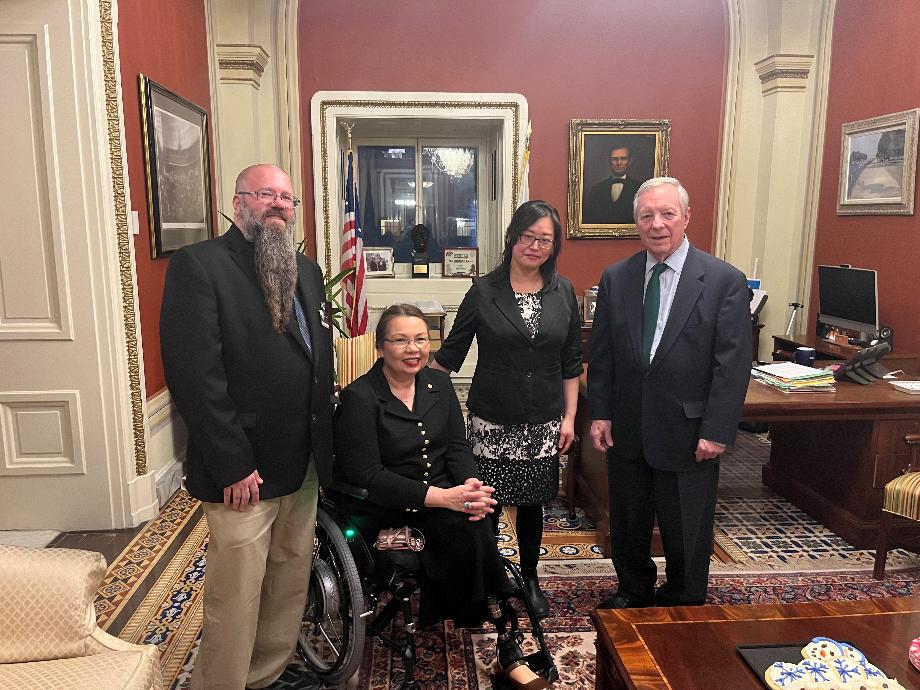
ALIYA RAHMAN, MARY GRANLUND, MUBASHIR HUSSEN, AND GERARDO OROZCO GUZMAN: Rep. Ilhan Omar (MN–05) invited four Minnesotans who have witnessed or experienced first-hand the devastation of the federal government’s invasion of their communities. Ms. Rahman, a disabled person with autism and a traumatic brain injury, “was driving to a doctor’s appointment when her window was smashed in by DHS agents, she was forcibly removed from her vehicle, and she was violently detained by federal agents,” Rep. Omar’s office said. Ms. Granlund is chair of the Columbia Heights School Board, which oversees the elementary school where five-year-old Liam Conejo Ramos has been a student. Mr. Hussen was stopped by masked agents who refused to verify his ID “despite Hussen repeating ‘I’m a citizen’ multiple times.” Mr. Orozco Guzman, “a workers’ rights organizer who has been fighting wage theft and labor trafficking,” has been detained at a number of abusive detention camps since his January abduction, including the deadly Camp East Montana outside El Paso, Texas.
Shockingly, Ms. Rahman faced continued harassment when she was arrested and removed from the chamber Tuesday night for “silently challenging Trump” during his speech, Democracy Now! reported.
ADRIANA QUIROZ ZAPAT: Ms. Quiroz Zapat was represented at the State of the Union by her niece, Monica Isabel Van Housen. Last March, ICE loaded the Colombian asylum-seeker onto a bus, “drove her to Mexico, and tried to dump her on the Mexican authorities,” The Bulwark reported in April. “The Mexicans, after hearing Zapata’s story of police corruption, threats, torture, and sexual violence spanning years, refused to accept her. They sent her, the ICE agents, and their bus back across the border.” She has been unjustly detained since despite the fact that she has protected status under the Convention Against Torture, said Rep. Rob Menendez (NJ-08).
MOHSEN MAHDAWI: Mr. Mahdawi was a guest of Rep. Becca Balint (VT-At Large) at a competing People’s State of the Union event, where he discussed how the administration targeted him for detention — and how his community fought to free him. Last April, Mr. Mahdawi was simply following the rules by attending his citizenship appointment when he was abducted by mass deportation agents. While a federal judge issued a ruling temporarily blocking officials from moving him out of Vermont, he remained unjustly detained. However, his advocates refused to give up. In a video of his eventual release, a large crowd sang “We Shall Overcome” as Mahdawi emerged making peace signs with his fingers.
During his People’s State of the Union remarks, Mr. Mahdawi urged attendees to stay strong and united against attacks seeking to pit neighbor against neighbor. “If we believe in justice, no force can intimidate us,” he said. “The tools of this administration are to frighten and intimidate us until we lose vision. Still, if we unite and work together from a place of love, not from a place of fear, they will not be able to.”
“He revealed that, after his release following 16 days of detention, his message to Trump and his administration was: ‘You will not intimidate me,’” The New Arab reported. “Mahdawi repeated phrases that the audience engaged with and repeated after him, directing them to the Trump administration, saying, ‘We are the people… we are not afraid of you, because the love in our hearts is much stronger than the darkness that blinds you.’”
Team USA’s Historic Wins Represent the American Dream
Ice skater Alysa Liu, the daughter of a Chinese dissident and political refugee, became the “first American female singles figure skater to win a gold medal in 24 years”
Team USA made sports history after winning an astounding 12 gold medals in Milan – a national record for the Winter Olympics games. “The historic Games was achieved through a number of American droughts coming to an end,” HuffPost reported. And, Olympic champions with direct immigrant roots helped make those wins possible.
Alysa Liu became the “first American female singles figure skater to win a gold medal in 24 years,” the San Francisco Chronicle reported, “and the first to win a medal of any color since 2006, when she was just 6 months old.” Liu is the daughter of Arthur Liu, a Chinese dissident who helped organize pro-democracy demonstrations after the Tiananmen Square massacre and eventually became a political refugee, resettling in the Bay Area, Forbes reported.
Liu’s victory at the Milan games cements her place among an elite class of iconic champions. “Eight American women have earned skating’s top honor. Three of them — Peggy Fleming, Kristi Yamaguchi and now Liu — are from the Bay Area, and two, Yamaguchi and Liu, are from the East Bay,” the San Francisco Chronicle continued. In Oakland, where Liu trained, her presence “looms large” as younger generations now cite her as an inspiration, The San Francisco Standard said.
“One girl, Abby P., 11, of Alameda, characterized Liu’s performance as ‘graceful,’ and ‘elegant,’” the report said. “‘I feel passionate — it makes me want to skate more!’ she said. ‘An Olympian was skating here, and I’m skating here too! She’s the celebrity of this place!’”
Figure skater Ilia Malinin, the son of Uzbek immigrants, “delivered a must-win free skate” that helped break a tie and win gold for the American figure skating team, USA Today reported. “The Americans jumped for joy on the podium as they were announced the Olympic champions and received their gold medals. The crowd roars for every name, with a big ovation for Malinin.”
The United States Olympic and Paralympic Committee said Malinin “began skating at age six, inspired by his parents, Tatyana Malinina and Roman Skornyakov, both former Olympic figure skaters for Uzbekistan.” They moved to the U.S. in 1998 “because their practice conditions in Tashkent, Uzbekistan, had deteriorated,” People reported. “Two years later, they tied the knot in January 2000.” Since then, they have called the United States their home.
“I like America very much,” Malinina said in 2002. “It was difficult to come to America, but easy to stay.”
There is simply no celebrating Milan – or any Olympic games, for that matter – without also celebrating the immigrant roots of Team USA. Just look at the numbers. “When examining individual athletes’ profiles, approximately 3.0% of athletes competing on Team USA are foreign-born and another 13.5% are children of immigrant parents(s),” the Institute for Immigration Research (IIR) at George Mason University said. “Combined, nearly 17% of Team USA has direct immigrant ties.”
A number of athletes who competed, such as Vadym Kolesnik, are themselves naturalized immigrants. The Ukrainian-American ice dancer placed fifth in Milan – a “stunning” Olympic debut, NBC Olympics reported. Kolesnik became an American citizen just this past August. “Today I was sworn in as a US citizen after nine years of living in and representing America,” Kolesnik wrote in an Instagram post following his naturalization ceremony. “This journey has been amazing and I am so grateful for everyone who has helped me get here.”
View this post on Instagram
And we’re grateful Kolesnik and all of our immigrant athletes are here. During a time when the federal government is actively “othering” immigrants, the Olympics games are a regular reminder that individuals who make their home here only make us a more prosperous, stronger, and joyous country, no matter who they are or what skills they possess.
Beyond “medals and achievement, the Olympics shine a light on how talent and opportunity transcend borders,” IIR Assistant Director Marissa Kiss and IIR Founding Director Jim Witte wrote in a recent op-ed. “This global competition is built not just on a diversity of athletes across nations, but within them — and few delegations demonstrate it more clearly than Team USA.”
Congratulations to all Team USA athletes for a job well done representing the United States in Milan. We’re proud of you.
Caregiving Can’t Happen Without The Skills, Professionalism, and Dedication of Essential Immigrant Workers
Ahead of National Caregivers Day, which is celebrated on Feb. 20, it’s vital to remember that the essential work of caregivers is more than just a job – it’s a purpose. “Working in child care has been enriching and rewarding because it goes beyond the professional,” said Felicitas, an early educator. “For me, it is a commitment to the future, to the formation of human beings, and to the possibility of positively influencing their lives.”
Like Felicitas, many of the caregivers who watch over our elderly and disabled loved ones, children, and others requiring regular assistance are immigrants. “They are the quiet force holding our care system together, providing care, love, stability, and education,” the National Women’s Law Center said last year. And, the simple fact is that caregiving simply can’t happen without their skills, professionalism, and dedication.
“In 2019, 36.5% of all home health aides in the United States were immigrants, a rate that was twice their share of the U.S. workforce overall (17.1%),” the American Immigration Council said in 2023. “This includes undocumented workers, who made up an estimated 6.9% of home health aides and 4.4% of personal care aides.”
“Despite their critical role, systemic barriers make it increasingly difficult for them to remain in the field,” the National Women’s Law Center noted. “They continue to face low wages, exploitative visa programs, and a lack of legal protections—all of which threaten their ability to stay in the workforce and, in turn, jeopardize millions of people’s access to care.”
It would affect caregivers and clients like Marlene Carrasco and Carmen Garcia, who were profiled by the Arizona Republic in December 2023. The piece highlighted how Ms. Carrasco, a Mexican immigrant and caregiver veteran of 30 years, provided dignified and personalized care for seniors like Ms. Garcia, helping her bathe, watch her diet, do light exercise, and play Lotería, a popular board game that spans generations of Latino households.
“In between, Carrasco did several loads of laundry,” Arizona Republic continued. “Carrasco logged notes in a binder to keep track of the food Garcia ate and the activities she did. Carrasco also texted updates to Garcia’s son throughout the afternoon.” Without Carrasco’s watchful eye, Ms. Garcia’s son, Our Lady of Joy Roman Catholic Church liturgical music director Gabe Martinez, worried his mom would be forced to spend hours alone.
Not only could this be life-threatening for seniors, kids, and others requiring care, it denies these individuals companionship, emotional support, and mental stimulation. It’s also important peace of mind for their loved ones. “It’s a great relief because I don’t have to worry about my mom, about whether she’s had something to eat,” Mr. Martinez told the Arizona Republic.
In addition to providing dedicated care and support to beloved family members like Ms. Garcia, immigrants also help fill critical labor shortages, which in turn boosts the economy for all. “There is already a shortage of workers such as Carrasco who care for aging adults in the U.S.,” the Arizona Republic reported. “The shortage is expected to worsen in the coming years, especially in Arizona, where the population is growing fast, and the population of older adults is growing even faster.”
Of course, those shortages can’t be filled if we aren’t giving immigrant caregivers the chance to stabilize themselves here in the U.S. and not have to worry if simply driving or taking public transportation to work could result in separation from their families and clients. During these highly stressful times, these essential workers also need tools to help manage their own self-care so they can continue to do their important work, experts add.
“So, the first rule for caregiving is ‘take care of yourself,’ according to the Family Caregiver Alliance,” Helen Dennis, an expert on aging, wrote at the Los Angeles Daily News last year. “And that includes managing stress. Warning signs might be poor sleep, irritability and forgetfulness. Consider identifying sources of stress that you can and cannot change and then take some action. Examples are walking, meditation, a yoga class or whatever works for you.”
If you know a caregiver, there are several simple yet meaningful ways you can help support them, such as offering to bring over a home-cooked meal, Dennis continues. During a time when even just stepping outside can feel frightening, offering to give a caregiver a ride to work can make a world of difference. Even just being a friendly ear on the phone can go a long way in letting them know that someone cares.
“Despite these systemic challenges, immigrant caregivers continue to persevere,” the National Women’s Law Center continued. “Their dedication goes beyond daily responsibilities—they sustain their communities. In the face of fear and adversity, they draw strength from solidarity and collective action.” Alma, another early educator, said that what keeps her “strong and motivated is knowing that we have several organizations fighting back against these immigration orders. They keep us informed, and they keep us in the fight.”
Nearly 17% of Team USA Has Direct Immigrant Ties, Research Shows
“… Beyond medals and achievement, the Olympics shine a light on how talent and opportunity transcend borders”
There is simply no celebrating the 2026 Winter Olympics without also celebrating the immigrant roots of Team USA – just look at the numbers. “Team USA is comprised of athletes who were born in the United States as well as athletes born abroad and athletes who are children of immigrant parents or second-generation immigrants,” the Institute for Immigration Research (IIR) at George Mason University said in recent research. “When examining individual athletes’ profiles, approximately 3.0% of athletes competing on Team USA are foreign-born and another 13.5% are children of immigrant parents(s). Combined, nearly 17% of Team USA has direct immigrant ties.”
View this post on Instagram
“The foreign-born athletes on Team USA were born in five different countries: Australia, Canada, Italy, Ukraine, and New Zealand,” IIR continued. “The road for competing and representing Team USA in the Olympics for foreign-born athletes varied. Some of the foreign-born Olympic athletes who are competing on Team USA have dual citizenship. Other athletes such as Vadym Kolesnik, Christina Carreira, and Kaillie Armbruster Humphries became naturalized U.S. citizens.”
Kolesnik, who is originally from Ukraine, was sworn in as an American citizen just this past August, fulfilling a critical component of his Olympics eligibility. While skating partner Emilea Zingas said Kolesnik was “really nervous” ahead of his exam, he passed with flying colors. “Today I was sworn in as a US citizen after nine years of living in and representing America,” Kolesnik wrote in an Instagram post this past summer. “This journey has been amazing and I am so grateful for everyone who has helped me get here.”
While competing in the Olympic games is a deeply personal accomplishment for any athlete, the games stood out for Kolesnik in a number of ways. Not only did he and Zingas end up placing fifth in Milan – a “stunning” Olympic debut, NBC Olympics reported – Kolesnik reunited with Ukrainian family members for the first time in four years, the AP reported. “You have to remember this war is really close to his heart,” Zingas said. “Every day he gets sent videos and messages about friends dying or getting injured. It’s not an easy thing. For the last four years, every day, he’s had some big weight put on him.”
View this post on Instagram
“For the second-generation athletes, their parents’ backgrounds are incredibly diverse with three-fourths of parents born in countries in Asia (i.e., China, Hong Kong, Japan, South Korea, Taiwan, Thailand) or Europe (i.e., Finland, France, Germany, Italy, Russia, Ukraine, Uzbekistan),” IIR continued. “Other countries include Canada, Argentina, and Mexico. This includes second-generation born and current George Mason University student and figure skater, Ilia Malinin, whose parents are both from Uzbekistan.”
Figure skater Maxim Naumov is not only among Olympians with foreign-born parents, he comes from a family of champions. His late parents, Vadim Naumov and Evgenia Shishkova, were also Olympians, placing fifth at the 1992 Winter Olympics in France, fourth at the 1994 Winter Olympics in Norway, and winning gold in pair skating at the 1994 World Figure Skating Championships in Japan. The pair had been coaching young skaters following their retirement when they were among the 67 passengers who were tragically killed in the American Airlines Flight 5342 collision in Washington, D.C. last year.
Maxim’s Olympic debut is the manifestation of a seed planted by his father in the time before he died. “In one of their last discussions as a family, Naumov’s father laid out the plan to ensure they could reach the Olympics in one year,” the Los Angeles Times reported. “He thinks about that talk constantly now.” In Italy, Maxim wore his father’s ring as a tribute. “He looked toward the rafters and spoke to his parents,” the L.A. Times continued. “‘Look what we just did,’ Naumov said. ‘We did it.’”
During the Paris games in 2024, the children of immigrants helped Team USA dominate the games. Gymnast Suni Lee, the daughter of a refugee born in Laos, won two bronze medals and a group gold medal, which combined with wins at the 2020 Summer Olympics made her one the most decorated American gymnasts of all time. Some jubilant attendees welcoming her back from Paris were members of Minnesota’s Hmong community. “Hmong people do not regularly see themselves in national media stories or celebrated as part of the national conversation,” journalist Nancy Yang wrote in 2021. “Lee has elevated a community that has for decades felt invisible and forgotten by America.”
Other Olympians with immigrant roots similarly triumphed during the 2024 games. Soccer player Naomi Girma, the daughter of Ethiopian immigrants, won gold. It was the women team’s first in more than a decade. Gymnasts Paul Juda and Asher Hong won bronze, marking the first time the men’s gymnastics team won an Olympic prize in over 15 years. Juda is the son of Polish immigrants and Hong is the son of Chinese immigrants. 20-year-old wrestler Amit Elor, a daughter of Israeli immigrants, “became the youngest U.S. wrestler, male or female, to ever win an Olympic gold medal,” Yahoo! Sports reported.
Recent summer games have also been notable for featuring the IOC Refugee Olympic Team. “That group, made up of independent Olympians who are refugees, debuted at Rio de Janeiro 2016 and won its first medal at Paris 2024,” The New York Times reported. The team was met with resounding applause at the Paris games, as we noted at the time. They were led by Cameroon-born boxer Cindy Ngamba and Syria-born taekwondo athlete Yahya Al Ghotany, who had the honor of being designated flag bearers for what was only the third-ever Olympic team composed of displaced individuals from around the world.
“I’m just one of millions,” Ngamba said at the time. “There are many refugees out there, just like me, who have not been given the opportunity [that we have], who will be watching the Olympics – and hopefully we can inspire them to believe in themselves and believe that through hard work, through hardship, you can strive in life and achieve miracles.”
Back in Milan, Malinin “delivered a must-win free skate” that helped break a tie and win gold for the American figure skating team, USA Today reported. “The Americans jumped for joy on the podium as they were announced the Olympic champions and received their gold medals. The crowd roars for every name, with a big ovation for Malinin.”
In an op-ed, IIR Assistant Director Marissa Kiss and IIR Founding Director Jim Witte wrote that “beyond medals and achievement, the Olympics shine a light on how talent and opportunity transcend borders. This global competition is built not just on a diversity of athletes across nations, but within them — and few delegations demonstrate it more clearly than Team USA.”
“Consistent with the ideals of the Olympics— excellence, respect and friendship — the U.S. has for many generations and in many ways met immigrants and refugees with a welcoming spirit,” they continue. “This spirit has been instrumental in providing a sanctuary and opportunities to millions of displaced individuals. In return, most immigrants and refugees work hard, contribute and give back to their new communities. Some become naturalized citizens. A select, dedicated few even represent their new nation on a global stage as Olympians.”