
The New Family Separation Crisis Is Here
A horrific number of U.S. citizen children have been separated from a parent under the Trump administration’s mass deportation agenda, a new study reveals
A May 18 report from the Brookings Institution estimates that nearly 147,000 American citizen kids have seen a parent detained under the Trump administration’s anti-immigrant obsessions, which have already endangered children’s safety by diverting federal resources away from investigating predators and traffickers in order to target hardworking moms and dads. The think tank found that of that number, more than 22,000 of these American kids have experienced the detention of both of their parents.
“Roughly 36% were younger than six years old, underscoring a hardline immigration enforcement strategy that has drawn widespread criticism from civil rights and immigrant advocacy groups,” The Guardian noted.
The think tank’s estimate is over 25 times larger than the number of weeping migrant children who were ripped from the arms of parents and guardians under the first Trump administration’s chaotic and intentionally traumatizing “zero tolerance” policy at the southern border, which ultimately resulted in the forcible separation of 5,500 kids. In 2024, experts with Human Rights Watch (HRW) said that as many as 1,360 children had still not been reunited with their parents six years after the administration’s human rights catastrophe was stopped under both court orders and massive public backlash.
We now run the risk of repeating this permanent family separation – but on an even larger scale. “Families are also now being split up in ways that are more dispersed, more hidden and harder to track,” as ProPublica noted.
While some deported parents may take their U.S. citizen children with them, others have been forced to make the agonizing decision to leave their children behind with a family member or close friend. This is not callousness; this is a parent feeling that their child may have the best chance of personal success in the U.S. even if it means being apart. Even so, the mass deportation officials plucking parents from their homes don’t keep track of this. “In many of these cases, the government is unaware of children left behind,” the study noted.
Other parents may decide to tell federal agents nothing about their children, knowing the vindictive nature of the mass deportation agenda. The CoreCivic-operated migrant family jail in Texas, for example, has been under fire for abhorrent conditions. And then this week, New Jersey’s Delaney Hall also denied state health inspectors full access to the GEO Group-operated site. “As I’ve said repeatedly, refusing to provide full access raises serious questions about what ICE is trying to hide from public view,” commented Gov. Mikie Sherrill.
When it comes to family separation, another recent report from Physicians for Human Rights (PHR) and the Women’s Refugee Commission (WRC) revealed that ICE is also not following its own policy regarding family units, “including a requirement that they ask anyone they arrest if they have children and ensure that parents have an opportunity to decide what happens to their children if they are deported.”
“Some parents reported trying to tell their arresting officers that they had children and being ignored,” the report said. “One mother, who was arrested outside a hospital after a medical appointment, had three of her children with her and three others at home. According to the physician who recounted her story, she repeatedly told her arresting officers that she had three other children whom she would want to come with her, but she was dismissed. The family is now separated, with three children in Honduras and three left behind in the US.”
“Last Monday, I was dropping off my son—who has a disability— at school,” said another deported mother. “I left him and when I came back, I saw that some men were coming. They didn’t ask me anything, they just put me in handcuffs, and I couldn’t say even a word. That’s how they detained me.”
In one of the earliest investigative reports last year detailing this emerging humanitarian crisis, one separated family shared how siblings Febe and Angelo Perez were asleep in their beds when mass deportation agents in full tactical gear invaded their home and abducted their mom, Kenia, who had just arrived home from work.
“‘Run away as far as you can,’ she texted her 14-year-old son, Isaac, who jumped out the window. Since Isaac was also undocumented, she worried ICE would take him too — leaving Febe and Angelo without any family in the country,” CNN reported at the time. “Desperate to keep her children out of foster care, her next call was to Jeff Chaney, a family friend and coworker who had agreed just a day earlier to take guardianship of the children if ICE came for her — something she had become increasingly nervous about under the Trump administration.”
“Unlike other cases examined by CNN, Perez said she was allowed to go into her apartment, wake her children, and tell them goodbye,” the report continued. Ms. Perez, who was deported to Honduras just days after her arrest, said that she asked her children “to be strong.”
“‘There are a lot of families that are in the situation that are not being written down,’ said Tara Watson, one of the authors of the Brookings report,” ProPublica continued. “It’s ‘important both for transparency and from a child health and wellbeing perspective to know what’s happening to the kids. How many of them are leaving the U.S.? How many of them are staying in the U.S. with close family? How many of them do we really not know what their situation is?’”
We do know that the administration’s anti-immigrant obsessions – which are also targeting immigrants with valid protections and many others applying for a green card in addition to long-settled undocumented neighbors – put millions of U.S. citizen children at risk. One 2024 analysis from the Center for Migration Studies found that an estimated 5.5 million American-born kids live in a household with at least one undocumented family member. Of this number, nearly two million U.S.-born children live with two undocumented parents.
“For both logistical and political reasons, the administration will not achieve its stated goal of removing every unauthorized immigrant from the United States,” the Brookings Institution report concluded. “But hundreds of thousands of children are likely to be directly impacted by the current immigration enforcement policy. Policymakers must reckon with the fact that many children are left without one or both parents as a result of immigration enforcement, that this is unlikely to change in the near term, and that no government entity is responsible for their well-being.”
And, we must also reckon with the fact that when even short amounts of separation can be harmful, mass deportation policy that could soon see billions more in spending will be forcing these children to endure a mental health crisis that may last for years to come.
Immigrant Service Members Made the Ultimate Sacrifice For the Land They Loved – America
One 2019 study from the Migration Policy Institute found that between 2001 and 2013, almost 300 foreign-born soldiers died in service of their adoptive country
José Gutierrez is not a name remembered by most Americans, but it should be. The Marine Corps. Lance corporal – believed to have been the second U.S. service member to have been killed during Operation Iraqi Freedom – grew up an orphan on the streets of Guatemala and arrived in the U.S. without papers. He learned English, finished school, and planned to become an architect but put that dream on hold in order to enlist.
Gutierrez, whose parents died when he was just 14, “wanted to give the United States what the United States gave to him,” his foster sister later remembered. “He came with nothing. This country gave him everything.” He was just 22.
This Memorial Day, we remember and lift up the names of the immigrant U.S. service members who, like Gutierrez, have made the ultimate sacrifice in service of their adoptive country.
Nigeria-born Army Pfc. Francis Obaji had plans to go to medical school after excelling at his Brooklyn, N.Y. high school studies, but one day in 2001 forever altered “the course of his life,” the American Immigration Council (AIC) said. “Francis was waiting for the Staten Island Ferry in lower Manhattan when the attacks of September 11 struck the world. After witnessing the horror of the attack from so close, Francis immediately decided to join the military.”
“Throughout his training and deployment in Iraq, Francis never lost his optimism, and he was unstoppable in his determination to defend his adopted country,” AIC said. “Sadly, on January 16, 2005, Francis died in a vehicle accident in Iraq.” Romania-born Army Sergeant Catalin Dima also enlisted after 9/11 and actually became an American citizen while deployed in the Middle East. He was killed on the same day he was promoted in rank in 2004, AIC said.
Marine Corporal and military photographer Sara Medina, a daughter of Mexican immigrants, was a student at an Aurora high school in Illinois when she decided to enlist. She was on what was supposed to be her last military mission and was newly-engaged to a fellow service member when she was killed in a helicopter crash while supporting earthquake relief efforts in Nepal in 2015. “She was doing what she loves,” said one Aurora community member. “She had a passion for it, and hopefully fulfilled her dreams.”
One 2019 study from the Migration Policy Institute found that between 2001 and 2013, almost 300 foreign-born soldiers died in combat. Not all have been U.S. citizens, either. For example, while Gutierrez had legal status at the time of his death, he was not yet naturalized. For his sacrifices, he was awarded posthumous citizenship. Cardinal Roger Mahony, then archbishop of Los Angeles, expressed gratitude but nonetheless called it “inadequate.”
“It seems to me that it is important for us to recognize that in his self sacrifice the importance of our immigrant men and women,” he said.

Foreign-born service members have been enlisting in the U.S. military since our nation’s founding, said FWD.us. “Hundreds of thousands of immigrants pledged to defend the United States with their lives in the Civil War, both World Wars, and conflicts like those in Vietnam, Afghanistan and Iraq,” the organization said in 2022. Many have served with distinction: Military.com reported in 2020 that “of the more than 3,400 Medals of Honor awarded since the Civil War, 22% have gone to immigrants.”
“In recent years, recipients of the Medal of Honor have included Florent Groberg, who was born in France but was awarded the medal in 2015 for actions in Afghanistan in 2012; Tibor Rubin, born in Hungary and awarded the medal in 2005 for his actions during the Korean War; and Leslie Sabo Jr., who was born in Austria and was posthumously honored in 2012, 42 years after he died in Cambodia,” the report said. Alfred V. Rascon, a retired Army lieutenant colonel who fought in the Vietnam War, was awarded a Silver Star for service a year before he ever became fully American on paper.
While overall recruitment numbers shift over time, “the foreign born have been a constant presence in the U.S. armed forces,” the Migration Policy Institute said in 2024. “As of 2022, nearly 731,000 U.S. veterans had been born outside the United States, representing 4.5 percent of the country’s 16.2 million veterans.”
Despite their centuries-long sacrifices and contributions to our country, U.S. military service members and their loved ones have not been immune from federal immigration enforcement policy, including deportation. The New York Times reported in March that the Trump administration “began deportation proceedings for 34 former members of the military over the past year,” while nearly 250 relatives were similarly targeted for removal.
This has been an intentional deviation from the norms, after the previous administration implemented policy instructing immigration agents to refrain from targeting these individuals.
“Military service is complicated, but when honestly entered into, it is a form of sacrifice that the country itself has long described as sacred, and the threshold for what is owed in return has to be correspondingly high,” Dr. Austin Kocher of Syracuse University writes. “It ought to be completely inconceivable to anyone in this country, and especially to anyone whose politics purport to be pro-American, that any veteran be arrested, detained, or deported, irrespective of what they have done or who they are.”
And, as José Gutierrez, Francis Obaji, Catalin Dima, and Sara Medina have demonstrated, when they volunteer to enlist and risk their lives in service of their adoptive nation. On Memorial Day, we remember their names – and the names of all who have fallen. “While they hail from places as varied as Africa, the Middle East, and the Caribbean, each of these solders shares one thing in common,” as AIC noted. “A patriotism and a dedication to their adopted country worthy of celebrating.”
Immigration Highlights of the Week: Trump Keeps Up Immigration Pressure Despite ICE and CBP Setback
The Senate went into its Memorial Day recess without passing the measure that would provide an additional $70 billion for ICE and CBP through the reconciliation process, which allows for approval by a simple majority and thus without Democratic support. The House also recessed, as the Senate must consider the bill first.
It appears there are differences among Republicans on certain issues that have caused unease in some quarters. Among these is the $1.776 billion fund announced by the Department of Justice to “compensate” Trump allies who claim they were “persecuted” by the administration of Democrat Joe Biden.
The payments would be made with public funds, and among those allies are the insurrectionists from the January 6, 2021, Capitol riot who attacked Capitol and District of Columbia police officers and who, despite being convicted and imprisoned, were pardoned by Trump.
Another point of contention in the reconciliation measure has been funding for the Secret Service, amid fears that the money could be diverted to the controversial ballroom that Trump wants to build at the White House—a project he had previously said would be paid for with private funds. In fact, media reports indicate that those funds will be removed from the project.
Undocumented Immigrants’ Finances in Trump’s Crosshairs
The legislative controversy has in no way altered Trump’s campaign to crack down on undocumented immigrants and force them to self-deport.
La Opinión reported that “the Trump administration opened a new front in its immigration policy: the financial system.” “Through an executive order signed on May 19, 2026, the White House instructed the Department of the Treasury and regulatory agencies to tighten controls on bank accounts, loans, and transfers linked to immigrants without legal authorization to work in the United States.”
The newspaper adds that “although the order does not directly ban remittances, it does propose new financial surveillance rules that could change the way millions of immigrants send money to their families in Latin America.”
“For now, many of the measures must still go through regulatory processes before taking effect. However, the message is clear: the Trump administration seeks to turn the financial system into yet another tool for immigration control,” the newspaper concluded.
Trump also increases the number of judges to speed up deportations.
La Opinión also reported that “according to CBS News, 77 permanent immigration judges and five temporary judges were sworn in this week, amid pressure from the Republican administration to strengthen its policy of mass deportations.”
This is intended to restore the number of judges to 700, as some 100 had been dismissed for failing to authorize deportations at the expected pace.
The same CBS article notes that “while they’re part of the executive branch, immigration judges are expected to be neutral, and not show bias towards noncitizens or the Immigration and Customs Enforcement lawyers seeking their deportation. Still, the Trump administration has publicly referred to them as ‘deportation judges’ in official job listings, calling on potential applicants in one ad to ‘deliver justice’ to ‘criminal illegal aliens.’”
CBS added that “Greg Chen, senior director for government relations at the American Immigration Lawyers Association, accused the Trump administration of seeking to ‘compel’ immigration judges to “act as tools of enforcement, not impartial adjudicators.”
The backlog of cases before immigration judges is estimated at 3.5 million.
They also propose increasing the fine for deportation orders issued in absentia to $18,000
La Opinión reported that “President Donald Trump’s administration is moving forward with a new plan to impose fines of up to $18,000 on immigrants with final deportation orders who are subsequently arrested by immigration authorities, in a measure that is part of the federal strategy to tighten immigration policy and promote self-deportation.”
“The proposal was published this week by DHS in the Federal Register and will remain open for public comment until June 22. The government seeks to raise the current fine of $5,130, established just last year, arguing that the amount no longer covers the actual costs of locating, detaining, and removing an immigrant,” the newspaper reported.
145,000 children have been separated from their parents, a report reveals
An analysis by the Brookings Institution found that since Trump began his second term, 400,000 immigrants have been detained within the country. This has affected some 200,000 children who have lost at least one parent in the process. “Our analysis suggests that more than 145,000 U.S. citizen children have likely experienced a parent booked into detention since the administration began, with more than 22,000 of those experiencing detention of all their co-resident parents,” the analysis states.
La Opinión reported that “the investigation warns that the federal government does not have a clear system for tracking what happens to minors after their parents are arrested by agents of U.S. Immigration and Customs Enforcement, known as ICE.”
Meanwhile, a contrasting initiative emerges: Trump wants to admit 10,000 white South African refugees, Afrikaners, who claim to be discriminated against
According to La Opinión, “the State Department sent an emergency notification to Congress with the aim of raising the cap on the number of refugees to be admitted this fiscal year to 17,500, more than half of whom would be South Africans fleeing discrimination because they are white.”
“U.S. authorities estimate that admitting these individuals would cost nearly $100 million in public funds,” the newspaper added.
“According to information released by the State Department, between October 2025 and last month, the Trump administration had resettled 6,069 refugees, of whom 6,066 came from South Africa and the remainder from Afghanistan.”
The South African government denies accusations of discrimination and land confiscation against white Africans.
Quotes of the week:
The reaction of two Republican senators, one to Trump’s plan to secure $1 billion within the ICE and CBP budget for his ballroom, which appears to have been left out of the measure:
“People can’t afford to buy food, gas, or healthcare, and we’re going to spend a billion dollars on a ballroom?” declared Bill Cassidy, Republican Senator from Louisiana.
And another on the announcement of a fund to “compensate” Trump allies who claim to have been “persecuted” by the Biden administration, including the insurrectionists from January 6, 2021:
“So the nation’s top law enforcement official is asking for a slush fund to pay people who assault cops? Utterly stupid, morally wrong – Take your pick,” said Kentucky Senator Mitch McConnell.
DACA Recipient Testifies That Her Wrongful Deportation Was ‘Abuse Of Power’ That ‘Traumatized’ Family
DACA recipients and loved ones told lawmakers during a Senate forum that the administration’s mass deportation agenda has left their families in “constant fear”
Maria de Jesus Estrada Juárez – the DACA recipient who was wrongfully separated from her U.S. citizen daughter this past February despite holding valid deportation protections – testified during a Senate Judiciary Committee “spotlight forum” that her ordeal was no bureaucratic mistake. “It was an abuse of power that traumatized my family,” she said, “and showed how easily immigrant families can be treated as disposable.”
The mom was targeted, detained, and kicked out of a country she had called her home for 25 years just hours after attending what she thought was a routine immigration appointment related to her green card application. “For 40 days I was trapped in a country I do not call home while my daughter lived in fear wondering if she will ever see me again,” she testified during the May 12 forum.
Estrada Juárez was able to win her fight to the U.S. only after a federal judge ruled that she had been deported “in flagrant violation of the regulatory protections afforded to her under DACA” and “in violation of the Constitutional protections afforded to her under the Due Process Clause of the Fifth Amendment to the U.S. Constitution,” the Los Angeles Times reported. “But while her family is now reunited, she told federal lawmakers that they are stuck in a state of unchanging anxiety.
“Now we live in fear. Constant fear,” Estrada Juárez said. “These are not just political talking points or policies on paper. These decisions to destroy families leaves permanent scars on children.”
Stephanie Villarreal testified on behalf of her husband, DACA recipient and essential healthcare worker Juan Chavez Velasco. He was detained for three months after ICE abducted him while he was on his way to deliver milk to their hospitalized newborn. “‘I never got to hold her’ before being taken away, he said in a phone interview from the Webb County Detention Center,” MS Now reported in March. He said he tried to tell ICE that he had DACA, they responded that it “doesn’t matter.”
Villarreal echoed his account during her testimony to senators, saying that Chavez Velasco tried to tell mass deportation agents that his protections were active and that he had already submitted renewal paperwork several months prior and was waiting for it to be approved. “They told him that it didn’t matter, and they took him,” she repeated. “I was on the phone with him and I heard it all happen.”
The dad’s DACA status ultimately expired while he was in detention. “He did everything he was asked to,” Villarreal continued. “He applied on time, he renewed successfully since 2012. That didn’t matter.”
In much-needed good news for the young family, Chavez Velasco finally got to hold his baby daughter after finally being released from ICE detention, the Families Belong Together campaign shared Monday:
Sen. Dick Durbin (D-IL) said during the spotlight forum that his office has heard from constituents who have also filed their DACA renewal paperwork ahead of time but, like Chavez Velasco, are “still losing their protections due to delayed adjudication.” Some applicants have been forced to wait for as long as six months – or even longer – to have their paperwork processed, leaving them at risk of losing their jobs and housing if their status expires and are then unable to legally work.
“As a result, the number of people with active DACA status has dropped by 32,000,” Senator Durbin said. “Additionally, USCIS is applying so-called ‘processing holds’ on applications from DACA recipients from 39 countries which the President said we will accept no one from. And there is no timeline for when processing will resume.”
The administration is also breaking DACA’s promise by issuing a decision that just disregards DACA period, and “sets a precedent that DACA status is no longer enough to automatically protect immigrants within removal proceedings, which can lead to deportation,” as Mission Local reported.
“Let’s be clear—the cruelty is the issue here,” Senator Durbin continued. “These are people who have lived in the U.S. for years, graduated alongside our kids, married and had their own U.S. citizen children, and are contributing to our communities.”
Rebecca Shi, founding executive director of the American Business Immigration Coalition, testified that ensuring DACA recipients can remain in their communities is essential to our continued wellbeing, noting that nearly 35,000 health care workers are enrolled in the program. She pointed to Florida patients who face interruption to their care because of renewal delays affecting a nursing supervisor.
“That means the patients that she sees every day, the nurses that she supervises every day, do not have her support and her cooperation, her mentorship, solely because she was born in Haiti,” Shi said. “She arrived in the US in 1999 at the age of 5 and was educated in American schools. She got her nursing degree here.”
“She has lived here for 27 years,” she continued. “She has met every requirement the government has asked of her, renewing her DACA on time, paying taxes, building a life defined by work, responsibility and community.”
The Center for American Progress estimated that in 2022, “more than 482,000 DACA recipients were in the workforce, collectively earning nearly $27.9 billion and contributing nearly $2.1 billion to Social Security and Medicare annually. In addition, their employers contributed more than $1.6 billion in payroll taxes toward Social Security and Medicare on these DACA recipients’ behalf.”
Greisa Martínez Rosas, executive director of immigrant youth-led United We Dream, used her time at the microphone to condemn the administration’s cut-by-cut attacks on DACA – and urge those with power to help end the suffering and uncertainty facing all Dreamers.
“Speaking here today is not just personal,” she said. “It’s my civic responsibility and part of the long legacy of immigrant youth who show up every single day to organize, advocate, and care for one another where systems have failed. As immigrant youth across the country endure a slate of coordinated attacks, Congress has no choice but to reckon with the truth: only full citizenship can afford communities the stability and dignity we deserve.”
“No longer can those in the highest halls of power treat immigration as a political liability when it has always been where the biggest issues of our time – from economic prosperity to labor stability – converge,” she continued.
Mass Deportation Machine Targets All: AAPI Month Edition
“Across the U.S., A/PI adults of all ethnicities and statuses are feeling the weight of anti-immigrant policies and political rhetoric”
This May marks Asian American, Native Hawaiian and Pacific Islander (AANHPI) Heritage Month, which honors the Asian American, Native Hawaiian and Pacific Islander neighbors who have enriched America’s history and are instrumental in its future success. These individuals include millions of immigrant community members, accounting for more than 30% of the United States’ total foreign-born population as of 2023.
“U.S. immigration from Asia has a long and complex history,” the Migration Policy Institute (MPI) said last year. “Starting in the mid-19th century, immigrants from Asia came primarily from China, Japan, Korea, and the Philippines for agricultural and construction work. However, after a series of restrictions targeting first Chinese immigration (the 1882 Chinese Exclusion Act) and then immigration from everywhere but Northern and Western Europe (the National Origins Acts of 1921 and 1924), immigration from Asia quickly ground to a halt.”
It would be a century after the Chinese Exclusion Act that immigrants from Asia would finally be allowed to migrate to the U.S. beyond a trickle, as we’ve previously noted.
Today, Asia accounts for “the second largest region of origin for immigration to the United States, after Latin America, accounting for 31 percent (or 14.6 million) of all 47.8 million foreign-born residents as of 2023,” MPI continued. AANHPI immigrants also make up a significant portion of the nation’s total undocumented population, accounting for 1.7 million of the 11 million individuals who currently lack legal status overall, according to Asian Americans Advancing Justice.
Despite AANHPI immigrants’ vast contributions to the U.S. – including $167.9 billion in federal income taxes and almost $72.5 billion in state and local taxes annually, according to the American Immigration Council – the ICE arrests of these community members are almost four times what they were under the past administration, according to data compiled by STOP AAPI Hate.
That data reveals that from January to October 2025, 7,752 ICE arrests, 7,243 detentions, and 2,776 deportations involved AANHPI individuals, some of whom were deported to so-called third countries where they have no ties, STOP AAPI HATE said. “Chinese, Indian, and Vietnamese immigrants are among those sent to Ecuador, Eswatini, and Sudan — which have horrific human rights records.”
But the human rights record here at home is nothing any decent person should be proud of. Under the current administration, ICE has seen its deadliest in-custody death rate in two decades. “Under President Trump, 41 people died in ICE custody, including 9 Asian immigrants,” STOP AAPI HATE said.
Nor have AANHPI U.S. citizens been immune from the economy-busting mass deportation agenda prioritized by this administration, which is currently seeking another $70 billion in funding with zero guardrails. This past January, a naturalized U.S. citizen of Hmong descent was dragged out of his home into the bitter Minnesota cold in nothing but his underwear, Crocs, and a thin open blanket. ChongLy Thao was not even a target of ICE’s operation and was swept nearly-naked in freezing cold weather “simply because he’s Asian,” independent journalist Marisa Kabas noted at the time.
“Though he ended up being returned, the damage is done and the message has been sent: If you’re not white, you’re not safe,” she wrote.
The administration’s nativist agenda has had profound impacts across AANHPI communities. “In a January 2026 national survey conducted with NORC at the University of Chicago, we found that half of A/PI adults in the U.S. said they or another person in their community (e.g., friends, family, and coworkers) were impacted by anti-immigrant policies or sentiment in the past year,” STOP AAPI HATE continued.
Data collected by the organization further revealed that 24% of survey respondents said that they’re facing economic or education repercussions, 39% said they’re withdrawing from public life, and 45% said they feel overall less secure in the United States. Many have been experiencing mental health issues over the attacks as well, the research found. “Respondents who report feeling the impact of Trump’s anti-immigrant agenda are 1.9 times more likely to experience higher rates of moderate or severe anxiety and depression.”
“The numbers tell a story, but so do the people behind them,” STOP AAPI Hate continued. “Across the U.S., A/PI adults of all ethnicities and statuses are feeling the weight of anti-immigrant policies and political rhetoric. Not even citizens are immune from the fear and uncertainty that the Trump administration has unleashed.”
“The good news is: we’re prepared to do something about it. 67% of U.S.-based A/PI adults said they are motivated to protect immigrant communities.” The organization is helping track anti-AANHPI bigotry by urging community members to report instances of hate here.
The defense of Asian Americans was a major theme in celebratory statements from federal lawmakers, who noted that their presence “long predates America’s founding.” AANHPI community members, they said, have explored space, have been some of the most decorated military service members in U.S. history, have helped transform union rights, and, in the late 19th century, were critical in completing the Transcontinental Railroad, which was pivotal in “helping transform the nation’s economy.” The Labor Department has previously called its completion “one of the greatest engineering feats in American history.”
“This year’s celebration precedes the 250th anniversary of the United States—a historic milestone and an opportunity to honor the generations of AANHPIs who have helped build and strengthen this nation,” said Congressional Asian Pacific American Caucus Chair Grace Meng (D-NY). “Our presence long predates America’s founding, beginning with the first recorded arrival of Filipinos in what is now the continental United States at Morro Bay in 1587.”
“Since then, our communities have played a vital role in shaping our nation. From the Asian immigrants who fought in the Revolutionary War to the Indian American astronauts who have pushed the boundaries of space exploration, our contributions can be seen in every facet of society. Our history is American history, and it deserves to be recognized as such—especially at a time when our nation’s leaders seek to diminish or erase it.”
“As Chair of the Congressional Asian Pacific American Caucus, I remain committed to improving the lives of Asian Americans, Native Hawaiians, and Pacific Islanders across the nation,” Rep. Meng continued. “CAPAC will continue fighting for a future where every person—no matter where they come from, what they look like, or how they pray—can live with dignity, safety, and prosperity.”
Immigration Highlights of the Week: ICE Undergoes a Reorganization Amid Controversy, Resignations, and Tension Over Immigration Raids
David Venturella will serve as the new ICE acting director following Todd Lyons’ departure later this month.
The veteran ICE official will take office amid controversy over violent ICE (and CBP) operations across the country that claimed the lives of two U.S. citizens in Minnesota at the hands of immigration agents, and as the agency faces multiple lawsuits over rights violations—including those of U.S. citizens—during operations by both agencies.
Venturella also takes office amid a standoff between Democrats and Republicans over the reforms demanded by the former regarding agent conduct and an accountability process that currently does not exist. That impasse led to a partial shutdown of the Department of Homeland Security (DHS), and now Republicans are seeking to add another $70 billion for ICE and CBP through the reconciliation process and without Democratic support, as it requires only a simple majority to pass.
What is most striking is that Venturella is a former executive of the GEO Group, the controversial private firm that operates 23 ICE detention centers with more than 26,000 beds, many of which have been accused of abuses including a lack of adequate medical care and where several deaths have even been recorded.
As reported by La Opinión, “according to public documents, the GEO Group holds contracts with ICE valued at over $1 billion… Democratic Congresswoman Delia Ramírez harshly criticized the appointment. ‘Let’s be clear: his appointment aims to ensure that Trump’s corporate bosses continue to profit at the expense of our communities’ suffering.’”
La Opinión also reported that “according to a report published by The New York Times, Venturella allegedly intervened personally in an immigration case to ensure the detention and deportation of a woman linked to a close ally of Trump.” DHS denies this.
Meanwhile, the head of the Border Patrol resigns
Michael Banks submitted his immediate resignation from the position of CBP chief.
CNN reported that “during Banks’ tenure, a subordinate Border Patrol official, Gregory Bovino, led the government’s immigration crackdown campaign within the United States, with the approval of then-Secretary (of DHS) Kristi Noem.”
Trump praised Banks and Bovino for their performance, but following the American public’s rejection of the operations they deem excessive, both officials are now out.
Last month, The Washington Examiner revealed that six current and former CBP employees accused Banks of paying for the services of prostitutes on overseas trips over the past decade. Banks was apparently investigated, but the inquiry was halted during Noem’s tenure.
Despite high-level resignations and firings, immigration raids continue to terrorize the community
La Opinión reported on a UnidosUS report concluding that “UnidosUS affiliates serving local Hispanic communities frequently report that entire families avoid seeking medical care for fear that ICE agents might show up at hospitals or clinics and proceed with detentions based on their appearance or the way they speak.”
“Other Trump administration policies have eroded access to healthcare… The indiscriminate enforcement of immigration laws, the sharing of Medicaid records with Immigration and Customs Enforcement (ICE), and the public charge rule have created a profound deterrent effect,” according to the report.
To top it off, ICE will be present at some 2026 World Cup stadiums
The announcement that ICE agents will be present at some 2026 FIFA World Cup matches across the country performing security “support” duties is causing great concern. There was no mention of mass raids, but the possibility of some arrests was not ruled out.
It was noted, however, that there would be no agents at SoFi Stadium or the Los Angeles Memorial Coliseum.
“International visitors who arrive legally in the United States to attend the World Cup have nothing to worry about,” said a DHS spokesperson quoted by The Hill. “What makes a person subject to immigration enforcement measures is whether or not they are in U.S. territory illegally; period.”
“At the same time, foreign visitors SHOULD be proactive and begin preparing their travel plans and documents well in advance to ensure a smooth travel experience,” the agency added.
Democrats Advocate for Permanent Legislative Solution for ‘Dreamers’
La Opinión reported that “Democratic senators and immigrant advocacy groups sounded the alarm about the future of thousands of DACA recipients after denouncing delays in renewals, detentions, and deportations under the Donald Trump administration.”
“Data cited by lawmakers indicate that in 2025, at least 261 DACA recipients were detained and 86 deported, despite having active protections,” the newspaper noted.
“One of the most striking testimonies was that of Ariel, a San Francisco-based nurse who arrived in the United States at age two and now faces the risk of losing her job due to delays in renewing her immigration protection,” it added.
“She is on the verge of losing her job caring for the sick and the promotion she had worked for, due to the failures and cruelty of the Trump administration,” said California Democratic Senator Alex Padilla.
Kevin González Laid to Rest in Durango
“With white flowers, marching band music, and applause, family members, classmates, and teachers bid a final farewell to Kevin González, an 18-year-old who died of terminal colon cancer in Durango. The funeral service was held at the high school where he studied, in an atmosphere marked by sadness but also by the affection of those who shared moments with him,” wrote La Opinión.
Telemundo reported that friends and family members held a memorial service at Kevin’s former high school and at Durango Cathedral.
Kevin and his parents went through an ordeal to be able to reunite before the young man passed away this past Sunday, as they had been detained while trying to enter the United States without documents to see their son. Kevin traveled to Mexico to wait for them.
A federal judge in Arizona finally ordered his expedited deportation to Mexico, and his parents were able to see him before his passing.
Quote of the week:
“He leaves us with a broken heart… An empty heart,” Maricela Ramírez, aunt of Kevin González, told Telemundo. Kevin, the 18-year-old terminally ill cancer patient, moved many with the ordeal he endured to see his parents—who were detained by immigration authorities—before he passed away.
DACA Recipient and Nurse’s Aide Helped Save Lives During COVID. Now She Faces Deportation
“She’s like the glue that keeps us all together,” said her brother. “Every happy event we have, we can’t imagine ourselves without her”
A DACA recipient and nursing aide who volunteered to help save lives in New York during the height of the COVID-19 pandemic has been detained for months and is at threat of deportation despite holding current protections valid through 2027, Spectrum News 1 reports.
Yenniffer England, a 32-year-old nursing professional who has called the U.S. her home since she was just four, was on her way to dinner with her brother and daughter this past February when she was targeted and pulled over by a Texas Department of Public Safety state trooper. “The Mexican national had an expired driver’s license and was taken to jail after the traffic stop,” Spectrum News 1 reported. But Texas State Rep. Armando Martinez said “England has constantly done everything required of DACA recipients, and that minor traffic and legal infractions are not reason enough for an arrest,” KRGV reports.
England, a mother of two U.S. citizens, is now separated from her family and could be deported to a country she hasn’t known as home for nearly three decades over a traffic violation that has resulted in a simple citation for other Americans. Her supporters gathered outside a privately-operated detention center in Raymondville, Texas, last week to rally for her release.
“She’s like the glue that keeps us all together,” her brother, Fransisco De La Rosa, said outside the MTC-operated El Valle Detention Center. “Every happy event we have, we can’t imagine ourselves without her.”
England deserves to be with her family, and the promise that the federal government made to DACA recipients – that they would be protected if they submitted their information, paid their fees, and followed the rules – should have ensured that. But the Trump administration has broken that promise, detaining or deporting hundreds of Dreamers since January 2025. DACA recipient Maria de Jesus Estrada Juárez was detained and deported this past February in “flagrant violation” of her protections. The mom won her return home the following month. Last month, the federal government agreed to let deported DACA recipient José Contreras Díaz return back home to his family – only to detain him for a second time. He was finally freed late last week.
But neither have the peace of mind they deserve. Estrada Juárez is “appealing the denial of her green card application” and worried “about what the next appointment might bring,” Mother Jones reported. Meanwhile, the administration has made clear it intends to keep targeting Contreras Díaz. “The end result will be the same — he will not be able to remain in the U.S,” said an unnamed Department of Homeland Security spokesperson.
As we noted last week, the administration has been subjecting DACA to death by a thousand cuts, including by issuing an immigration court ruling that makes it easier to kick out young immigrants like Yenniffer, Maria, and José, as well as slow-walking DACA renewals so that these breadwinners not only become vulnerable to family separation, but also lose their ability to legally work to support their loved ones even if mass deportation agents haven’t detained them.
Like Yenniffer, Ariel – whose real name is being withheld to protect her from government retaliation – is another essential healthcare worker at risk of losing everything she’s worked to achieve. She’s among DACA recipients who risk falling out of status due to lengthy renewal delays, Mission Local reports. The San Francisco nurse filed her paperwork more than four months ahead of her April deadline. But even that wasn’t enough time.
“When her DACA status expired on April 15, Kaiser gave her 30 days of unpaid leave,” Mission Local reported. “Now, as the May 15 end of the unpaid leave approaches, it appears that she will lose her job and the promotion she had been training for.” Despite calling the U.S. her home for more than three decades, putting herself through medical school, and spending months training to co-lead her unit, Ariel is now exploring whether to leave America entirely.
Not only would she be forced to uproot her life, the patients who depend on her care and expertise will feel the impact too, her colleagues and advocates said.
“Perioperative nursing shortages are already impacting access to care,” Elizabeth Lancaster, vascular surgeon at Kaiser, wrote in one letter of support. “The absence of this single, highly trained clinician has real consequences for surgical capacity and patient care continuity.” Sydney Simpson, a fellow nurse at Kaiser and union representative, plainly stated that “patients are going to suffer.”
While Simpson expressed frustration with Kaiser’s internal policies making it difficult for Ariel to keep working while her status is in limbo, it’s federal delays that are the root cause of this dilemma affecting healthcare workers and patients. But instead of prioritizing resolution of this issue so that Dreamers can continue caring for patients, the administration is demanding more money for mass deportation and $1 billion in taxpayer funds to help fund a ballroom instead.
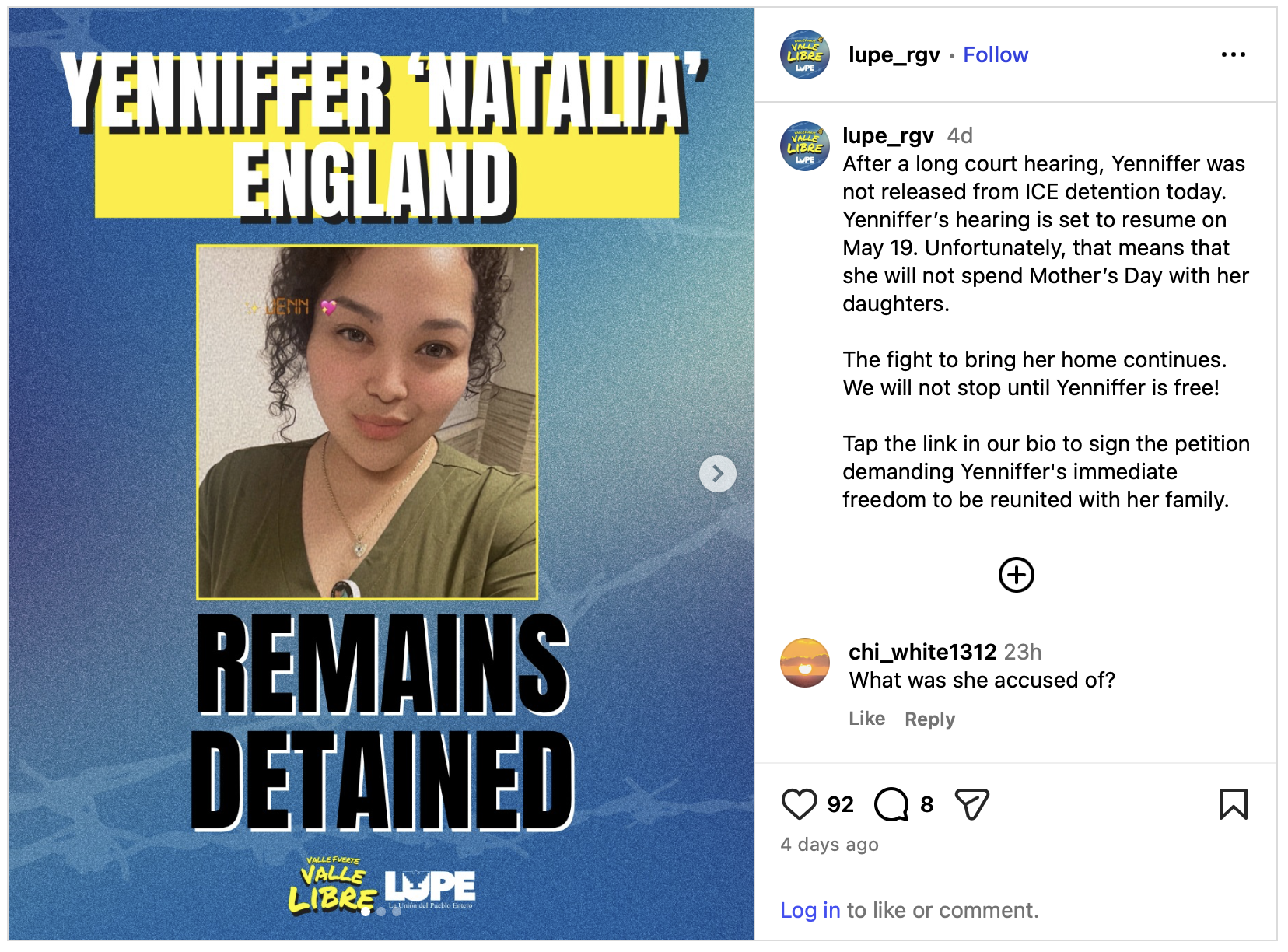
Back in Texas, Yenniffer’s recent court hearing did not result in her release from El Valle Detention Center, as her advocates had been hoping. Her continued detention meant that she spent Mother’s Day separated from her U.S. citizen children. So did many other mothers. “According to the Migration Policy Institute (MPI), detention levels have surged to historic highs, with roughly 61,000 individuals in custody in late 2025, and approximately 40% of them were women,” as Dr. Maia Niguel Hoskin wrote in February. While it’s unclear exactly how many mothers make up that percentage, the federal government’s reopening of a notorious migrant family jail in Dilley, Texas, has resulted in the detention of more than 5,600 parents and children, Human Rights First said last month.
LUPE said that Yenniffer’s next court date is set for May 19 and that her supporters will not stop until the mother is free. “The fight to bring her home continues,” the organization wrote.
Special Saturday Edition: Community Members Raise Funds — And Hope — For Immigrant Moms Ahead Of Mother’s Day
“We want them to know there are some people who love them, some people who support them – we want them to have hope”
Local faith leaders and community members have spent every day this week leading up to Mother’s Day working to deliver yellow flowers – “symbols of hope, kindness and compassion” – to moms who are currently in federal immigration detention and separated from their children, CBS News 8 reports. The campaign, “Mother’s Day Across Borders,” seeks to let these loved ones know that they haven’t been forgotten and are missed by their families and communities.
“We want them to know there are some people who love them, some people who support them – we want them to have hope,” Pastor Maria Santa Cruz told CBS News 8. “Children who are suffering without their parents, and parents who are suffering without their children.”
“According to the Migration Policy Institute (MPI), detention levels have surged to historic highs, with roughly 61,000 individuals in custody in late 2025, and approximately 40% of them were women,” as Dr. Maia Niguel Hoskin wrote in February. While it’s unclear exactly how many mothers make up that percentage, the federal government’s reopening of a notorious migrant family jail in Dilley, Texas, has resulted in the detention of more than 5,600 parents and children, Human Rights First said last month.
That report found that parents and children detained at the privately-operated Dilley Immigration Processing Center have been subjected to mistreatment and inhumane conditions, including dirty water that has sickened families, moldy food, and inadequate prenatal monitoring, “placing both mothers and their unborn children at serious risk and detaining them in violation of ICE’s own policies,” as Human Rights First said.
Just this week, The Guardian revealed that mass deportation agents have arrested the parents of at least 27,000 children in the first seven months of the Trump administration, in a new family separation crisis “that has far surpassed in scale the ‘zero tolerance’ policy of the first Trump administration, when the US systematically separated immigrant children from their parents at the US-Mexico border.”
It’s likely that in many cases, the same facilities that are currently denying moms and children food that hasn’t been contaminated by worms will not allow community members to deliver any flowers this Mother’s Day weekend. “If the flowers are not accepted, these pastors still plan to write letters to the moms who are in custody – and they will display the flowers, outside of the courthouse and detention center – so that they at least raise awareness,” CBS8 reported.

Other Mother’s Day events seek to support immigrant moms amid the federal government’s mass deportation agenda, which is actually risking the wellbeing of communities everywhere by making us poorer, sicker, and less safe.
In Washington state, “Immigration Resources and Immediate Support (IRIS) has launched a fundraiser to provide groceries to 20 immigrant single mothers who are guardians to more than 58 children across Whatcom and Skagit counties,” The Bellingham Herald reports. “Many have either seen their partner deported or left a relationship due to domestic violence.”
“Whatcom County had the third-highest number of per capita Immigration and Customs Enforcement (ICE) arrests across all Washington counties in 2025, according to data released by the University of Washington Center for Human Rights,” the report noted. The organization hopes to raise enough funds to help mothers access groceries, personal hygiene products, and clothes.
In Texas – the epicenter of migrant family detention – a Mother’s Day fundraiser organized by a borderlands organization that has for years provided free legal services to community members “aims to celebrate families while supporting immigrant communities across the region,” KTSM reports.
“Estrella del Paso, a nonprofit organization that provides immigration legal services, is hosting ‘Madres y Mariachis,’ a brunch event honoring both Mother’s Day and Día de las Madres,” the report said. The event will feature a buffet‑style brunch, live mariachi music, live auction, and good vibes, the organization said. “Every ticket helps provide free immigration legal services to low‑income immigrants, mixed‑status families, refugees, and asylum seekers in El Paso and New Mexico, many of them mothers fighting to keep their families together.”
In the face of nationwide attacks, it’s the everyday people who are stepping up and working tirelessly to help keep our communities safe and united. They deserve our heartfelt gratitude. We also hope this Mother’s Day can be another reminder that what all mothers need is stability to raise their families to their fullest potential. That means a just, people-centered system that respects them, their children, and their humanity. This Mother’s Day, we send our love to all the moms out there, and promise to keep fighting for them and their kids.
Pope Leo Selects Formerly Undocumented Immigrant To Lead West Virginia Faithful
Evelio Menjivar-Ayala, currently auxiliary bishop in the archdiocese of Washington D.C., has urged Americans to stand up for their immigrant neighbors
Pope Leo XIV’s pick to lead West Virginia Catholics is a prelate who was at one time an undocumented immigrant. Evelio Menjivar-Ayala, who has served as an auxiliary bishop in the archdiocese of Washington D.C. since 2023 and has now been selected by the pontiff to become the new bishop of West Virginia, is a Central American immigrant who fled for his life hidden in the trunk of a car, The Guardian reports.
“Born on 14 August 1970, in Chalatenango, El Salvador, Menjivar-Ayala’s journey to the priesthood began in the violence of the Salvadorian civil war, where he and his family narrowly survived being fired upon by soldiers while fleeing their home, he previously told the Catholic Standard,” The Guardian said. “After two failed attempts to reach the US, hindered by deportation and a guide who deserted the migrant group, he finally succeeded on his third try, despite a brief imprisonment in Mexico and a grueling desert crossing.”
Menjivar-Ayala, who arrived in the U.S. with just an extra set of clothes as his only possessions, worked a series of essential jobs in construction and janitorial services while earning his GED before entering the priesthood, The Guardian noted.
During a press event announcing his elevation to bishop of West Virginia, Menjivar-Ayala pledged to stand by working people, including immigrants. Menjivar-Ayala has already asserted fierce support for immigrant communities as Washington’s auxiliary bishop, including penning an April 2025 National Catholic Reporter op-ed that rebuked the federal government’s mass deportation agenda and urged faithful to not be complicit in the targeting of their neighbors.
“To those of you who are silent or think this does not involve you, to those of you who are not troubled by this — or worse, who applaud it — particularly those who are Catholic, I ask you: Do you not see the suffering of your neighbors?” he wrote. “Do you not realize the pain and misery and very real fear and anxiety these unjust government operations and policies are causing? Is your conscience not disturbed? How can you stay quiet? In the final teaching of his public ministry, Jesus warned that we will be judged on how we respond to others in distress (Mt 25:41-46).”
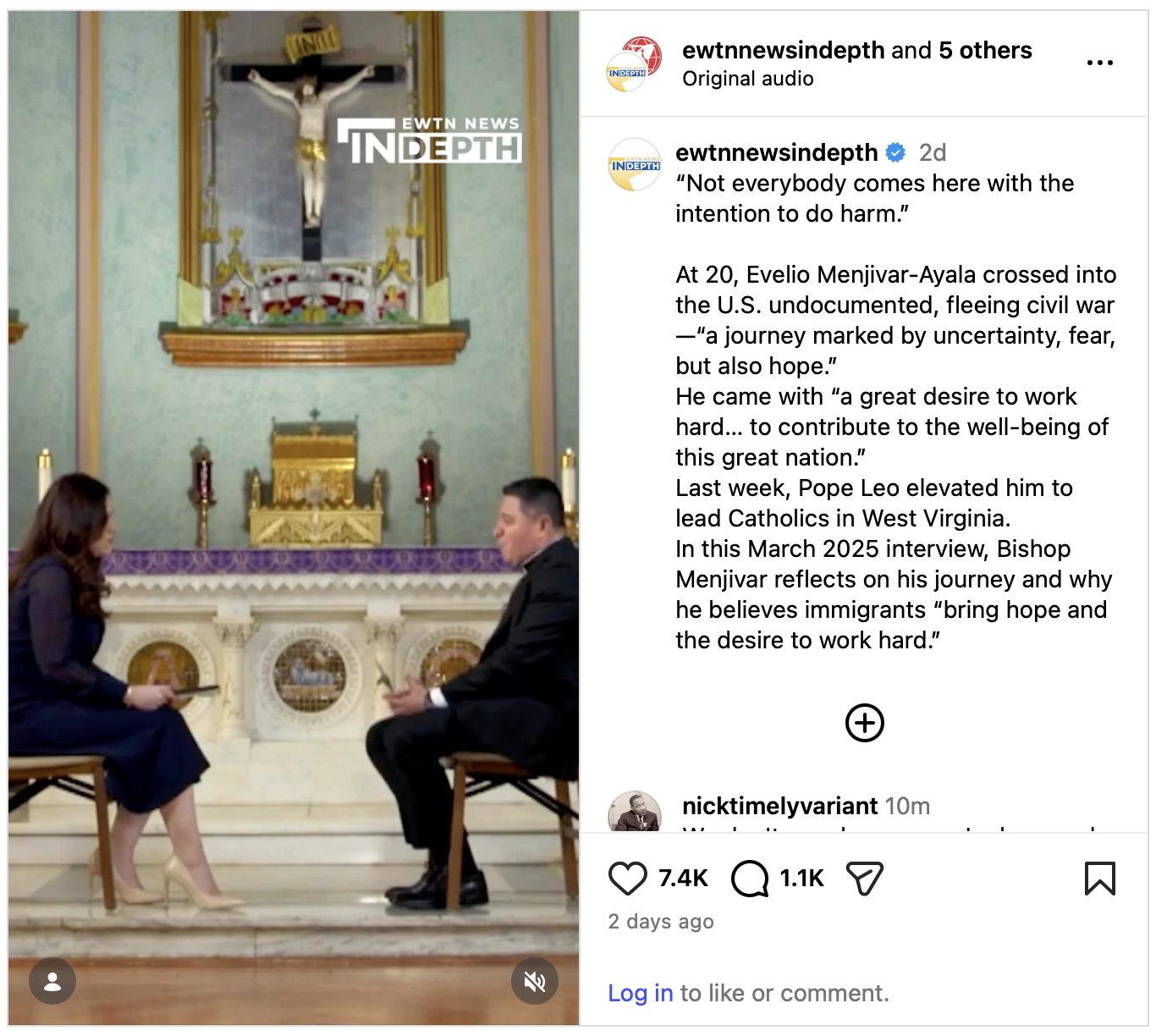
Menjivar-Ayala’s elevation to bishop of West Virginia is a continued affirmation of the pro-immigrant legacy established by the late Pope Francis and continued on under his successor’s term. In November, Pope Leo condemned the U.S. government’s mistreatment of immigrants, saying that “when people have lived good lives—many of them for 10, 15, 20 years—treating them in a way that is, to say the least, extremely disrespectful, and with instances of violence, is troubling.”
The remark, one of several pro-immigrant statements from the pontiff that fall, came after a rare, nearly-unanimous “Special Message” from the U.S. Conference of Catholic Bishops lamenting the “vilification” of immigrants.
“We are concerned about the conditions in detention centers and the lack of access to pastoral care,” bishops wrote. “We lament that some immigrants in the United States have arbitrarily lost their legal status. We are troubled by threats against the sanctity of houses of worship and the special nature of hospitals and schools. We are grieved when we meet parents who fear being detained when taking their children to school and when we try to console family members who have already been separated from their loved ones.”
“Leo, who has previously urged local bishops to take the lead on speaking out on matters of social justice, said he appreciated the U.S. bishops’ statement and urged Catholics and all people of goodwill to listen to what they said,” National Catholic Reporter noted.
In his April 2025 op-ed at the National Catholic Reporter, Menjivar-Ayala urged everyday people to rally their courage by noting the example of the late Óscar Romero, who served as auxiliary bishop of the Archdiocese of San Salvador until his assassination in March 1980. Commonly referred to as “‘bishop of the poor’ for his work defending the Salvadoran people,” Romero was murdered “after calling for international intervention to protect those being killed by government forces,” as U.S. Catholic notes.
“When I was growing up in El Salvador, there was a man who was not afraid to speak out,” Menjivar-Ayala wrote. “His name was Óscar Romero, archbishop of San Salvador. It seems to me that we need more Óscar Romeros today. We need everyone of good will to follow his lead and demand that the government respect human dignity.”
Menjivar-Ayala also issued a call to federal officers urging them to “reclaim your conscience. What you are doing is worth nothing if it is stained with unjust cruelty,” he continued. “That is not what America stands for. You too can and should speak out against this terror and infliction of suffering on people. You can refuse to be involved in oppression and these grievous assaults on human rights and dignity.”
Trump Is Breaking DACA’s Promise
Renewal delays, detention, and deportation: The administration is making clear that young immigrants can no longer rely on DACA for protection
The Trump administration has been hellbent on targeting immigrants who hold legal status and current protections – and not even the beneficiaries of one of the most popular immigration programs in recent U.S. history are being spared from this mass deportation agenda.
In an alarming new precedent, the Justice Department’s Board of Immigration Appeals (BIA) – the highest administrative body for interpreting and applying U.S. immigration laws – issued a decision that could make it easier for mass deportation agents to arrest, detain, and kick out DACA recipients despite holding long-standing protections that have allowed them to live and work in the only country that many have known as home.
“In an April 24 four-page decision, Chief Appellate Immigration Judge Garry D. Malphrus sided with federal attorneys and wrote that a previous immigration judge had ‘erred’ in terminating the removal proceedings of a person just because they were a DACA recipient,” Mission Local reports. “Though the case has been reassigned to a new immigration judge for review, it sets a precedent that DACA status is no longer enough to automatically protect immigrants within removal proceedings, which can lead to deportation.”
“To be clear: the BIA’s decision does not take away any protections that DACA provides right now,” and DACA remains in place for now for current and former beneficiaries, the National Immigration Law Center stressed. “However, if someone with DACA gets arrested and detained by immigration or other law enforcement and ends up before an immigration judge, the judge may now look into their case more closely to comply with the BIA decision.”
It is one of the most startling escalation points facing Dreamers since the first Trump administration’s attempt to end DACA outright in 2017. However, the Supreme Court narrowly ruled that officials had unlawfully terminated the program. Following Trump’s return to power last year, his brazen new tactic has been to just ignore DACA protections outright, deporting at least 86 beneficiaries and detaining another 261 others, according to figures shared by members of Congress.
In one case that sparked nationwide outrage, DACA recipient Maria de Jesus Estrada Juárez was detained and deported this past February despite following the rules by attending her green card appointment. The Sacramento mom — who had called the U.S. her home for more than two decades before her unjust deportation — won her return home the following month. But in continued evidence that this is a delegalization campaign deliberately seeking to make as many people as possible deportable, officials re-detained a second Dreamer who was permitted to return home to the U.S. following his deportation earlier this year, The Texas Tribune reports.
“U.S. Immigration and Customs Enforcement, or ICE, had agreed to let José Contreras Diaz, 30, return to Texas on Wednesday,” the report said. “Contreras thought he would reunite with his wife and infant son, but as he landed, ICE agents arrested him again and took him to Port Isabel Detention Center in South Texas.”
Contreras’ attorney, Stacy Tolchin, told The Texas Tribune that she’d cited Estrada Juárez’s case in her letter to the administration urging his return, noting the federal judge’s ruling that the mom had been deported in “flagrant violation” of her DACA protections. Contreras thought he was coming back home to his family and life. But it all appeared to be a ruse just to detain him indefinitely at South Texas’ Port Isabel Detention Center, which has been the site of reported abuses, including “grossly negligent” medical care, going back years.
“Why bring someone back on a charter flight and use a lot of resources just to detain him, again?” asked Tolchin. “He was so excited to come back and meet his baby, so for this to happen it’s just mind blowing.”
The administration’s delegalization campaign is also being carried out in quieter but no less destructive ways. “Renewal wait times for the Obama-era program that allows people who were brought to the U.S. as children to temporarily remain in the country and work have increased to levels not seen since 2016 when there were significant technical issues,” the AP reports. “Federal lawmakers and immigrant groups say some applicants recently have had to wait 6 months — about 183 days — or longer.”
These delays aren’t simply a matter of bureaucratic frustration, like experiencing a long line at the DMV. They’re intentionally destructive. The Heritage Foundation’s notorious Project 2025 proposed terminating the status of hundreds of thousands of DACA recipients “by eliminating staff time for reviewing and processing renewal applications,” as the Niskanen Center noted in 2024. Should protections lapse while applicants are waiting for their renewals, beneficiaries lose their deportation relief and work permits, which risks their livelihoods, hurts their families, and could have far-reaching repercussions in fields that are already facing worker shortages, such as health care.
The delays have already proven devastating for young immigrants like Elsa Sanchez and Maria Fernanda Madriga. Both are currently out of work due to the administration’s delays.
Sanchez submitted her renewal five months ago and is waiting for a decision on her renewal, the AP said. “When the deadline passed at the beginning of April, she was put on leave at her job at a healthcare IT company and now, as a single mother of a college freshman, has no income.” Madriga, who actually works as an immigration attorney, submitted her renewal paperwork about six weeks before her deadline, which she said was consistent with her past filings. But she also lost job when her deadline came and went.
Not only is she now dealing with the loss of her livelihood, as an immigration attorney, she worries about the added stress already facing her colleagues and clients. “My first concern was my cases,” she said, “because I knew I was going to have to hand off everything, and my team is already overworked.”
The administration’s agenda could not be more out of touch with American voters, who strongly support putting Dreamers on a pathway to legalization and allowing them to more fully contribute and keep their families together. Instead, Trump is breaking the promise that the federal government made to hundreds of thousands of young immigrants, which said that if they submitted their information, paid their fees, and followed the rules, they could live their lives with some ease.
“For over a decade, DACA has endured relentless, politically motivated attacks,” DACA recipient and United We Dream Deputy Director of Federal Advocacy Juliana Macedo do Nascimento told NPR. “This decision is yet another step in dismantling the program without the government taking responsibility for ending it outright. … This is a quiet rollback of protections, and our communities are paying the price in real time.”
Notable Americans To Have Benefited From Birthright Citizenship Include Trump Officials
Secretary of State Marco Rubio once defended the constitutional protections he’s now complicit in undermining
Last year, the Trump administration issued an executive order that purported to end birthright citizenship for the American-born children of certain non-citizen immigrants. While the order was ultimately blocked as unconstitutional by lower courts (and could now face a similar fate in the highest court in the land), it would have in part instructed the State Department to wrongfully block passports from these categories of U.S.-born children.
Ironically, the department’s top official is himself an American citizen thanks to the same 14th Amendment rights now under unprecedented attack by the administration.
Secretary of State Marco Rubio “is the son of Cuban immigrants who did not become naturalized U.S. citizens until 1975, years after their son was born,” USA Today reported last year. Rubio, a former champion of a pathway to citizenship, was actually a one-time critic of the kind of un-American policy he’s now condoning and that could result in potentially millions of stateless U.S.-born children. In fact, Reason reports that Rubio defended birthright citizenship in a legal motion seeking to dismiss a fringe challenge to his 2016 presidential bid that – you guessed it – claimed he wasn’t really a natural-born U.S. citizen due to his parentage.
Rubio isn’t the only prominent administration figure to have benefited from this protected right, either. Medicare and Medicaid Administrator Mehmet Oz, FBI Director Kash Patel, and Second Lady Usha Vance are all U.S. citizens thanks to birthright citizenship, the Stop AAPI Hate campaign notes.
Beloved public figures “would not have been American citizens when they were born if birthright had not existed,” USA Today further noted. Legendary martial arts icon Bruce Lee “was born in San Francisco while his parents were traveling with the Chinese Opera,” the report said.
“The National Archives notes that under birthright citizenship he was considered a citizen ‒ though he would not be under Trump’s revision to the law,” USA Today said. “Lee’s parents filed for a Return Certificate on his behalf … enabling him to return to the United States if he later wished to do so. Lee did return at the age of 18 and grew into the iconic martial artist and film star known across the world.”
Screen Actors Guild Award-winning actor and activist Diane Guerrero is also a U.S. citizen thanks to birthright citizenship. Guerrero, who portrayed Maritza in the hit Netflix show “Orange Is The New Black,” was born in New Jersey to undocumented immigrants from Colombia and has been an outspoken advocate for immigrant communities since publicly revealing the deportation of her parents and brother when she was just 14.
This is a country of immigrants, Guerrero said in 2019. “People forget – they like to forget that their ancestors came here with the same dream, with the same hopes, with the same fears. And it’s unfair to say that because people are coming later that they don’t deserve to be here, especially people seeking asylum.”
We should be thankful for them. Researchers with the Center for Migration Studies estimate that the beneficiaries of birthright citizenship will have contributed an estimated $7.7 trillion to the U.S. economy by 2074, “including a projected $1 trillion by future children not yet born and whose economic contribution would be most at risk under the implementation of the Trump administration’s executive order.”
“The cumulative economic losses that could occur if the right to U.S. citizenship by birth is eliminated are considerable,” researchers find, including a potential loss of up to 400,000 workers typically requiring some college education.
“As courts weigh the future of the Fourteenth Amendment, our estimates of the economic contributions of birthright citizenship beneficiaries provide essential information,” researchers continue. “Our analysis suggests that removing this birthright would have significant negative implications for the U.S. economy and its workforce.”
This fight around birthright citizenship is now at the Supreme Court, where justices have heard arguments in Trump v. Barbara, the case around the administration’s effort to terminate this guarantee. Outside the court, hundreds rallied in defense of our constitutional values, including a descendant of Wong Kim Ark, the San Francisco-born Chinese American cook whose historic Supreme Court battle more than 125 years ago affirmed the constitutional principle that everyone born here is American.
Norman Wong, Mr. Ark’s great-grandson, felt it was important to be outside the court to connect his ancestor’s fight to the struggles of today. His great-grandfather “knew he was an American,” Mr. Wong previously said. “And he demanded that his citizenship be recognized. He was willing to stand up. Wong Kim Ark didn’t make the rule. He affirmed the rule.”
In his remarks to the crowd, Sen. Alex Padilla (D-CA) said that if you want to know where to stand on birthright citizenship, all you have to do is look at what our Constitution says. “The 14th Amendment: All persons born or naturalized in the United States are citizens of the United States. If you’re born here, you are a citizen. It couldn’t be more clear,” he said.
“And yes, this is personal for me,” Sen. Padilla continued. “I’m a proud citizen of the United States. And I’m a proud son of immigrants. And the moment I was born on U.S. soil, I was born a citizen.”
Recognizing and Honoring Immigrant Contributions On May Day
“Immigrant workers are not just helping; they are essential to keeping this industry running”
May Day celebrates the achievements of workers and the labor movement – and that includes the millions of immigrants who help keep our country running year round.
We recognize and honor the HEALTH CARE WORKERS who keep our communities healthy. In hospital settings, 17% of clinical workers are immigrants, specializing in diagnosing and treating patients. “Among clinical occupations, immigrants represent a relatively high share of physicians working in hospitals (27%),” KFF said last year. “About one in five (19%) physicians are naturalized citizens and another 8% are noncitizen immigrants.
These professionals include the nearly 300,000 Black immigrants who work as physicians, registered nurses, and home health aides. Among Haitian immigrants alone, more than 100,000 work as healthcare workers. And as the U.S. continues to face a shortage in healthcare and other essential industries – the American Hospital Association projects a shortage of about 100,000 critical health care workers by 2028 – it’s immigrants who will be essential in bolstering this critical labor force.
We recognize and honor the CAREGIVERS who watch over our elderly and disabled loved ones, children, and others requiring regular assistance. “They are the quiet force holding our care system together, providing care, love, stability, and education,” the National Women’s Law Center said last year. “In 2019, 36.5% of all home health aides in the United States were immigrants, a rate that was twice their share of the U.S. workforce overall (17.1%),” the American Immigration Council said in 2023. “This includes undocumented workers, who made up an estimated 6.9% of home health aides and 4.4% of personal care aides.”
Gina Policard, a home health worker originally from Haiti, told Documented last year that she initially began her career as a way to pay the bills, but then fell in love with her work and her patients. “But I love the job because I love taking care of people the same way I do for my family,” she said.
We recognize and honor the EDUCATORS who work tirelessly to prepare our children for their future. This includes an estimated 15,000 teachers who are protected by DACA. “DACA-recipient teachers relate firsthand to the estimated 620,000 undocumented K-1 2 students, who confide in them about their experiences in immigrant families,” the 19th reported last year. “They show youth that regardless of legal status, it’s possible to attain one’s professional goals.”
Among these educators is Los Angeles Unified School District history teacher Angélica Reyes, who was brought to the U.S. when she was just an infant. “My immigration status inspires both my undocumented and documented students because they know all the obstacles that are faced by folks with my immigration status can be overcome,” she said. “They know that if I could do it, that’s something that they could do as well.”
We recognize and honor the FARMWORKERS who feed us rain or shine and are the backbone of the agricultural industry. Without their skilled labor, we simply wouldn’t be able to eat.
“Immigrant farmworkers make up an estimated 73% of agriculture workers in the United States,” with approximately half of this population lacking legal status, FWD.us said in 2022. “Farm labor is absolutely essential work that puts food on our tables across the country, powers the economy and supports our communities, from dairy farms in Wisconsin to strawberry fields in Florida and apple orchards in Washington. All together, food and agriculture sector is a $1.053 trillion industry.”
Despite their critical role in the lives of all Americans, many of these essential workers remain vulnerable due to poor working conditions, low wages, and, for those lacking legal status, the ongoing threat of mass detention and deportation. “Undocumented farm workers make up approximately 50% of the farm labor workforce,” FWD.us said. In California, various estimates put that number anywhere from 60% to as high as 75%.,
We recognize and honor the CONSTRUCTION WORKERS who are quite literally building our future through their essential labor. “Immigrants make up nearly 30% of the national construction workforce. In states like California and Texas, immigrant workers account for 40% or more of construction labor,” the American Business Immigration Coalition (ABIC) said last year. “The U.S. construction industry employs nearly 1.6 million undocumented immigrants, according to reports based on U.S. Census data and labor surveys.”
But, like farmworkers, these essential laborers carry out their work at great risk due to extreme weather and workplace hazards. All six victims of 2024’s Francis Scott Key Bridge collapse – Alejandro Hernandez Fuentes, Dorlian Ronial Castillo Cabrera, Carlos Daniel Hernández Estrella, Miguel Ángel Luna González, José Mynor López, and Maynor Yasir Suazo-Sandova – were Latin American immigrants who had called the Maryland area their new home.
We recognize and honor the HOSPITALITY WORKERS who are key to tourism and local economies all over the country. “Immigrant workers are not just helping; they are essential to keeping this industry running,” ABIC said, noting that one in three hotel and lodging workers is an immigrant. Immigrants are also leaders in this industry, owning 43% of motels and small hotels, 37% of restaurants, and one in three new hospitality businesses, the organization said.

We recognize and honor IMMIGRANT WORKERS EVERYWHERE, who through their vast financial contributions help sustain our public schools, libraries, fire departments, and essential federal programs like Social Security, Medicare, and unemployment insurance to the benefit of us all. These workers paid $651.9 billion in tax contributions in 2023, including $419.8 billion in federal tax contributions and $232.1 billion in local and state tax contributions.
This May Day, let’s remember that these workers and neighbors are not only an essential thread in the fabric of America, we simply wouldn’t be able to succeed without them.