
One Year of Abuse of Power Watch
We have said from the start that attacks on immigrants open the door to attacks on everyone’s fundamental rights. That prediction is now playing out across our screens all over the country
Immigration has never been easy. It has been part of our nation’s story since its founding, and we have struggled, generation after generation, to manage it well. Yet for decades, immigration was one of the few issues where leaders from the right and the left, business and labor, could sit at the same table and find common ground.
That era is over. For decades now, Congress — under Democratic and Republican control alike — has failed to meaningfully update our immigration laws. Instead of governing, both parties have used immigration as a political football, and the result is a system so dysfunctional that Americans have come to see it as unmanageable and intractable. That failure is costing us: our values, our economic interests, and ultimately our humanity.
The Trump administration has taken advantage of that dysfunction and weaponized it. And now we are facing not just a policy failure — but a daily barrage of chaos and cruelty of unimaginable proportions, carried out by our own government against our own people. As an American who believes in this country’s basic tenets, watching this administration pursue its mass deportation obsession with no regard for cost or consequence is more than unsettling. It is a betrayal of what we claim to stand for.
We knew the Trump and Stephen Miller agenda would be unforgiving. In 2024, Trump promised that mass deportation would be “a bloody story.” In his second term, he is living up to that promise, and that is why, one year ago, we launched Abuse of Power Watch, a real-time documentation hub built to expose the harms of mass deportation and government overreach. Still, the brutality, the lack of restraint and the complete disregard for our democratic norms shock the conscience. Renee Good, Alex Pretti, Lorenzo Salgado Araujo, and Johan Sebastián have become household names because of the sheer brutality and contempt Immigration and Customs Enforcement (ICE) has shown in each case. And here we are still waiting for a modicum of accountability.
Yet, for every case that draws attention, many more do not. The death toll from this deportation agenda keeps climbing, driven by a growing number of deaths inside detention centers. U.S. citizens and legal immigrants are now routinely racially profiled under deadly Kavanaugh stops and threatened with deportation regardless of their status. Families are being separated, leaving U.S. citizens and immigrant kids abandoned. Masked agents in unmarked cars, with no badges, are pulling people off the street from California to Minnesota to Virginia — a tactic that evokes death squads of Central America. And even documented immigrants are being stripped of their legal status. All of this in their effort to meet their goal of 1 million deportations.
The cruelty doesn’t stop there. Thousands of unaccompanied children are now at risk of losing access to legal representation, a change that would lead them into the pipeline to deportation by forcing them to appear in immigration court alone.
As we have seen over the last year and a half, the impacts of the abuse of power are not contained to immigrant communities alone. It is being felt by American citizens, American communities, and America’s children. At America’s Voice, we have said from the beginning that attacks on immigrants open the door to attacks on everyone’s fundamental rights. That prediction is now playing out across our screens all over the country.
Amidst this darkness, there is a ray of hope: Americans are rejecting these abuses. Recent polling shows 60 percent of Americans disapprove of how ICE is doing its job, and a majority — 54 percent — disapprove of Trump’s handling of immigration, his lowest net approval on the issue of his second term. And among Latino voters, the numbers are even starker: by a 65-30 margin, they say Trump’s actions on immigration are going too far. Communities are seeing the abuses and they’re repelled.
And it is in this gap between what this administration is doing and what our nation accepts where the work has to happen. As we witness these horrors day after day, we have to guard our hearts and minds against the normalization of cruelty and the tolerance of the intolerable. We have to use this moment to organize — while the country is still watching, still uneasy, still willing to say enough. We need to have the hard conversations, to struggle together with the inherent tensions of a very complex issue, and we have to bring others into our fold. Together, we must demand that our leaders chart a path forward that finally matches our stated values with a functional immigration system that is fair, controlled, and humane.
Catholic Nun Abducted By ICE Speaks Out: I Cannot Stay Quiet About What Is Also ‘Happening to Others’
Sister Letty did “everything the law has asked of her,” but she was still targeted. She worries about others facing this same crisis. Even Christians aren’t safe under Trump’s mass deportation agenda
The South Texas Catholic nun who was abducted by ICE last month said she feels she must speak out about her ongoing ordeal – the Trump administration is still seeking to deport her despite widespread backlash to her arrest – because there are too many others going through the same situation without the same kind of headlines that her outrageous case has received.
“There are many others in this same situation, people who have been given some form of protection under our laws, who have followed every rule asked of them, and who still live with uncertainty,” Sister Leticia “Letty” Ugboaja said in her first public remarks since her June 28 abduction. “While she’s grateful to those who helped her, she said, that ‘does not mean I can stay quiet about what happened to me, or about what is still happening to others,’” the AP reported.
Sister Letty, who belongs to the Daughters of Mary Mother of Mercy and also serves the Rio Grande Valley as a registered nurse, was on her way to Sunday Mass when ICE detained her despite the fact that an immigration judge had previously granted her protection due to fears of persecution in Nigeria. Sister Letty said that federal agents ignored her plea to at least allow her to attend Mass and even confiscated her rosary. She was left in a state of heartbreak and confusion.
“Honestly, in that moment, I did not understand what was going on, what was happening to me,” she said. NBC News footage of her release later that same day showed her visibly shaken while being reunited with Sister Norma Pimenel, a Catholic Charities leader.
“Ugboaja said she did not want to remain silent about her situation and wants people in similar situations to have the opportunity to tell their story before they’re taken from their homes,” The Texas Tribune reported. “I believe every person in this situation, like me, deserves to be heard, deserves to be listened to, deserves to be given attention and opportunity,” she said.
But rather than allow Sister Letty to continue being a valued member of her community, the administration is reportedly still seeking to deport her – and to a country that she doesn’t even know. Attorney Carlos Moctezuma Garcia said federal immigration officials indicated “they are pushing to have Ugboaja deported to a third country, not her native Nigeria,” Border Report said.
“Which is very concerning for us,” Moctezuma Garcia told the outlet. “That is obviously not what we want.”
“The Trump administration’s third-country removal policy has been criticized by lawyers and human rights groups and has faced legal challenges,” the AP noted. “The Department of Homeland Security has said the agreements allow people seeking asylum in the U.S. to pursue protection in the other country, and that the agreements are used to try to address large backlogs in immigration courts.”
But Sister Letty already has protection – here in the United States. While an immigration judge denied her asylum application in 2019, she was granted “protection from removal to Nigeria, concluding that ‘she had met the high legal standard required to show it was more likely than not that she would face torture if returned there,’” USA Today reported.
Since then, she’s done “everything the law has asked of her,” Garcia said, including keeping her work permit current and going to all of her appointments.
The targeting of Sister Letty isn’t about the rule of law of making our outdated immigration system fairer – it’s about stripping legal protections from as many people as possible in order to kick them out, no matter how long they’ve lived here, no matter their family ties, no matter their place in their communities. Nor is the targeting of Sister Letty some sort of oversight or paperwork error. Just days ago, another two Rio Grande Valley faith leaders were also detained by ICE.
Religion News Service reports that Pastor Nepthali Zozaya Saucedo and Cinthia Sarai Cardona Otero, who are married, were arrested while traveling to a marriage retreat in North Carolina led by the Billy Graham Evangelistic Association. While a Latino Christian National Network board member said that the Assemblies of God pastors came to the U.S. legally and hold valid R-1 religious worker visas, ICE detained the couple and reportedly threatened them with prolonged family separation in order to pressure them into signing documents agreeing to self-deport.
Cardona Otero “described in detail the repeated attempts that she alleged immigration agents made to coerce them into signing papers: that they would be deported separately to different third countries, not their home in Mexico; that they could not make calls without signing the papers; and that they would face up to six months of incarceration without their sons,” Christianity Today reported.
The couple was finally released two days after their detention. They attended service that Sunday, where, like Sister Letty, Zozaya Saucedo made a tearful plea for immigrants still languishing in detention and separated from their families.
“As the body of Christ, we can intercede, and not just for our family and friends,” he said, “but also for people we maybe haven’t even seen, but who also endure pain, who also suffer injustice, who are also fighting to see the light of the sun again and have dignified food for themselves, a space to sleep and a space to be, and above all, a space to be reunited with their families.”
Alarming Report: Dozens of Mass Deportation Agents Charged With or Convicted of Physical and Sexual Assault of Women and Children
After noticing “disturbing” allegations against Cincinnati ICE agents, the Ohio Immigrant Alliance began its investigation. “What we found deeply alarmed us,” the group said
The racist and violent history of the ICE agent that took the life of Maine dad Johan Sebastián is disturbing – and “not unusual,” according to a devastating report from an Ohio-based immigrant rights advocacy organization that examined the criminal background of nearly 60 mass deportation officers going back two decades to the present day.
“After noticing a disturbing trend of Cincinnati ICE agents committing sexual or violent offenses against women, the Ohio Immigrant Alliance began looking deeper into the criminal backgrounds of other agents. What we found deeply alarmed us,” the organization said in the report. It found that of the 59 agents identified by Ohio Immigrant Alliance, 85% percent had been charged with or convicted of sex offenses, with nearly two-thirds targeting children.
“Of the 59 individuals, 50 (84.7%) have been charged with or convicted of sex offenses, and 37 (62.7%) committed crimes targeting children. Taken together, 35 individuals (59.3%) committed sex offenses against children — the single largest category on the list,” the report said. Mass deportation agents employed by both Immigration and Customs Enforcement (ICE) and Customs and Border Protection (CBP) commonly abused their authority in order “to commit, conceal, or contribute to their crimes,” the report continued.
‘THE MAN HUNTING PREDATORS WAS ONE HIMSELF’
Beginning in late 2024, “Ramon Marquez, a CBP agent in Arizona, exploited his role overseeing the Border Patrol Explorer Program — a youth activity — to sexually abuse a minor participant. Investigators found that incidents occurred at his home, Explorer activities, out-of-town trips, and even Border Patrol facilities. He had also inappropriately texted another child in the program.”
The abuses stretch back years. In 2005, ICE official Frank Figueroa “was caught on video exposing himself to a 16-year-old girl at a mall food court,” the report continued. “The bitter irony: Figueroa was formerly in charge of Operation Predator, the ICE program that deported individuals convicted of sex crimes. The man hunting predators was one himself.” Figueroa was ultimately slapped on the wrist and allowed to retire with his full pension.
VIOLENT BEHAVIOR SHOULD BE A DEALBREAKER
While the administration has been haphazardly recruiting an army of unqualified agents to carry out its mass deportation obsessions – the reported agent who killed Johan Sebastián was hired just last year – the report reveals that it’s not only a matter of unvetted hires, but also a toxic work culture where predatory, violent behavior is apparently not a dealbreaker. Many of the agents detailed in the report “remained employed for decades at ICE or the Border Patrol despite red flags.”
“Dana Ray Thornhill was first arrested for sexual assault of a child at the age of 13 and served time in the Arizona Department of Juvenile Corrections.” But that history did not preclude him from being hired by the federal government. “Despite this, he was hired by the Border Patrol and worked there for nearly 20 years before being caught again for child molestation and sexual exploitation of minors.”
‘NO WAY’ THAT ICE DIDN’T KNOW IT HAD A SERIAL ABUSER IN ITS RANKS
In another notable case that has been in the headlines throughout the past months, local police were called to the home of 20-year ICE veteran Samuel Saxon nearly two dozen times due to domestic violence incidents in the 18 months prior to his 2025 arrest and indictments, the report said.
Throughout that time, he had strangled his partner “several times and broken her nose and her pelvis, an injury that required surgery.” During the final time that police were called to the couple’s home, the arriving officers “saw bruises on the woman’s chest that are consistent with being forcibly grabbed by the chest and neck,” WCPO reported last year. They were called when a neighbor witnessed Saxon grabbing a woman by her neck and dragging her into an apartment.
There’s simply “no way” that ICE leadership didn’t know it had a serial abuser in its ranks, said Ohio Immigrant Alliance Executive Director Lynn Tramonte.
“His victim had broken bones that required surgery,” Tramonte said. “The police came to his home 23 times in less than a year and a half. He had a DUI. One of his bosses even called the police to do a welfare check when he didn’t show up for work, and they found him holding a knife. His supervisor admitted he was a ‘loose cannon.’ This went on for years, ICE knew about it, and they kept promoting Saxon instead of firing him. That’s not how a law enforcement agency should operate.”
In April, Saxon also pleaded guilty to lying to the DHS watchdog in relation to the domestic abuse charges. That should come at no shock, considering how often agents have lied and said that victims like Renee Good and Lorenzo Salgado Araujo weaponized their cars against them, only to have those claims totally fall apart.
IT’S NOT JUST ICE
And while ICE frequently occupies the news headlines due to its horrific public displays of bloody violence within our communities, CBP accounts for nearly three-quarters of all cases in the report. “Both agencies show high rates of sex offenses (CBP: 86%, ICE: 81%), but ICE cases are more likely to involve underage victims — 69% of ICE cases involve children, compared to 62% for CBP.”
Previous research from the Southern Border Communities Coalition has found what it calls a “culture of abuse” at CBP. “In 2019, researchers estimated that CBP officers are 5 times more likely to be arrested than local and state law enforcement personnel,” Southern Border Communities Coalition noted. “CBP personel have been arrested for corruption, sexual assault, aggravated assault, domestic violence, and sex crimes against children.”
CONTINUED DEATHS HIGHLIGHT URGENT NEED FOR ACCOUNTABILITY
These reports should remain top of mind as outraged Americans continue to demand justice and accountability following four immigration-related deaths in the span of just one week this month. One of the four victims, Jesús Manuel Arenas-Silva, died on the same day as Johan Sebastián after suffering a fatal cardiac event while being transferred between camps in Georgia.
This deadly crisis of people dying under our immigration system is systemic. Just this week, a court-appointed doctor issued a searing review of “nightmarish” medical failures at a detention facility in California.
“The exponential growth of deaths in so-called ‘civil’ immigration jail, and the opening up of a new killing field — the deaths of civilians on U.S. streets — is directly related to the factors we outline in our report,” Tramonte continued in a statement received by America’s Voice. “ICE and border agents should never be given guns and free rein to roam U.S. communities. Their job is to enforce civil laws, but they act like they live in the wild west, killing people in our streets. Congress has to stop writing blank checks to these agencies and start enforcing order and accountability.”
Mass Deportation Of Healthcare Workers Will Devastate Families, Home Health And Eldercare
A special thanks to Donald Trump, Congressional allies for abandoning your loved ones needing special care. More than 350,000 immigrants’ legal status is set to expire today
The Supreme Court’s June 25 ruling allowing the Trump administration to terminate TPS for Haiti and Syria is set to upend the lives of hundreds of thousands of our immigrant neighbors – and the many sick and elderly Americans who depend on them to survive.
Experts say that stripping legal work status from hundreds of thousands of healthcare workers and “deporting Haitian TPS recipients will have a catastrophic impact on the nationwide healthcare workforce crisis — a workforce that is hugely dependent on immigrant labor,” as NPR noted following the court’s unjustdecision. Approximately 103,000 Haitian immigrants in particular work as health and home care workers across the country, and emergency rooms, senior care facilities, and patients will be left facing a crisis when work authorization for these skilled and dedicated essential workers expires today, July 27.
The fallout from this healthcare disaster was completely avoidable. The Trump administration could have chosen a different path but instead created a self-inflicted crisis that will be particularly felt in Florida. Half of the nation’s 350,000 Haitian TPS holders live in the state, and roughly 35,000 of these community members, such as Nina, work as nurses or home health aides, Mother Jones reports.
‘JEOPARDIZE ACCESS TO CARE’ ACROSS THE COUNTRY
The certified nursing assistant, who has lived in the U.S. since an earthquake devastated Haiti in 2010, recalled that during the worst of the pandemic, “when visits from family and friends were cancelled, she held the hands of patients on their deathbeds,” the report said. “Sometimes you get people who don’t have family or friends,” Nina said. “We are their family.”
FHCA, Florida’s largest nursing home association representing nearly 700 facilities, noted in a letter to the administration that the loss of these essential workers has the “potential to destabilize an already fragile long term care workforce and jeopardize access to care for countless nursing home and assisted living residents,” both in Florida and across the U.S. The letter urges officials to consider eldercare shortages and “allow affected individuals to pursue available lawful immigration pathways without abrupt interruption of employment.”
Unfortunately, immigrants with legal status and their employers have already been experiencing an interruption of employment due to administration policy. In California, Channing House has already lost DACA-protected workers due to intentional processing delays. Now the facility is also facing the loss of workers who hold TPS, The New York Times reports.
TOTAL DISBELIEF; ILLOGICAL ACTION
“Many residents expressed disbelief and outrage at the possibility that their caregivers, immigrants who have lived in the United States for the better part of their lives, could soon be forced to leave,” the report said. Lou Thompson, who lives at Channing House with his wife, Alice, is one of them. “What can be done, and who are we going to ask to do it?” he asked.
There’s simply no logic in rounding up and deporting a dedicated worker like Gloria Castellanos, a TPS holder who serves as director of dining at Channing House. With two decades of experience at the senior living facility under her belt, she knows every resident’s dietary requirements off the top of her head. That kind of knowledge and compassion simply can’t be replaced tomorrow.
“I just want the opportunity to keep working,” she told The New York Times. “If one of these days you don’t see me, you’ll know what happened.”
Her fears are not unfounded. ICE is reportedly set to ramp up abductions in areas including Springfield, Ohio, and U.S. officials have already told the Haitian government to expect multiple deportation flights carrying hundreds of delegalized Haitian contributors every single week once their protections have been fully revoked, The Haitian Times reports.
“The U.S. Embassy informed us that there will be weekly deportation flights carrying a total of 250 or more Haitian migrants back to the country,” Jean Négot Bonheur Delva, director general of Haiti’s National Office of Migration, told the outlet. “At that pace, he said, Haiti could receive roughly 1,000 deportees every month from the U.S.,” the report noted.
Many of those who risk being sent to certain violence by the U.S. could be its own citizens – 50,000 American citizen children have at least one parent who is a Haitian TPS holder. We know from our recent history that not even American children stricken with cancer have been safe from being deported from their own country.
Other Haitian contributors, including a nurse in Kentucky, “are making preparations to leave their children, who are U.S. citizens, behind if they are sent away,” Spectrum News reports. The nurse “said she’s trying to focus on her work taking care of disabled people. But it’s hard to not think of the worst-case scenario, imagining being separated from her children, who are ages 13, 12, 8, and 2, and being sent to her home country that she left more than two decades ago. She reads in the news that there are gang wars, kidnappings, killings.”
CONGRESSIONAL HYPOCRITES HAVE TO ANSWER FOR THEIR ACTIONS
Healthcare workers will be at heightened risk in areas like Miami, which in recent months has seen more ICE abductions than any other area of the country. “Here at home in South Florida, Haitian TPS holders are part of the backbone of our workforce, especially in critical sectors like healthcare,” saidRepublican Rep. María Elvira Salazar, who represents a part of the area in Congress. “This is not theoretical for us. When people cannot safely return, Congress has a responsibility to act.”
But that call to her colleagues falls empty when looking at the record. This past summer, Salazar voted to hand Donald Trump and Stephen Miller’s mass deportation agenda another $70 billion in funding, with no strings attached. TPS holders were already being unjustly detained. Should they lose this status entirely, they will be entirely vulnerable under a mass deportation agenda reinvigorated thanks to a critical vote from Salazar.
Hundreds of thousands of long-settled immigrants – and the Americans who depend on them – will now be paying the price of that vote.
“People who run nursing homes, chronic care hospitals and home care agencies, they are all saying this is a crisis,” Dr. Steffie Woolhandler, a distinguished professor of public health at City University of New York’s Hunter College, told The 19th. “There has long been a shortage of folks who are willing to do direct care work as nursing aides, and there’s still a shortage now, so of course if the U.S. deports them all it’s just going to make it worse.”
They Got Everything They Wanted
Trump and Miller have accomplished everything they promised on immigration. Ask yourself one question: is your life any better?
This is a guest post by Matt Hildreth, Executive Director of Rural Organizing.
Last week in Biddeford, Maine, a 25-year-old father named Johan Sebastián left his house to go to work. He had a work permit. He had a Social Security number. He had a three-year-old kid in his vehicle.
An ICE agent shot him dead in the street.
Johan Sebastián wasn’t even the person ICE was looking for. Homeland Security Secretary Markwayne Mullin admitted as much to U.S. Senator Angus King (I-ME). The agents were staking out an address to serve a deportation order on someone else, and when Johan Sebastián drove away from his own home, they blocked his car and opened fire. A neighbor who watched it happen said he heard Johan Sebastián say, “I tried to stop.”
The agents weren’t wearing body cameras. The administration’s own budget request for ICE this year cut programs that would’ve increased transparency, while adding money for nearly everything else.
Biddeford is a town of 22,000 people. It’s the kind of place where the sound of gunfire on a summer morning brings neighbors out onto their porches. By that evening, hundreds of people were standing in Biddeford’s Mechanic Park while another vigil was underway in Portland’s Monument Square with Mainers holding flowers and candles for a man most of them had never met.
Six days earlier, ICE agents in Houston shot and killed Lorenzo Salgado Araujo, a 52-year-old construction business owner who had lived in this country for more than 30 years. He had no criminal record. He had applied for residency. He was driving his crew to a job site when unmarked vehicles started chasing him. His brother says it took 20 to 30 minutes for an ambulance to arrive.
And the hardest thing for most Americans to accept is that these killings are not outliers or fringe examples of the system breaking down. For Donald Trump, Stephen Miller, and MAGA Republicans, this is exactly how their immigration system is designed to work.
In May 2025, Stephen Miller and then-Homeland Security Secretary Kristi Noem called ICE leadership into a meeting and demanded 3,000 arrests a day, triple what agents had been making. Miller said the number aloud on Fox News and later told CNN the quotas were “a floor, not a ceiling.”
There was a problem with that number. There are not 3,000 violent criminals a day to arrest, and there never were. So Miller directed ICE to stop focusing on people with criminal convictions and start staking out work sites, Home Depots, and city streets. Senior ICE officials emailed officers telling them to“turn the creative knob up to 11” and encouraged them to grab “collaterals,” meaning anyone they happen to encounter while looking for somebody else. A former ICE official summed up the new directive plainly: quantity over quality.
Johan Sebastián and Lorenzo Salgado Araujo are the people ICE is targeting with their quotas. A construction worker driving his crew to a job site is exactly who you catch when you stop hunting criminals and start staking out work vehicles in order to get your numbers up. Johan Sebastián was a “collateral.” He wasn’t the target. He was the man who drove away from an address agents were watching, and under the quota system, that was enough to end his life.
In other words, the system is operating exactly as it was designed. After the murder of Johan, Maine Senator Susan Collins (R), who voted to give ICE and CBP an additional $70 billion, issued a statement claiming she had convinced Secretary Mullin “cease all non-urgent vehicle stops.” She then took credit, “I am encouraged that the Department has agreed to do so.” Semafor touted this as a “show of clout” by Collins.
That “clout” lasted less than a day because Trump blasted the idea in a Truth Social rant, claiming that “We CANNOT give up one of ICE’s most important & effective Crime Fighting tools, THE TRAFFIC STOP! Once we do, we are playing right into the criminal’s hands. The Radical Left Dumocrats would like to see this done, but it won’t happen on my watch. ICE…go back and do your very important job.”
Trump and Miller call the shots on immigration policy from the White House. They have gotten everything they wanted from Republicans in Congress. Every dollar. Every policy. Every authority. They wanted mass deportation, and they’re doing it. They wanted the border sealed, and they sealed it.
The White House brags that more than 605,000 people have been deported and that 2.5 million people have left the country in total. The United States had negative net migration in 2025, the first time that has happened in at least half a century. Detention hit a record 71,000 people in January. CBP has awarded contracts for 587 miles of new border wall.
DHS just announced thirteen straight months of zero releases at the border. Southwest border apprehensions are 94 percent below the Biden-era average, the lowest levels in more than three decades. This fiscal year opened with the fewest border encounters ever recorded.
And follow where the money went. Congress has handed DHS roughly a quarter trillion dollars for this project since last summer, more than the budgets of the FBI, the DEA, and the U.S. Marshals combined. That money is not sitting in a vault. It is flowing to private detention corporations converting warehouses into camps, to contractors building 587 miles of wall, and to county jails renting beds to ICE for per-diem revenue. Miller’s quota is not just a policy. It is a business model. Every arrest fills a billable bed, and somebody’s quarterly earnings call depends on keeping those beds full. This is the oldest trick in American politics: they want you afraid of your immigrant neighbor so you never ask who is cashing the check.
For ten years, Trump and MAGA Republicans promised that if they ever got to run immigration their way, with no judges getting in their way, no Congress holding back the money, no bureaucrats slowing them down, life would improve for the American people. And now that they’re running the entire show, only 14% of Americans say the economy is getting better.
The most extreme enforcement regime in modern American history is fully in place. America is no safer, and Americans are still struggling.
MAGANOMICS HAS FAILED BECAUSE ECONOMIC GROWTH IS BASED ON ADDITION, NOT SUBSTRACTION
In 2017, then-OMB Director Mick Mulvaney said that “MAGAnomics” would grow the US economy by three percent year after year. The theory was that tax cuts, deregulation, tariffs, and immigration restrictions would rebuild American prosperity from inside Trump’s border wall.
Nine years later, the number tells the story. Under Trump, economic growth peaked at 2.9 percent in 2018 and never reached 3 percent. It ran 2.8 percent in 2024, fell to 2.1 percent in 2025, and nearly stalled out at the end of last year. By the yardstick its own architects set, MAGAnomics has failed every single year it has been tried.
CNN’s Harry Enten added up the MAGAnomics bill for American families recently. Tariffs have cost Americans $231 billion. The war with Iran cost another $134 billion. The collapse in international tourism cost $8.4 billion more. Altogether, that is $373 billion since Trump took office, about $2,784 per household. Enten put that number in terms any family can measure: three to four months of food. And his estimate doesn’t even factor in the lost revenue from workers being deported or removed by Trump’s immigration agenda.
ENTEN: “I’VE RUN THE NUMBERS. HERE’S HOW MUCH TRUMP HAS COST AMERICA (SO FAR)”
The fact is, you cannot promise growth while removing the people who produce it. Mass deportation was always a key tenet of MAGAnomics. Trump and his team sold immigration restriction as a labor policy, the idea that fewer workers would mean higher wages for the rest of us. But an economy is not a fixed pie with too many forks in it. Workers are also consumers, taxpayers, business owners, and neighbors. When you deport the meatpacker, you don’t just lose the meatpacker. You lose the rent he paid, the groceries he bought, the school his kids kept open. Rural counties know this better than anyone, because we are the places where one closed plant or one lost family shows up in the school enrollment numbers the next fall.
MAGAnomics promised prosperity through subtraction. MAGA math said that fewer imports, fewer workers, and fewer neighbors would equal more money in the pockets of the American worker.
In small towns and rural communities, we know that bigger paychecks come from addition, not subtraction. We understand that our towns that are growing are growing because people moved in, including immigrants who came to work in the packing plants, the dairies, the orchards, and the nursing homes, who opened restaurants on main streets that had been dark for years, who enrolled their kids in schools that were one consolidation vote away from closing.
Most Rural Americans, like me, believe broad-based prosperity, strong labor unions, and a robust social safety net create a more stable, more productive, and more resilient society. We know that when our neighbor has a good year, the entire community benefits.
For the last several years, Trump and Miller have gotten everything they wanted. Every dollar, every policy, every quota. And what did it add up to?
The worst Rural Economy in a generation.
Is DHS Spending $1.5 Billion To Avoid Oversight In California? It Sure Seems Like It
Now that DHS owns two detention camps formerly belonging to private prison profiteer CoreCivic, “finding out what’s going on inside of them is likely to become harder”
The federal government is paying a private prison profiteer more than a billion dollars in taxpayer funds as part of a likely scheme to evade accountability for its in-detention abuses. CoreCivic announced earlier this month that it finalized the sale of two California facilities to the Trump administration for a whopping $1.5 billion, including $739.2 million for the Otay Mesa Detention Center in San Diego and $732.6 million for the California City Detention Facility in California City. The sale is estimated to net CoreCivic $1.1 billion, the private prison profiteer boasted.
A MOVE TO SHIELD PRISON FROM STATE OVERSIGHT
The administration has already paid roughly that same amount to buy up nearly a dozen warehouses to serve as mass detention camps (some of that plan appears to be on hold – for now). However, the recent purchases in California appear to be “a move that may serve to shield the facilities from state oversight,” Mother Jones says. “California law requires that privately held detention centers be subject to oversight by local and state authorities, as well as members of Congress. Now that DHS owns the buildings, finding out what’s going on inside of them is likely to become harder.”
THERE IS PLENTY TO HIDE
And, there’s plenty that ICE likely wants to hide from Americans who are newly outraged over the recent ICE-related deaths of immigrant dads Lorenzo Salgado Araujo and Johan Sebastián. In recent years, immigrants at both the Otay Mesa Detention Center and the California City Detention Facility have staged hunger strikes to protest inhumane conditions, including prolonged detention and medical neglect that has resulted in entirely preventable deaths.
When a Cameroonian immigrant collapsed at Otay Mesa in 2019, it took the facility nearly an hour to get him emergency care. By the time EMS arrived, it was too late.
“After staff discovered that Nebane Abienwi had suffered a stroke at the Otay Mesa Detention Center, it took 50 more minutes for emergency medical services to arrive and provide the required higher-level care, because the on-call medical provider at the detention facility did not respond to a nurse’s request for authorization to call an ambulance,” American Civil Liberties Union, American Oversight, and Physicians for Human Rights said in a 2024 report. While Mr. Abienwi had informed staff that he’d recently been hospitalized for hypertension, Otay Mesa’s medical staff didn’t monitor him for high blood pressure.
“This delay in EMS services and a higher level of care may have changed the outcome for Mr. Abienwi,” a physician said in the report.
“Men with diabetes or psychiatric conditions who arrived late last month complained they couldn’t get their medication,” The Los Angeles Times reportedlast year about the California City Detention Facility, a former state prison that was reopened as an immigration detention by the administration last year. “One man at the detention center, open barely a month, tried to kill himself, officials said.” Other detained individuals have reported being stripped of dignity and price-gouged by the multi-billion-dollar corporation (CoreCivic reported $2.6 billion in total revenue in 2025) for the most basic needs, like sanitary napkins.
CHANGE IN OWNERSHIP IS A CALCULATED SCHEME
ICE’s purchases of the two facilities won’t appear to make any discernible difference for the quality of life for individuals currently detained there: CoreCivic says in a release that it “expects to continue to manage the California City Facility and the Otay Mesa Facility” under current ICE contracts. So why the sale?
Well, sometimes the correct answer is the most obvious one. The change in ownership from CoreCivic to the federal government could “protect the detention centers from legal attacks,” Mother Jones said. “As Katya Schwenk of The Lever put it in March, when the plans were first reported, federal ownership may help ICE evade not only state monitoring but ‘some lawsuits tied to alleged abuse, including labor violations.’”
“California created oversight for private detention facilities because we have seen too many abuses, including deaths, behind closed doors,” said state Sen. María Elena Durazo, who has authored legislation ensuring state oversight. “It is shameful for any government agency to try to sidestep basic health and safety protections for people in its custody. If the federal government believes that purchasing these facilities allows it to avoid oversight, that is unacceptable.”
THE DEATH TOLL MOUNTS
This effort comes as federal immigration officials have acknowledged yet another in-custody death. “Jesús Manuel Arenas-Silva, a 45-year-old man from Venezuela, died in ICE custody on July 13, 2026, during a transfer out of the Irwin County Detention Center in Ocilla, Georgia,” writes Austin Kocher, a professor at Syracuse University. He’d been detained for just four days when he became the at least 50th person to die in federal immigration custody since the start of the Trump administration.
Kocher writes that Folkston D. Ray ICE Processing Center, the detention camp that Mr. Arenas-Silva was being transferred to, “has a record of its own.”
“In April 2024, under the Biden administration, Jaspal Singh, a 57-year-old man from India, died at the Folkston ICE Processing Center after a doctor delayed treatment for his chest pain,” he continues. “ICE’s own review of his death found that the facility’s medical care ‘deviated beyond safe limits and directly contributed to his death.’” The problems are systemic – and are being exploited under the mass deportation obsessions of the current administration. Rather than reining in these abuses, it’s also gutting oversight and is imprisoning immigrants on “a scale of mass detention not seen since the mass incarceration of Japanese Americans and nationals during World War II,” NPR noted in March. Meanwhile, the ICE death count continues.
Hundreds Of Thousands of Immigrant Children Are Facing Immigration Court By Themselves
“I was nervous because it was my first time going to a court,” said one boy. The federal government is seeking to deport him to a country he doesn’t even know
Kids deserve to be protected at all times, no matter their legal immigration status. Two recent analyses of federal data reveal that hundreds of thousands of children – including many kids who arrived in the U.S. without their parents or legal guardians – are currently facing immigration court alone. “Of 751,861 children with pending removal cases, 57%—or 425,093 children—lacked legal representation,” the Vera Institute of Justice and Drop Site News said.
One child who has been forced to appear in deportation court alone is ten-year-old Wilfredo. Despite the fact that he arrived with his mom and both have pending asylum cases, he’s been separated from her since last year, after she was detained during a routine traffic stop. With no other family here in the U.S., he’s being watched by his mom’s former boss while he faces deportation court alone, the report said.
““I was nervous because it was my first time going to a court,’ Wilfredo told Univision after his hearing. The DHS is seeking to deport him to Ecuador, a country where he knows no one and has never been.”
Unlike individuals in the criminal court system, immigrants facing deportation court have no right to a government-appointed attorney. This even extends to vulnerable children, who are going to court without an attorney at a higher rate than adults, Vera Institute of Justice and Drop Site News said. 57% of immigrant children currently in the court system lack legal representation, a rate “slightly higher than that of adults, 54% of whom are unrepresented in immigration court in pending cases.”
This should shock the conscience. The fact is that when individuals in immigration court have legal help, they fare better at every stage of the court process. Facing this process alone “is extremely difficult for adults, especially those who may have trauma histories or are unfamiliar with the English language, and all but impossible for children,” Vera previously said.
This also isn’t new: children have been rushed through deportation court without legal help across administrations. What is new is that under the mass deportation obsessions of the current administration, these vulnerable children are being “detained and removed at about three times the rate they were during the last time President Donald Trump was in office,” ProPublica reports.
“In addition, a ProPublica analysis of court data found that immigration judges, who report to the Justice Department, have issued more than 10,000 removal and voluntary departure orders each month for immigrant minors who either migrated alone or with relatives, a rate that is nearly four times higher than in Trump’s last term,” the report continues. “The vast majority of unaccompanied minors removed last year had no criminal history in the United States, ProPublica’s analysis of ICE data showed.”
In Seattle, federal immigration officials are looking to speed up these deportations by ordering hundreds of children to appear at mass immigration hearings, KUOW reported July 9.
“Seattle’s immigration court is packed with kids this week,” the report said. “Minors used to only have their hearings on Fridays, attorneys say — but starting Tuesday, the federal government embarked on what it says is a new way to process a backlog of cases. All these cases used to take months or years to process. Now they’re being moved up, sped up, and packed in on more days — in what are called ‘mega master’ hearings. These expanded hearings have already been taking place for adults over the past weeks and have now started for children.”
And while many are unaccompanied minors – again, children who arrived in the U.S. on their own – some have appeared in court with parents or guardians, the report said.
“The system is not a child-friendly system,” Kids in Need of Defense (KIND) managing attorney Hillary Larsen told KUOW. “It’s virtually impossible to go through the system having the child represent themself.” Yet children are intentionally being forced to navigate this system alone, as Vera Institute of Justice and Drop Site News noted.
“In February 2025, the Trump administration issued a ‘stop-work’ order to legal service providers such as KIND that are funded by the Department of Health and Human Services. That order disrupted support for nearly 26,000 children before it was rescinded three days later,” the report said. But just weeks later, the administration “abruptly terminated” federal grants that funded legal help for these kids. While a federal court said legal groups needed to get paid, KIND says it’s still owed $25 million.
“KIND, which relied on federal funding to cover 68% of its budget to represent more than 4,000 unaccompanied children, has reduced its staff to work within a strained budget. The organization is currently operating under these three month increments,” the report continued. In Texas, one report noted how a child walked into immigration court “with a stuffed lion”:
Under the administration’s war on children, federal immigration data has also revealed that officials have detained at least 500 infants and toddlers since last year, finding that children have been detained in what parents have described as “substandard conditions” that have left youngsters “sick, isolated and regressing in their physical and intellectual development.”
These attacks on children also extend far beyond those in detention. “Families in Tennessee with critically ill or severely disabled children who are undocumented are being asked to make a difficult choice: leave the state program that pays for lifesaving medication and treatment or stay and have their child reported to immigration authorities,” The Washington Post reported. Hundreds of families in the state have received a letter instructing them to either leave the program or face being reported. But as the Tennessee Outlook noted, there is no other safety net alternative in the state available to these children.
“This is life and death for very, very many of these kids,” Tennessee Justice Center Executive Director Michele Johnson told The Washington Post.
“I will not let him die. I will knock on doors, search for people, it doesn’t matter who I have to ask, who I have to talk to or wherever I have to travel. I will do anything,” one mom was forced to withdraw her 10-year-old son from the program told The Washington Post. “Please tell people that my husband pays taxes,” she continued to the Tennessee Outlook. “We are not trying to take anything from other people. We are just trying to help our son, as any parent would.”
As Communities Mourn Houston Dad, ICE Kills Again In Maine
No one is safe: ICE kills another father on his way to work. How many more?
The mourning and outpouring of support for Lorenzo Salgado Araujo continued through the weekend with neighbors and communities coming together to rally in California, Colorado, Oregon, Washington, D.C., and across Texas. Then ICE took another life on Monday, this time in Biddeford, Maine.
While developments continue, what is known is that mass deportation agents fatally shot a 25-year-old father who “was authorized to work in the United States and had been issued a Social Security number,” Maine Immigrants’ Rights Coalition and Presente! said in a joint statement. Like Salgado Araujo, Johan Sebastián had just started his day and was driving to work when – again, like Salgado Araujo – he was killed during a so-called “targeted” actionthat was not even targeting him in the first place. Another example of a Kavanaugh stop that turned deadly.
Witness Daniel Boucher described a horrific scene where Johan Sebastián was “bleeding profusely from the head,” the Portland Press Herald reported. “He was talking. He said, ‘I tried to stop.’” Boucher said he “watched in disbelief as the man’s legs stopped moving as he lay on the ground. He believes he watched him die.” His body would remain there uncovered, he said.
A second neighbor said he witnessed Johan Sebastián’s widow “crying at the scene, holding her daughter’s hand,” the Portland Press Herald continued. The child, just three-years-old, was still wearing her Bluey pajamas.
WITH ALL ITS MONEY, ICE DIDN’T BOTHER TO BUY BODY CAMERAS
Despite the fact that ICE is the highest-funded federal law enforcement agency in the nation under the Trump administration, two members of Maine’s Congressional delegation, Sen. Angus King and Rep. Chellie Pingree, said that they “both believe agents were not equipped with body cameras.” In Houston, Rep. Sylvia Garcia said that agents who took the life of Salgado Araujo were also not wearing body cameras.
“Even after we’ve given ICE specifically $20 million for body cameras and Kristi Noem promised in February of this year that she was going to purchase them and get them in the field, that here we were in Houston that the agents didn’t have them,” she said.
Outraged Biddeford neighbors descended almost immediately on the local office of Sen. Susan Collins, who just weeks ago joined nearly all Congressional Republicans to give ICE and CBP another $70 billion in taxpayer funds – and with zero oversight or accountability measures despite mass deportation agents executing two U.S. citizens in broad daylight at the beginning of the year. “Around noon, about two dozen protesters marched into Collins’ office, but were shooed out minutes later as police arrived,” the Portland Press Herald reported. “‘This is your fault Susan!’ one man shouted.”
The Maine father’s death came just six days after mass deportation agents shot down Salgado Araujo, a Houston resident of more than three decades and father of three U.S. citizens. In South Austin, hundreds packed a church to mourn – and wondered if they might be next to fall on the radar of the administration’s violent and unsparing mass deportation agenda.
“Kayla Estevez said she fled her home country seeking safety for herself and her children,” reported KUT News. “She said her daughter is buried in the U.S. and wondered whether immigration enforcement could keep her from visiting the grave. ‘Will I still be able to take flowers to her?’ Estevez asked through an interpreter. ‘Will I still be able to go to work and come back and hug my kids?’”
THE ICE MACHINE SPREADS TERROR IN MINNESOTA, TEXAS AND NOW MAINE
Community support also came from Minnesota, where mass deportation agents brutally shot and killed two Americans in January. The administration falsely claimed that both Renee Nicole Good and Alex Pretti were the actual aggressors, a script that it dusted off to use against Salgado Araujo despite no video evidence implicating the dad. In fact, the more that federal officials have tried to explain away this completely avoidable death, the more their case has fallen apart.
While ICE initially claimed that Salgado Araujo was stopped during a supposed “targeted enforcement operation,” the agency later admitted that he was in fact not the intended target at all. Since then, a representative for the three witnesses who were with Salgado Araujo when he died said that officials have been pressuring them to self-deport. The three detained men – including Salgado Araujo’s brother, Victor – “said a federal officer fired at them almost immediately after exiting his vehicle and that at no point did the driver veer in his direction,” The Washington Post reported.
“You don’t pressure witnesses to a shooting to self-deport if your goal is to get to the bottom of what happened,” Radley Balko, a criminal justice reform expert, told The New Republic. “You pressure them to self-deport when you want to make sure that nobody learns what actually happened.”
In one significantly worrying deviation from its Minnesota and Houston scripts, DHS said that the ICE officer didn’t fire at Johan Sebastián because he feared for his life, but rather because he “feared for public safety,” CNN reports. “So he killed him just because he did not want him in America, not because of any specific threat to agents?” asked immigration policy expert David Bier. But as Balko noted, Johan Sebastián was not even the target of the warrant. “Which means they had no reason to think he was dangerous.”
“Fleeing an immigration stop does not make you a threat to public safety,” Balko continued.
KILLING INNOCENT PEOPLE IS BELOW THE CIVILITY OF A HUMANE NATION
We’ve said it before, and we’ll say it again: the administration’s mass deportation obsessions represent a threat to all of our neighbors, no matter their legal status. Armed with $240 billion from Congress and Stephen Miller’s goal of a million deportations a year, ICE has pushed agents to chase arrest quotas at any cost. Agents pursuing those quotas have been treating our neighborhoods and communities as hunting grounds, with no accountability.
Lorenzo Salgado Araujo and Johan Sebastián, two men who came to this country for their chance to reach for the American Dream, are now the 10th and 11th individuals to be shot dead by mass deportation agents since the start of the administration. These agents have faced zero accountability and continue to stalk our streets and communities, endangering us all. In fact, Maine Immigrants’ Rights Coalition and Presente! said that “members of our community were still reporting ICE activity” even as Johan Sebastián lay dying on the ground and his young daughter wept nearby.
“No child—whether a toddler, teenager, or adult—should lose a parent to the indiscriminate, lawless violence of our federal immigration agencies,” said the Children Thrive Action Network.
“In the wake of these two deaths, ICE has reportedly ordered agents to pause initiating most vehicle stops nationwide while it retrains officers,” America’s Voice noted Tuesday. “A partial, temporary pause on one tactic does not fix the underlying problem: a hastily hired, undertrained force of armed agents operating under exorbitant, politically driven arrest quotas. ICE cannot be trusted to police itself.”
“The utter disregard for human life is breathtaking,” said Executive Director Vanessa Cárdenas. “In just six days, ICE agents in two different states shot and killed two fathers, husbands, and providers. Their immigration status is irrelevant. In America, we don’t kill people in the streets because of the way they look. This pattern of unaccountable killings is unconscionable and unconstitutional and must end, period.”
“Congress and DHS owe this country an independent investigation into Lorenzo’s and Johan’s deaths,” Cárdenas continued, “and they owe us answers about a chaotic and out-of-control deportation quota system that’s terrorizing communities and killing our family members, neighbors, and friends.”
ICE Has Again Taken The Life Of One Of Us
When will enough be enough?
Lorenzo Salgado Araujo was heading to work early this week when he was shot and killed on a Houston street by ICE. Salgado Araujo, a construction business owner and beloved father of three U.S. citizens that he put through college, had called the area his home for 35 years and was in the process of working to attain legal status. He was 52.
A NORMAL WORKING DAY UNTIL, ‘THEY’RE KILLING ME’
“He started his day Tuesday as he did most days: waking at 5 a.m. before the rest of the city,” The Houston Chronicle reported. “His wife cooked him breakfast and, at 5:50, he kissed her goodbye. He took his lunch and boots to his white work van, patted his dog and headed to pick up his construction crew and drive out to the suburbs, where they were working on more of the homes he’d spent his career building.”
But he would never pick up his workers or arrive at his job site that day. Salgado Araujo would become the 10th person to be fatally shot by mass deportation agents since the start of the second Trump administration. During a press conference, Ronaldo, one of Salgado Araujo’s American citizen children, said he “did not learn about his father’s final moments from a hospital or law enforcement. Instead, confirmation of his death came in the cruel form of videos on social media,” The Bulwark reported.
“I recognized him immediately: not from his appearance, but from his voice crying in the street as he was bleeding out,” Ronaldo said. “One witness told The Washington Post that he heard a man—Lorenzo—gurgling and shouting ‘Me estan matando’—they’re killing me,” The Bulwark continued.
LIKE MINNEAPOLIS, ICE AGAIN BRINGS LAWLESS TERROR TO TOWN
Much like the immediate reaction that we saw to the state-sanctioned killings of Renee Good and Alex Pretti, devastated Houstonians poured into the streets to mourn their neighbor. “A crowd of hundreds marched in Houston’s Magnolia Park neighborhood 36 hours after a federal immigration officer shot and killed a man along that very street,” Houston Public Media reported.
There, Conchita Reyes, in conjunction with LULAC’s Houston chapter, shared a gut-wrenching statement from Salgado Araujo’s family.
“Here on Canal Street is where my dad Lorenzo Salgado Araujo was shot and bled out before passing away,” Reyes read. “He lay here in pain and in fear for his life and with the fear of leaving his family behind. He did not deserve to die. He deserved to take his workers to the job site, finish the houses, and go back home to his loving wife.”
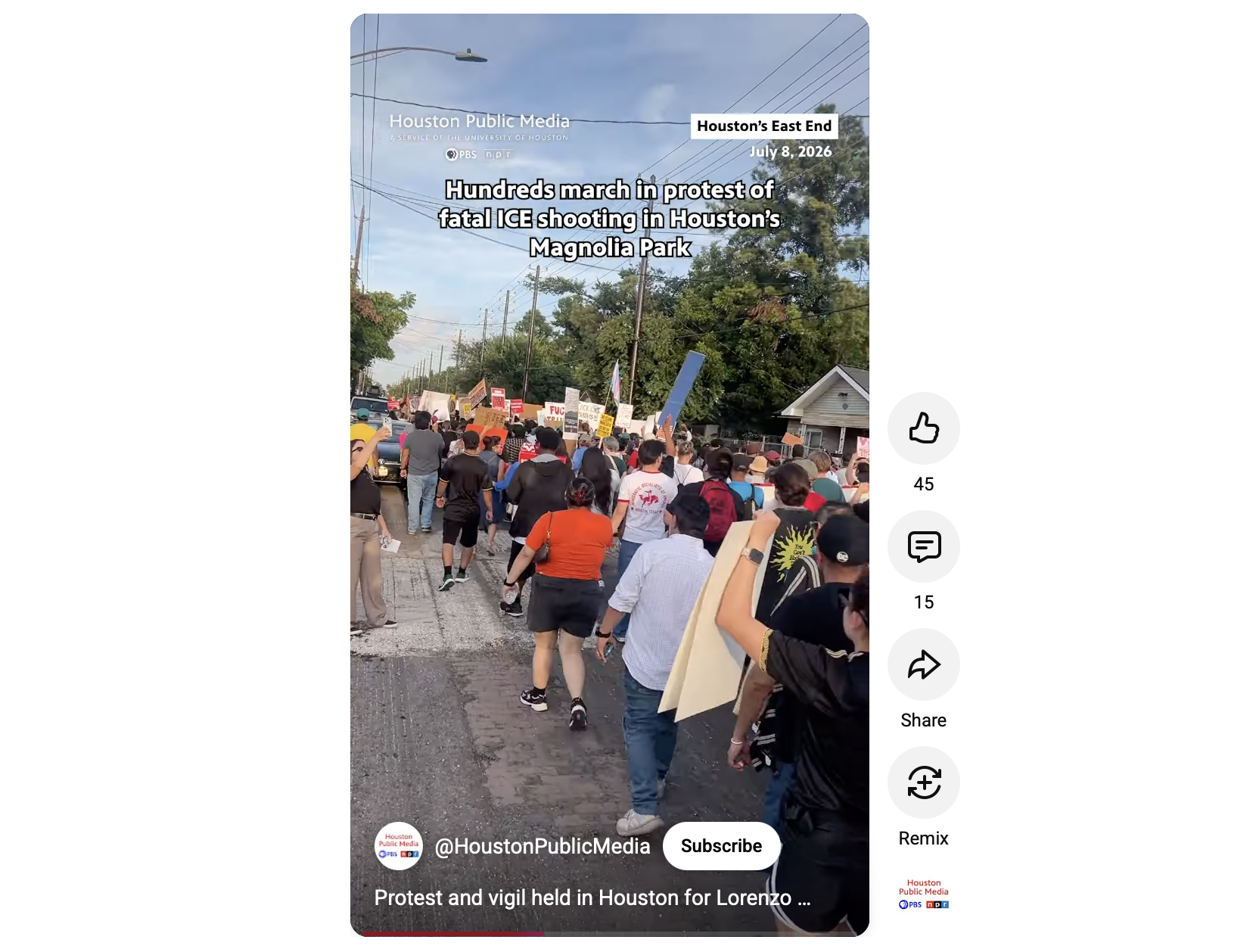
Reyes also called for full accountability in the form of an independent investigation. Independent truth-finding will be critical in obtaining justice for Salgado Araujo and his family, because ICE wasted no time in dusting off the same script it used in Minnesota, when federal authorities lied about the circumstances around the January 2026 shootings of Good and Pretti and claimed the two unarmed citizens were the actual aggressors. ICE is now claiming that Salgado Araujo rammed an agency vehicle, but no video has surfaced showing that.
Officials launched similar claims about Ruben Ray Martinez, who was shot dead by ICE in March 2025. “For nearly a year, DHS and the Texas Department of Public Safety attempted to conceal ICE’s involvement in the shooting and lied about the circumstances, falsely claiming that Martinez intentionally struck an agent with his vehicle,” Rep. Greg Casar (D-TX) said in March. “The claim was later contradicted by video evidence, released only after demands by Members of Congress.”
OUR OWN FEDERAL GOVERNMENT REFUSES TO COOPERATE
Following Good and Pretti’s deaths, federal authorities also impeded state investigators – a playbook they now appear to be repeating in Houston.
“The district attorney in Harris County, Texas, said Wednesday that federal authorities have sidelined local officials,” and is urging “eyewitnesses to come forward with their own accounts, including videos or photos,” The Washington Post reports. And now the ICE Office of Professional Responsibility, an oversight branch that investigates agents’ misconduct, is sending threatening letters to Americans who have expressed distrust and anger online over the deaths of Good and Pretti. Little to no real investigation by the federal government has been done over these deaths.
Federal authorities are also working to squash eyewitness accounts by pressuring three men who witnessed Salgado Araujo’s killing to self-deport, reportsThe New Republic’s Greg Sargent. One of the three is the victim’s brother, Victor. “They’re being pressured to sign self-deportation orders,” Juan Proano, LULAC CEO and a representative for the families, told Sargent. “They’re currently in detention. These men hold the key to what actually happened.”
NOTHING HAS CHANGED; THE ICE SURGE AND IMMIGRANT PURGE CONTINUES
Former DHS Secretary Kristi Noem was ousted earlier this year as part of a public relations stunt to convince the American people that ICE, as well as CBP, had turned the page following the bloodshed we all saw on the streets. But as we and many others said at the time, as long as Stephen Miller remained at the helm of the Trump administration’s mass deportation obsessions, the DHS campaign of lawlessness and masked terror would continue on.
“The department has sought to refashion itself as a more professional organization that makes less noise while still executing the Trump administration’s mass deportation agenda,” The Bulwark continued. “Just this Monday, in fact, Politico Playbook asked whether the mass deportation drive was softening or whether ICE had simply gotten better at avoiding negative attention. They reported that Markwayne Mullin, the new homeland security secretary, championed a ‘quieter and smarter’ approach, and that the nation shouldn’t ‘expect another Minneapolis anytime soon.’”
But now another one of our neighbors is dead, another family is grieving, and another agent with a body count continues stalking our streets endangering all regardless of where they were born.
HOW MANY MORE?
“This is the same playbook the Trump administration used in Minneapolis, and now it has cost Lorenzo Salgado Araujo his life,” responded America’s Voice Executive Director Vanessa Cárdnas. “A masked agent in an unmarked car killed Lorenzo in his own neighborhood where he lived for 35 years working and raising a family. Like Minneapolis, local Houston law enforcement is being locked out of its own investigation to get at the facts. This is what unaccountable, unrepentant, unconstitutional enforcement looks like.”
“How many more families have to bury a father, a mother, a son before Trump and Miller’s mass deportation machine is held accountable?” Cárdenas continued. “Congress and DHS owe the Salgado family the truth about what happened, and they owe every family in this country an end to the killing in our streets.”
Pope Leo Marks America 250 By Reminding Us We Are A Nation Of Immigrants
“In every generation, those who have arrived seeking freedom, opportunity and a place to belong have helped to shape the nation’s character,” the pontiff said in his July 4 letter calling for the “welcoming” of immigrants
From the very founding of our country, our leaders have proclaimed the United States a nation of immigrants. Pope Leo XIV, the first U.S.-born pontiff, marked last weekend’s July 4 semiquincentennial celebrations by issuing a special letter reminding us all to live up to those ideals.
‘HELPED SHAPE THE NATION’S CHARACTER’
“Defending human life also includes welcoming, protecting and assisting immigrants, whose hopes, sacrifices and contribution have formed part of the history of this country from its very beginning,” he wrote. “In every generation, those who have arrived seeking freedom, opportunity and a place to belong have helped to shape the nation’s character. To receive them with compassion and generosity is not only an act of charity, but also a recognition of the dignity that belongs to every human person.”
“May this milestone renew the shared commitment to the promise of freedom, justice, opportunity and democracy,” the pontiff continued. “May Americans honor the courage and vision of those who came before them by strengthening their communities, respecting their differences and working together toward a more perfect union.”
‘I WANT TO BOW BEFORE YOUR DIGNITY’
Putting his plea for compassion into action, Pope Leo traveled to the small Italian island of Lampedusa, where he “laid a bouquet of white and yellow flowers at the simply marked graves of migrants drowned at sea,” The Washington Post reported. “The Gospel resounds where peoples meet, people welcome one another, their lives intertwine and different cultures engage in dialogue,” he said. “It falls silent, however, when each person makes him or herself an island.”

Pope Leo’s visit to Lampedusa was the second consecutive month that he visited an island that is the final destination of one of the most dangerous routes for African migrants seeking new lives in Europe. One stop during his week-long Spanish tour last month included a visit to the Canary Islands, where he visited a migrant center and listened to the heart-wrenching stories of migrants and trafficking victims.
“Dear migrants, before saying anything else to you, I want to bow before your dignity. You are not just numbers or files. You are people who have left behind families and homes. You have dreams that no one has the right to despise,” he said, urging leaders to act on “legal and safe pathways, rescue and assistance, real cooperation against traffickers, effective protection for victims, serious processes of reception and integration, and policies that allow every person to live with dignity in their own land.”
“We cannot grow accustomed to counting the dead,” Leo continued. “Human dignity has no passport and does not lose its value when crossing a border.”
DEPORTATION AGENTS DETAIN A NUN
America’s contradictions on immigration were on full display on July 4 and in the days leading to the semiquincentennial. On June 28, Sister Leticia “Letty” Ugboaja was detained by mass deportation agents while on her way to Sunday Mass in South Texas. Sister Letty, who is originally from Nigeria, was in her habit “when agents stopped her near the church, cuffed her and took her rosary,” Migrant Insider reported. “The detained nun also needed medication,” which “federal agents didn’t allow her to get,” The Texas Tribune said.
“Diocesan officials have confirmed only that she entered the country legally,” Migrant Insider continued. “They have not said what triggered the stop, and neither has ICE. The diocese has already said, on the record, that whatever protocol let agents cuff a nun walking to church needs to be rewritten.”
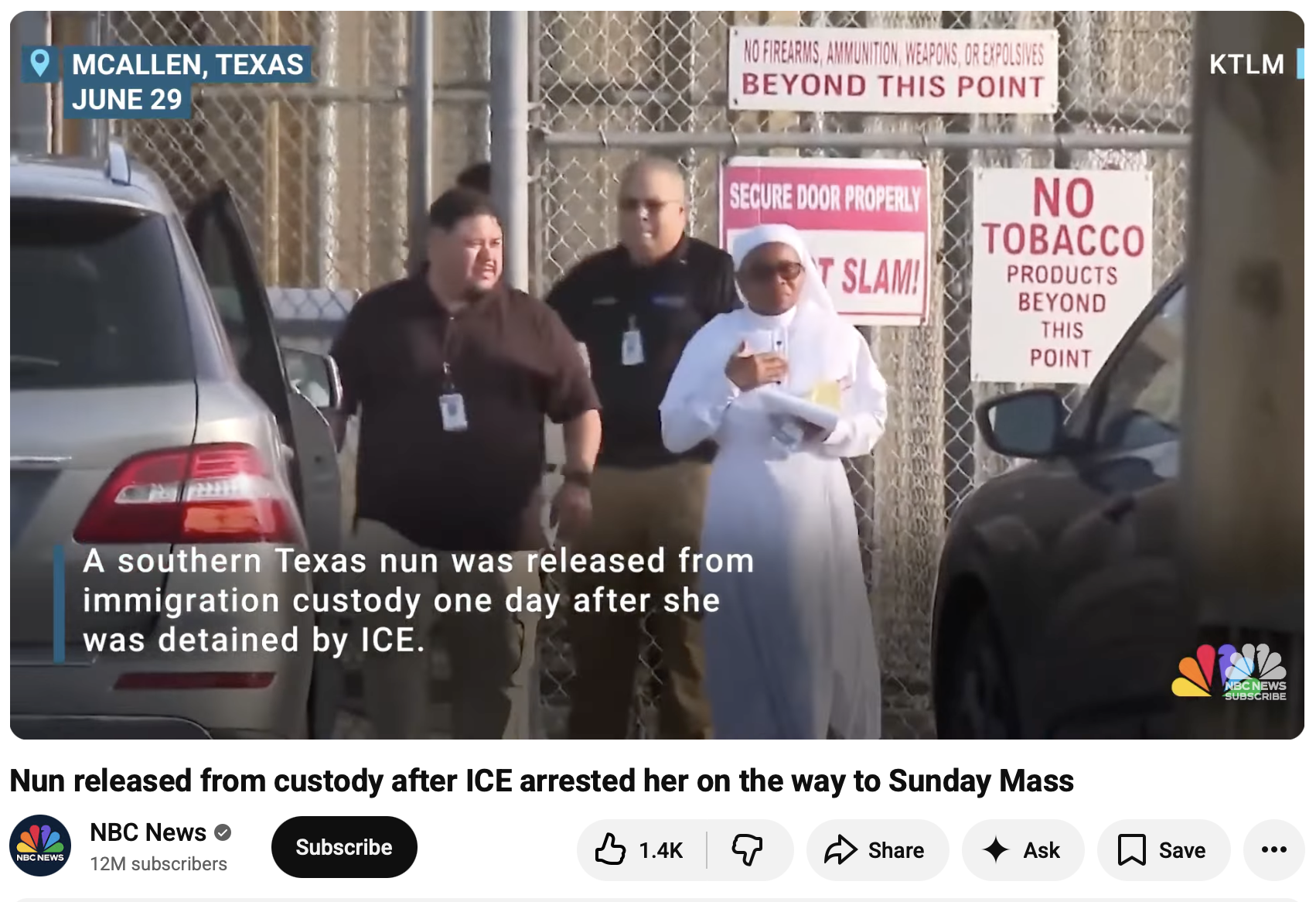
The confiscated rosary was not returned to Sister Letty when she was released later that day, Migrant Insider said. NBC News shared footage of a visibly shaken Sister Letty being released from ICE custody and embraced by Sister Norma Pimentel, a Catholic Charities leader. “She was very distraught and scared, and didn’t understand what was happening,” Sister Pimentel said.
A GLIMMER OF HOPE, SWEARING ALLEGIANCE TO AMERICA
Yet in the days that followed, thousands of immigrants raised their right hand to be sworn in as American citizens by the same government that had just hours earlier abducted a nun on her way to church. These new Americans have not been immune from obstacles of their own. The naturalization process “has become more burdensome with longer waits, tougher citizenship testing standards and high filing fees,” The Guardian noted. “The barriers and the continued aggressive immigration crackdown raise a question for people eligible for naturalization: are they still welcome here?”

As Pope Leo reminded in his July 4 letter to the U.S., not only is welcoming the stranger in keeping with our unique distinction as a nation of immigrants, it’s in our best interests, economically and beyond. “No one can single-handedly bear the weight of the challenges the world is facing,” he stated. “We need one another, and we need to work together in unity to confront the challenges that the world is facing today.”
More Than 350,000 Documented Immigrants Set To Be Stripped of Legal Status and Deported, Causing Ripple Effect In Communities
“I would be separated from my young son if I had to leave this country,” said one Haitian TPS holder. “Leaving with him is not even an option”
The Trump administration and its Congressional allies have made it clear: hundreds of thousands of documented immigrants are set to be stripped of their legal status and deported. Right now, they are living in total uncertainty about their jobs, homes, and whether their families will be ripped apart or forced out of the country entirely. On June 25, the Supreme Court issued a decision allowing the administration to continue with its predetermined decision to end the legal status for an estimated 350,000 Haitian and 6,000 Syrian immigrants.
MIXED-STATUS FAMILIES FACE SEPARATION: ‘I’M HURTING FOR MY LOVED ONES’
Many of these contributors – like Harlaine, a nurse who asked to be identified only by her first name – have held TPS for well over a decade. Since arriving here from Haiti at just five and gaining TPS after a devastating earthquake hit the island in 2010, she’s put herself through school, worked the frontlines during the pandemic, and continues to save lives in cancer care. Last year, she welcomed a U.S. citizen child. Her entire world is here.
So when she found out that the high court had issued a 6-3 ruling that will allow the federal government to unjustly revoke her legal status and take away her ability to continue living and working in the United States, she became grief-stricken and stayed in bed for the whole day. “I’m hurting for my loved ones, for so many other people. I’m mourning for them, and I’m scared for them,” she told KQED.
But she’s especially worried about her baby. “If Harlaine is forced to leave, she fears she’ll lose him,” the report said. “My issue is separation. I would be separated from my young son if I had to leave this country,” she continued. “Leaving with him is not even an option.”
Remember: the same administration that has claimed it’s safe for Harlaine to return to Haiti has issued the highest level travel alert urging Americans to stay away. “Crimes involving firearms are common in Haiti. They include robbery, carjackings, sexual assault, and kidnappings for ransom,” the State Department said in an April advisory. “Do not travel to Haiti for any reason.”
The double-speak is reprehensible. If it’s unsafe for Harlaine’s American citizen child, it’s unsafe for Harlaine as well.
HOSPITALS, NURSING HOMES FACE DEVASTATING LOSS OF WORKERS: ‘VERY UPSETTING FOR THE SENIORS I KNOW’
The fact is that the fallout from the Supreme Court’s unjust decision will extend far beyond the walls of Harlaine’s home. More than 100,000 Haitian immigrants work as health and home care workers alone, and emergency rooms, senior care facilities, and patients will be left facing a crisis should they lose thousands of skilled and dedicated essential workers en masse within a matter of just a few days. Per the USCIS website, Employment Authorization Documents for essential workers are set to expire July 10.
“Rita Siebenaler, a resident of Goodwin House Bailey’s Crossroads in Virginia, called the [Supreme Court’s] decision “sad, dreadful, and very upsetting for the seniors that I know,’” The Washington Post reported. “‘We are now threatened with the loss of valuable, trained, vetted, very, very reliable caretakers,’ she said on a call with reporters hosted by the American Business Immigration Coalition Action.”
In Massachusetts, the loss of nursing home aides alone is “going to be a disaster, Steffie Woolhandler, a professor of health policy at City University of New York at Hunter College, told NPR. The commonwealth is home to the third-largest Haitian TPS population in the U.S. “It’s going to be a disaster in the Boston area, where a lot of our nursing home and home care aides are Haitian,” she said. “If the United States becomes inhospitable to noncitizens, which I think Trump is doing, we’re going to have a lot of problems staffing our entire healthcare system.”
U.S. ECONOMY STANDS TO LOSE BILLIONS IN TAX REVENUE
To her point, our entire country will feel pain under the administration’s unprecedented mass delegalization campaign. Not only will communities lose valued neighbors, our economy stands to lose the estimated $5.9 billion that Haitian workers and consumers contribute annually, including $805 million in federal and payroll taxes and $755 million in state and local taxes. While Syrian TPS holders number just 3,860, their labor force contributes an estimated $100 million annually to our economy.
Far from carrying out its duty as a constitutional check on the executive branch, the conservative faction of the Supreme Court has appeared to ignore key evidence in order to give the administration more room to turbocharge this mass delegalization campaign that has also targeted DACA recipients, refugees, and individuals with humanitarian parole. Another recent Supreme Court decision has also allowed the administration’s border agents to turn asylum-seekers back to certain danger.
10,000 ARRESTS IN JUST FIVE DAYS
Even before this pair of devastating court decisions continuing to take a sledgehammer to our country’s distinct status as a nation of immigrants, ICE has already been dramatically escalating its mass deportation tactics.
Last month, ICE abducted more than 10,000 people in the span of just five days. For context, daily numbers have roughly doubled from about 1,000 a day earlier this year. Federal officials told The New York Times the directive came straight from the White House, which demanded higher arrest numbers. To hit those completely arbitrary quotas, agents have been focusing their efforts on picking people up at routine immigration check-ins – you know, people just trying to follow the rules – over the kind of high-profile raids that have drawn mass public outrage.
Some of the administration’s allies in Congress have managed to state the obvious, saying that deporting Haitian contributors back to certain danger would be a huge mistake. “I mean, that’s the reason why TPS was established to begin with, just like with Venezuelans,” said U.S Rep. Carlos Giménez (R-FL). His state is home to the largest Haitian TPS population in the nation. He added, “If Venezuelans lose their TPS status — which they have, too — we should reinstate that because of the devastation caused by these earthquakes that happened last week.”
But when Giménez had the opportunity to make a real difference, he instead sided with the administration’s mass deportation apparatus, last month votingto hand over another $70 billion in taxpayer funds to ICE and CBP – and without any of the necessary oversight and accountability needed.
REAL COURAGE IS NEEDED
“An additional $70 billion in funding for masked agents and brutality in our neighborhoods with little to no accountability is a travesty for American families who are trying to make ends meet,” America’s Voice Executive Director Vanessa Cárdenas said following the bill’s House passage. Long-settled contributors like Harlaine now stand to be targeted thanks in part to that vote. If Giménez and his colleagues truly care, they should act legislatively to prevent what advocates are calling an “impending tragedy.”
Immigrants Remind Us Of How Great Our Country Can Be
Immigrant joy of citizenship is bringing out the best of our country. “I’m filled with pride,” said one newly-naturalized U.S. citizen
For high school teacher Coco Wachli Banks, this July 4 holiday will be one to remember for a lifetime – and not just because of the semiquincentennial celebrations. This year she’s celebrating her first American Independence Day as a U.S. citizen, after Banks – along with 66 other immigrants from nearly 30 countries – was sworn in during a June 26 ceremony in FLORIDA at Miami’s Freedom Tower.
“To commemorate the 250th anniversary of this country, I can’t explain it, but I’m filled with pride,” the French teacher said. “I’m going to be the proudest American when it happens.”
Martha Garcia, a fellow educator hailing from the Dominican Republic, was similarly elated at accomplishing another life-changing goal, WPLG Local 10 reports. The first one was becoming a teacher and helping children develop. “They are definitely the future,” she said. Now she’s accomplishing another goal that is her own to cherish. She said that when she found out her naturalization had been approved, she cried.
“I don’t know why they picked me, but when they told me, I said, ‘Why me? … It’s so unique and I’m so thankful.”
In NEBRASKA, Lincoln Mayor Leirion Gaylor Baird told the nearly 40 new citizens at the city’s June 26 ceremony that they are “part of what makes Lincoln so diverse and inclusive,” KOLN 10/11 News reports.
Cintia Robinson, originally from Brazil, said she’s “proud to be an American.” She came to the U.S. as an exchange student while in dental school and ended up meeting her future husband, KOLN 10/11 News reported. He cheered her on from the audience as she became a full American on paper. “I’m proud to be in this country,” she said. “I’m very grateful to be accepted here, coming from Brazil, and becoming an American.”
Raya Al Zuhair, along with her husband and three children, also became a U.S. citizen that day. “Al Zuhair said her family’s journey started six years ago when they moved to Nebraska from Iraq,” Nebraska Public Media reported. Al Zuhair said moving to America has given the family a new sense of belonging. “We can now officially call Lincoln our home,” she said.
Lincoln has enjoyed a population boom in the past few years thanks to immigrants and refugees making the region their new home. “In fact, in 2016, Nebraska resettled more refugees per capita than any other state in the United States,” said the City of Lincoln.
“We are better, safer, stronger, and richer in every sense of the word, because of new Americans like you who join our community and who belong here,” Mayor Gaylor Baird told the audience, “which is why I want to thank all of you for choosing Lincoln and for choosing the United States.”
In fitting with the theme of America’s 250th anniversary, the historic VIRGINIA home of the first American president is set to again host a naturalization ceremony to welcome the nation’s newest citizens. Visitors to George Washington’s Mount Vernon estate will also be able to listen to readings of the Declaration of Independence in order to better understand the “enduring responsibilities of citizenship,” said Douglas Bradburn, museum president. “George Washington understood that the success of the American experiment would depend on an informed and engaged citizenry,” he said.
Last year at Mount Vernon, more than 100 immigrants became U.S. citizens during a ceremony that featured remarks by former California governor and actor Arnold Schwarzenegger. He told new Americans to treasure what they bring to their adoptive country.
“America needs you with your accent, with your memories of your homeland, the hopes and dreams that you have, and your love for freedom and for family,” said Schwarzenegger, who is himself an immigrant and naturalized American of about four decades. “You do not just deserve to be in America. You are needed here.”
HARTFORD, CONNECTICUT
CLEVELAND, OHIO
WESTCHESTER, PENNSYLVANIA
CHATANOOGA, TENNESSEE
VIENNA, VIRGINIA
During a time when immigrants like Coco Wachli Banks, Martha Garcia, Cintia Robinson, and Raya Al Zuhair are being scapegoated and “othered,” it’s these same immigrants who in truth are helping to keep the American experiment alive. They’ve worked hard for years to be an American. They’ve left ancestral homes and communities behind to begin anew here. Countless hours have been spent studying for the naturalization exam. Many have spent thousands in legal and paperwork fees. And they’ve followed the rules in order to not risk being able to finally raise their right hand to swear an oath to support and defend the Constitution.
“At a time when our own government seems to have abandoned the promise of America, it falls to all of us — immigrant and native-born alike — to recommit to what this country stands for,” as America’s Voice Executive Director Vanessa Cárdenas wrote earlier this week. “The ideas described in the Declaration of Independence, the Bill of Rights, the Constitution — may not have been written with us in mind. But what they describe is at the core of what immigrants believe and aspire to.”
“So on the Fourth of July, I will wear my red, white, and blue,” she continued. “I will bring out my flag and display it on my porch with a mix of pain and pride, hope and joy. Pain in knowing that our own government is targeting people like me. Pride in the courage and grit that my family and so many immigrant families demonstrate every single day. Hope that in the end, more of us will choose love over hate. And joy– knowing that at 9:30 pm ET I will be standing with my family and friends eating burgers and hot dogs, watching the fireworks, and recommitting with every fiber of my heart to our national motto: Out of many, one.”